Only one barrier remains
pp. 43-44 · Read in the full issue
in N-claims case
Marshall Islanders seek ing US$5 billion in damages for U.S. nuclear testing have spent six years in legal skir mishes with U.S. attorneys trying to get their day in court.
The April 23 decision of a U.S. judge moved the case closer to a trial when he ruled in favor of the Marshallese and against the U.S. on two of three key legal points in the dispute.
But the Bikini, Enewetak and other Marshallese will again have to wait as Claims Court Judge Kenneth Harkins re served judgment on whether his court has jurisdiction to hear the case. The jurisdictional question is the final barrier preventing the Marshallese from getting their day in court.
“It’s a happy day for the Bikinians, ” said American attor ney Jonathan Weisgall. “We’re thrilled. He’s gone 70 yards toward letting us get our day in court. We’ve got 30 yards to go.”
Judge Harkins ruled against the U.S. position on “espousal” which goes to the heart of the nuclear claims settlement con tained in the Compact of Free Association.
Under the Compact, the Marshall Islands government accepted a $l5O million settle ment of all nuclear claims. The disputed espousal provision of this Compact settlement would bar all current and future law suits from going to court In his oral ruling, Harkins did not state the reason he ruled in favor of the Marshallese posi tion on espousal. The Bikini, Enewetak and other northern island Marshallese had ad vanced a number of arguments against espousal, including that the government’s act of espous ing (taking over) its citizens’ claims was unconstitutional be cause it took away the fun damental right to sue for prop
erty damage guaranteed by both the U.S. and Marshall Islands constitutions. In addi tion, they said that the Marshall Islands government legally could not espouse claims be cause it was not a sovereign government during the period of the nuclear testing from 1946-1958.
Although U.S. attorneys told reporters after the hearing that the ruling was not damaging to their case, Judge Harkins’ rul ing clearly sided with the Mar shallese position, undermining the validity of Compact’s espousal provision.
U.S. Justice Department attorney Gary Randall said that the courts cannot “look behind or second guess” the actions of the executive branch and Con
gress with regard to another sovereign power.
Bikini attorney Weisgall re sponded in his testimony to Judge Harkins that there is a “serious factual dispute” over the question of Marshalls’ sovereignty. The U.S. argues that the Marshalls is completely sovereign, he said. “But the facts show that as far as the U.S. is concerned the Marshall Islands has sovereignty for one purpose only to espouse the nuclear claims of its citizens,” said Weisgall.
The Marshall Islands was a U.N. Trust Territory governed by the U.S. during the Compact negotiations. Last October President Reagan declared the Compact implemented and the Trusteeship terminated a fact
disputed by the nuclear claimants who say that the U.S. has never notified the U.N.
Security Council of the action.
The Marshallese are repre sented by Washington-based attorneys. Judge Harkins or dered the attorneys for the U.S. and the Marshallese to file additional briefs on the jurisdic tion issue by the middle of June, after which a final deci sion is expected.
A favorable ruling for the Marshallese would allow the cases to come to trial. While many people in the Marshalls were celebrating the April 23 ruling, Weisgall sounded a note of caution.
“It’s very important to note that if we win on the jurisdiction issue, we haven’t won the case.
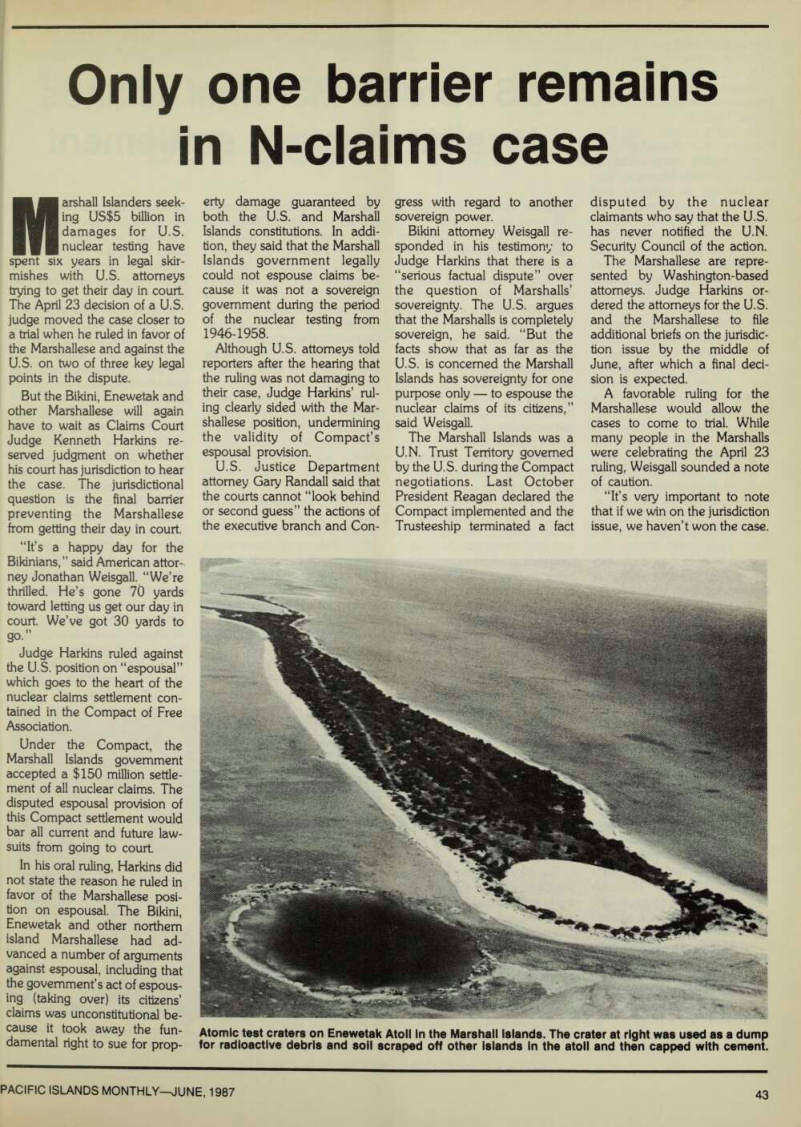
Atomic test craters on Enewetak Atoll in the Marshall Islands. The crater at right was used as a dump for radioactive debris and soil scraped off other islands in the atoll and then capped with cement.
It only means we get our day in court to argue our case to a U.S. judge,” he said.
About 5000 land owners are represented in the cases before Judge Harkins.
In the Compact, the U.S.
“accepts the reponsibility for compensation owing to citizens of the Marshalls Islands for loss or damage to property and person of the citizens of the
Marshall Islands . . . resulting
from the nuclear testing prog ram which the Government of the United States conducted in the northern Marshall Islands between June 30, 1946 and August 18, 1958.”
Affected Marshallese argue, however, that the $l5O million fund provided in the Compact is not enough compensation, nor does it take into account the possibility of problems in future generations.
The Bikini and Enewetak portions of the lawsuits note that the 66 nuclear explosions resulted in the complete de struction of three islands in each atoll, and the radiation con tamination of others. Today, while a sizeable portion of the Enewetak population has moved back to their atoll, they are restricted from living or taking food from islands in the northern and still contaminated section of the atoll.
The Bikinians are pushing the U.S. Congress to fund the initial stages of a nuclear cleanup of their atoll. The Reagan administration which claims to support a Bikini re settlement did not include any money for Bikini cleanup work in its just submitted federal budget for Congress.
“Even more remarkable,” said attorney Weisgall, “the ad ministration was set to approve $1 million needed to finish Bikini Atoll scientific studies.
But at the late April budget hearing, U.S. Assistant Interior Secretary Richard Montoya said the Office of Management and Budget had not approved any money for Bikini.”
Weisgall, when asked if there was any connection between the favorable Claims Court rul ing and the Reagan administra tion delay in approving Bikini funds, said “something tells me that was not a coincidence.”
Gift Johnson