Copra industry under review
p. 33 · Read in the full issue
trade winds
For the hundreds of thousands of Pacific Islanders who depend on copra as their sole or pnncipal source of income, the future is bleak.
Copra prices are at their lowest since the Great Depress ion. Inside and outside the industry many commentators feel they can never now recov er. Alternative vegetable oils such as palm oil and synthetic substitutes in soap manufac ture, such as tar and petroleum based detergents, have secured a permanent hold in copra’s traditional markets.
For many Pacific peoples, such as those in the coraline island groups of Fiji, the Solo mons and Vanuatu, there is quite simply no alternative cash crop. Moreover, the coconut and its tree play a central role in providing food and shelter in coastal village communities.
Now their only source of in come is receding. Can anything be done?
The PNG Copra Marketing Board offers no panacea, but it has commissioned a survey of the country’s copra industry which will offer a range of policy options from which the Board and Government will shape a strategy for the future.
Since PNG ranks second in the world behind the Philippines as a copra exporter, its prescrip tions for salvaging the industry have implications for the smal ler producers throughout the Pacific.
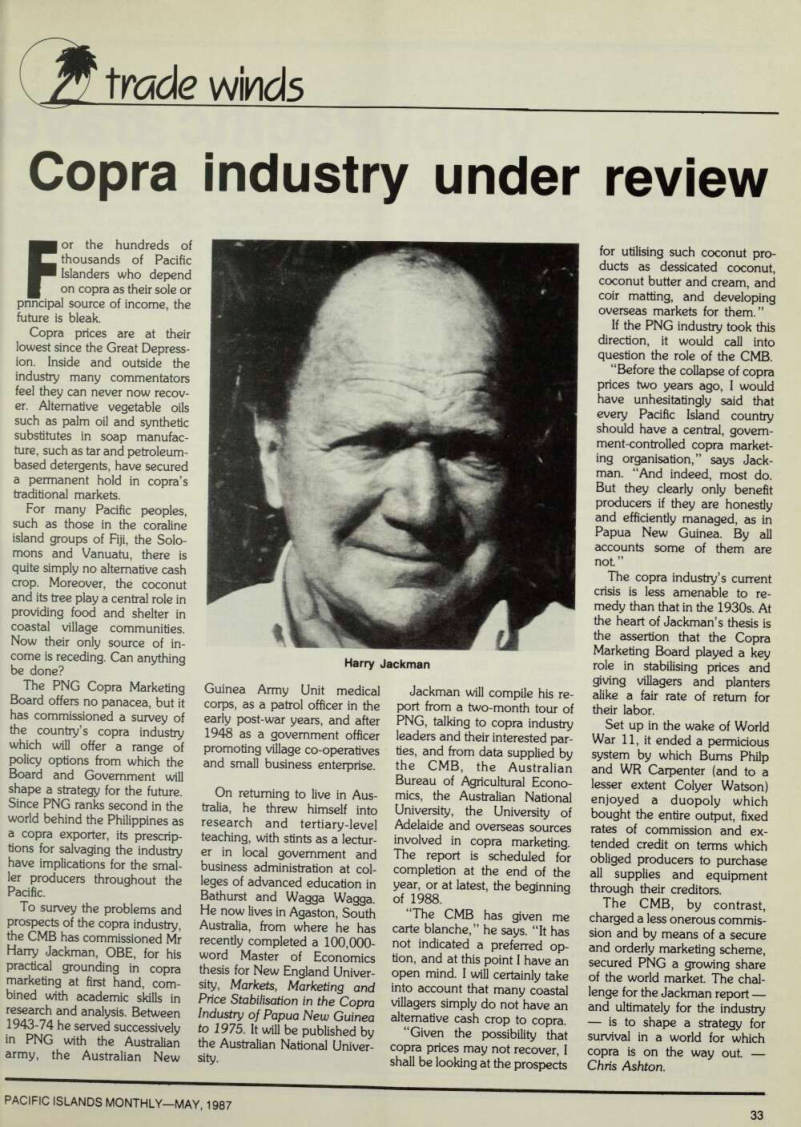
To survey the problems and prospects of the copra industry, the CMB has commissioned Mr Harry Jackman, QBE, for his practical grounding in copra marketing at first hand, com bined with academic skills in research and analysis. Between 1943-74 he served successively in PNG with the Australian army, the Australian New
Guinea Army Unit medical corps, as a patrol officer in the early post-war years, and after 1948 as a government officer promoting village co-operatives and small business enterprise.
On returning to live in Aus tralia, he threw himself into research and tertiary-level teaching, with stints as a lectur er in local government and business administration at col leges of advanced education in Bathurst and Wagga Wagga.
He now lives in Agaston South Australia, from where he has recently completed a 100 000word Master of Economics thesis for New England Univer sity, Markets, Marketing and Price Stabilisation in the Copra Industry of Papua New Guinea to 1975. It will be published by the Australian National Univer sity.
Jackman will compile his re port from a two-month tour of PNG, talking to copra industry leaders and their interested par ties, and from data supplied by the CMB, the Australian Bureau of Agricultural Econo mics, the Australian National
University, the University of
Adelaide and overseas sources involved in copra marketing.
The report is scheduled for completion at the end of the year, or at latest, the beginning of 1988.
“The CMB has given me carte blanche,” he says. “It has not indicated a preferred op tion, and at this point I have an open mind. I will certainly take into account that many coastal villagers simply do not have an alternative cash crop to copra.
“Given the possibility that copra prices may not recover, I shall be looking at the prospects
for utilising such coconut pro ducts as dessicated coconut, coconut butter and cream, and coir matting, and developing overseas markets for them.”
If the PNG industry took this direction, it would call into question the role of the CMB.
“Before the collapse of copra prices two years ago, I would have unhesitatingly said that every Pacific Island country should have a central, govern ment-controlled copra market ing organisation,” says Jack man. “And indeed, most do.
But they clearly only benefit producers if they are honestly and efficiently managed, as in Papua New Guinea. By all accounts some of them are not”
The copra industry’s current crisis is less amenable to re medy than that in the 19305. At the heart of Jackman’s thesis is the assertion that the Copra Marketing Board played a key role in stabilising prices and giving villagers and planters alike a fair rate of return for their labor.
Set up in the wake of World War 11, it ended a permicious system by which Bums Philp and WR Carpenter (and to a lesser extent Colyer Watson) enjoyed a duopoly which bought the entire output, fixed rates of commission and ex tended credit on terms which obliged producers to purchase all supplies and equipment through their creditors.
The CMB, by contrast, charged a less onerous commis sion and by means of a secure and orderly marketing scheme, secured PNG a growing share of the world market. The chal lenge for the Jackman report and ultimately for the industry is to shape a strategy for survival in a world for which copra is on the way out Chris Ashton.
Harry Jackman