Flosse’s promotion proves too Much
pp. 28-29 · Read in the full issue
When Tahitian strong man Gaston Flosse suddenly on February 7 resigned from his post as Premier of French Polynesia, it was widely inter preted as the unavoidable con sequence of the numerous accusations for corruption, vote buying and illicit personal en richment levelled at him for many months by opposition politicians (P/M, Sept., p. 23).
Quite exceptionally, these charges had been given much publicity in France, although definite proof of any serious criminal offences was lacking.
Particularly damaging was a series of articles published in the radical independent news paper Liberation which dubbed Flosse Mr Ten Percent the cut he was supposed to get for fixing government contracts and this unfortunate nickname stuck immediately.
There is no doubt, however, that Flosse’s downfall was above all caused by the repe ated difficulties and conflicts engendered by his acceptance of the post as junior Minister for Pacific Affairs in the French Government formed by Jac ques Chirac after the narrow victory of the conservative par ties in the March, 1986 elec tions. (P/M, July, pp. 20-21).
Flosse, who is a consummate politician, must at the outset have had some inkling that he risked to develop a split personality by trying to assume the duties of a French Cabinet Minister (with an office in Paris), while remaining at the helm of the local Polynesian Govern ment (with an office in Pape ete). But as has often happened in the past, his personal ambi tions outweighed these well founded misgivings.
On the other hand, Chirac’s eagerness to include a Pacific islander in his Cabinet may seem rather strange, especially as the number of Polynesian votes in favor of his RPR party which Flosse had been able to deliver was negligible. But it must be remembered that Flos-
se’s appointment had a certain propaganda value both in France and abroad, as it was announced and actually looked upon as a solid proof that the few remaining French posses sions in the Caribbean, the Pacific and the Indian Ocean are not colonies, but overseas extensions of France, inhabited by French citizens with the same rights and opportunities as those living in the “mother country.” Previously, the most shining showpiece of this politi cal fiction had, of course, been former French Prime Minister Raymond Barre, who, in fact, was bom at Reunion Island, but otherwise fits the bill very badly, as he is wholly Caucasian and has spent all his adult life in France. Flosse was therefore definitely a better choice, as he has at least a Polynesian mother and speaks the native language fluently.
The propaganda value to be derived from the nomination of a native Cabinet Minister from an overseas territory counted less, however, for Chirac than his hopes, or shall we say illusions, that Flosse would be able to act successfully as a roving French ambassador in the Pacific. (Or, as a French submarine on a torpedoing mis
sion, to borrow another de scription of his new role, often heard at the latest Forum meet ing.) Sure enough, Flosse could not do worse than the pompous French Cabinet Ministers, diplomats and bureaucrats who in the past have been dispatch ed to the Pacific independent nations to charm and seduce their leaders and who usually, on their returns to Paris, bitterly blamed their failures on “Aus tralian machinations. ” (P/M, Mar. ’B5, pp. 29-30).
A more pertinent question was, of course, whether Flosse could do better than his prede cessors. If the answer is essen tially negative, the reason is definitely not that he lacked ideas, charm and energy but simply that he had been given a completely impossible task.
How was he, for instance, to explain to island leaders that they should not do any busi ness with the Russians or the Libyans, when his own “mother country”, France, is Russia’s most important trading partner in Europe, as well as the main supplier of weapons and fighter planes to Colonel Gad dafi? Another tricky question that would and did crop up again and again, was why the French, who pretend that their
nuclear tests are harmless, do not make them then, in their own country.
That was nothing, however, compared to the difficulties Flosse encountered, when he began searching for arguments to dissuade the Forum coun tries from adopting the Raro tonga treaty creating a de nuclearised zone in the South Pacific. An equally tough prop osition was to show why the original inhabitants of New Caledonia and French Polynesia alone should be de nied the right to independence.
The only successes Flosse could chalk up on his scoreboard were not of his doing, but due to natural dis asters, for each time a cyclone wrought havoc somewhere, it allowed him to dispatch a French navy ship with succor and assume the role of the good Samaritan. Unfortunately for him, most of the recent cyclones have ravaged islands whose governments were already friendly towards France, i.e., the Cook Islands, American Samoa and Futuna, while the only new friend he made in this manner, Prime Minister Kenilorea of Solomon Islands, was thrown out of office because of his shadowy deals with his benefactor.
The final blow to the prestige of the long-suffering Minister for Pacific affairs came in Decem ber, when the UN General Assembly decided to include New Caledonia among the non-autonomous territories to be put on the road to independ ence in accordance with its charter and resolution 1514.
With a singular lack of logic, the senior minister for the French overseas territories and depart ments, Bernard Pons, who was personally responsible for this turn of events, blamed Flosse for not having been able to stop his “Pacific brothers and cousins” from making this “anti-French” move. As French Press rumors have it, Pons is
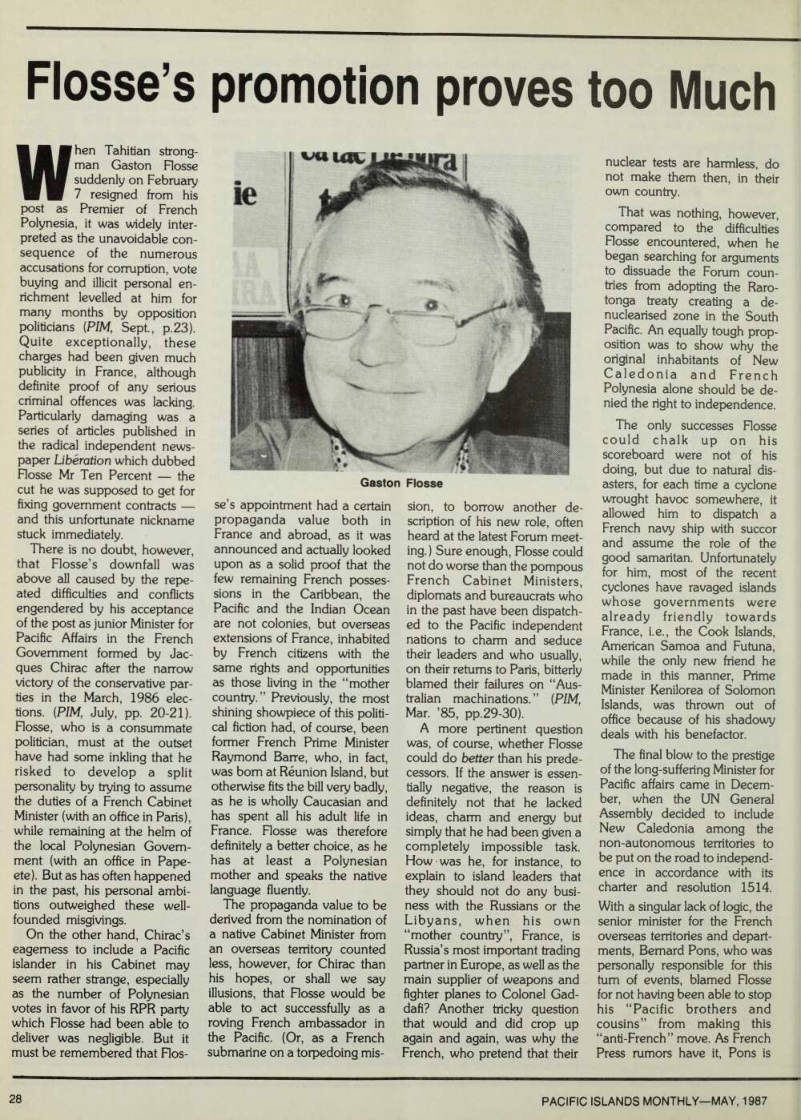
Gaston Flosse
now attempting to have Flosse dumped from the Cabinet.
In addition to his frequent trips to other Pacific nations to make friends and twist arms, Flosse had also to fly off reg ularly to Paris to attend Cabinet meetings. Mostly for not good reasons at all, as the matters discussed as a rule only con cerned internal French prob lems. These frequent absences from Tahiti gradually made him lose control of home affairs.
This was particularly the case in December, when the Papeete dockers struck and ugly vio lence was averted at the last minute only because the lead ers of the Evangelical Church stepped into the political vacuum and managed to negotiate a solution (P/M, Feb., P-50).
For the first time Flosse publicly admitted the obvious truth that he could not continue any longer to ride two wild horses. The most sensible solu tion would have been to aban don his French Cabinet port folio, which had only given him headaches, and firmly grasp the reins of the local government again. According to his own account, this is precisely what he proposed to do in January.
Chirac’s categorical refusal ar rived in the form of an ex ceedingly laudatory letter, addressed to “My Dear Gas ton,” and telling him in no uncertain terms to do exactly the opposite, i.e., to resign from his position as premier of the local government in order to concentrate henceforth on the immensely more important task “of developing the co-opera tion and strengthening the friendship with all nations in the region. ”
So far Chirac had easily pulled the strings in the Polyne sian puppet show. But when it came to electing a new Premier in mid-February, the leaders of Flosse’s ruling Tahoeraa party suddenly broke loose and be gan jumping about in a totally disorderly fashion. It was only with the greatest efforts that Gaston Flosse in the end was able to impose his protege, Jacky Teuira, who up to then had been speaker of the Territorial Assembly, by 23 votes against 15 which went to
Deputy Alexandre Leontieff.
As a conciliatory gesture, the new Premier reappointed all the ministers in the previous Polynesian Government, with the exception of the Minister of Finance, Patrick Peaucellier, who had the courage to step down voluntarily, because he realised that his no-nonsense (and therefore very unpopular), tax policies would not be pur sued. Instead of healing, the wounds have since then be come even deeper, and there is a definite risk that the Tahoerua party will eventually split into two more or less hostile fac tions.
In the opposite camp, the trend is presently the reverse.
Not only has the number of parties which favor independ ence and condemn the nuclear tests steadily increased to a point where they now represent more than 50 per cent of the electorate, but they have also begun to form loose alliances.
The most recent demonstration of this new unity was the anti-nuclear rally organised on March 7 in Papeete jointly by Oscar Temaru’s Polynesian Liberation Front and Jacqui Drollet’s la mana te nunaa party, which drew a crowd of 2000 cheering and clapping Polynesians. Equally notewor thy are the close ties which these political leaders have gra dually established with the FLNKS movement, which on this occasion was represented by a four-man delegation. The rally was also attended by ten Japanese members of the Gen suikin anti-nuclear movement, who spent altogether a week in Tahiti to gather information about the rising number of radiation-induced cancer dis eases.
Acting in accordance with the battle cry continually heard dur ing the Papeete rally; “Melane sians and Polynesians — same combat!” Oscar Temaru flew off to New York a few days later in the company of FLNKS leader Jean-Marie Tjibaou. His main mission: to ask the UN Committee on Decolonisation not to forget French Polynesia during the forthcoming hear ings on Kanak independence. — Maria-Therese and Bengt Danielsson.