Pacific travel Costs vary widely
pp. 34-35 · Read in the full issue
If you are travelling in the Pacific, hope that an in ternational organisation is paying the bill.
A review of travel reimburse ment systems of six entities, including three international or ganisations, shows: • The United Nations has the highest travel allowances, and • Allowable meals and lod ging costs vary by a thundering margin of 16 to 1.
Most organisations dispatch ing employees on international travel set maximum limits for 24 hours worth of meals and lod ging; the range for United Na tions-paid travel in the Pacific is from a high of (US)$247 for a day in Tokyo to (US)$l5 for 24 hours in areas labelled “else where” in Tonga, Tuvalu and the Trust Territories. (US dol lars are used as the measure of costs in this article and the accompanying table).
PlM’s survey covered the travel compensation systems of the United Nations, the In ternational Monetary Fund (IMF), the World Bank, and the American, Australian and Canadian governments. The World Bank system is the easiest to administer (and prob ably the costliest): its employees are simply paid what they spend for meals and lodging.
No upper limit, but much need for collecting receipts.
The US, the UN and IMF set maximum per diem payments as shown in the table. The Australians and Canadians use a different system; the official traveler is reimbursed for his or her lodging bill in full, and then given a stipulated sum for meals (also shown in the table).
The IMF system is rough and ready; this organisation, which routinely tells Third World gov ernments to tighten their belts and pay their debts, gives its employees five levels of per diem, $B5, $95, $llO, $125 and $135. These are applied
countrywide though IMF people probably rarely leave the capital, as their work is largely with government agen cies.
The United Nations and the US Government have adopted much more complicated sys tems, and the reimbursement rates vary much more widely than those of IMF. The UN and the US have different rates for each nation, and often several rates for a given nation. Take the United Nations rates in Tuvalu (pop. about 8000): if you stay in the capital, they will pay you $42 a day, but if you go to “elsewhere” in that coun try, locations presumably with out commercial hotels, the rate falls to $l5.
A close reading of the accom panying table shows that one can make 27 rate comparisons (among IMF, UN and US); in 12 of these the United Nations has the most generous allow ance, in 9 it is IMF, and in 3 it is the US. (In another three it is a tie).
There are gaps in the table because the IMF does not calculate rates for jurisdictions that do not belong to the fund thus none of the US or French territories are listed.
Similarly, Australia figures its rates only for places where it posts (or in the case of Nauru) used to post its diplomats and Canada does the same.
There are some remarkable discrepancies in these establish ed rates. For example, the US will pay as much as $lO9 a day in Kiribati, while the usually generous UN provides no more than $4B a day. In Tonga, the IMF figures it costs $llO a day, but the UN and the US both pay less than half that figure.
And in Japan, the United Na tions pays almost twice what the IMF does for room and board. On the other hand, the UN and the US agree, that it costs exactly $3B in Nauru, $B3 in Wallis and Futuna and $lOl in Tahiti.
The Australian and Canadian figures are not comparable to the others, since they are for meals only, but when you com pare their meals costs to the meal allowance within the IMF system, it is clear that the Australian rates are lower than those of IMF. The IMF system is that at the $llO rate, for exam ple, $5O is for food and $6O is for lodging. When you compare IMF meals and Australian meal allowances in three nations, this is what you get:
The question arises: is $5O a reasonable allowance for a re staurant-prepared breakfast,
lunch and dinner in Tonga?
IMF thinks so, but Australia, the US and the UN think not.
Canada has no position on this issue as its diplomats do not venture into Tonga.
Noted below are some of the specifics for the islands that could not be squeezed into the table.
Cook Islands. The United Nations has a special rate for employees staying at the Hotel Raratonga ($B4), for those staying elsewhere in Raratonga it is $65, for Aitutaki it is $39, and for Atiu and elsewhere in the Cooks it is $3O. (We saw no other rate set for a specific hotel in the UN list for the Pacific).
Federated States of Mic ronesia. Neither the United Na tions nor, strangely, the U.S.
Nation Australia l.M.F.
Fiji 43 50
Png
42 50 Tonga 23 50
State Department travel ex pense publication released in December, recognised the new status of FSM (or the other associated states), lumping them all together under Trust Territories. By January, how ever, the new status was recog nised in the US document. UN rates are $B4 for Truk, $62 for Ponape, $49 for Yap, $49 for Kosrae, and $l5 for the else where category; the compara ble US rates are $67, $B3, $43, $45 and $2O.
Fiji. UN rates for the cities of Suva, Nadi and Lautoka are $BO, commercial hotels else where are $55, and guest houses elsewhere are $25. The
US will pay $BB in Suva, Nadi and Sigatoka, but $3O else where.
Kiribati. The US pays $lO9 on Christmas Island (which was once claimed by Washington) and $47 in other areas.
Marianas. US per diem rates are $92 for Saipan, $76 for Rota and $6B for Tinian.
The Republic of the Marshall Islands. The US will pay $3B a night on Kwajalein, $6B on Majuro and $2O in other loca tions; the UN sets a $B4 rate on Majuro, and $l5 elsewhere.
Palau. American rates are $Bl for the capital island,
Koror, and $2O for other.
Papua-New Guinea. The UN has five rates for this country: $l2B for Port Moresby, Lae, Popondetta, Rabaul, Mt Hagen, Kieta and Kiunga; $96 for Kundiawa, Wewak and Mandang; $BB for Alotau, Kainantu and Vanimo; $67 elsewhere with hotels, and $34 elsewhere without commercial hotels.
The Solomon Islands. The United Nations has five rates for the islands: $55 for Honaira, $2B for Gizo, $22 for Auki, $3O for hotels elsewhere and $2O for the elsewhere without
hotels. The US has a flat and more generous $66.
Vanuatu. There are four UN rates here: $97 for Port Villa, $76 for Santos, $55 for Tanna and $32 for elsewhere, Western Samoa. The UN will pay $66 a day in Apia, $42 a day in Assau, and $27 else where, There are differences in the accounting techniques used by the entities but the rates quoted provide some light on what a traveller can expect in terms of hotel and meal charges in the Pacific. David S. North , Washington.
What it Costs to Travel in the Pacific Views from Several Organisations (Meals and Lodging Costs for 24 hours In U.S. Dollars)
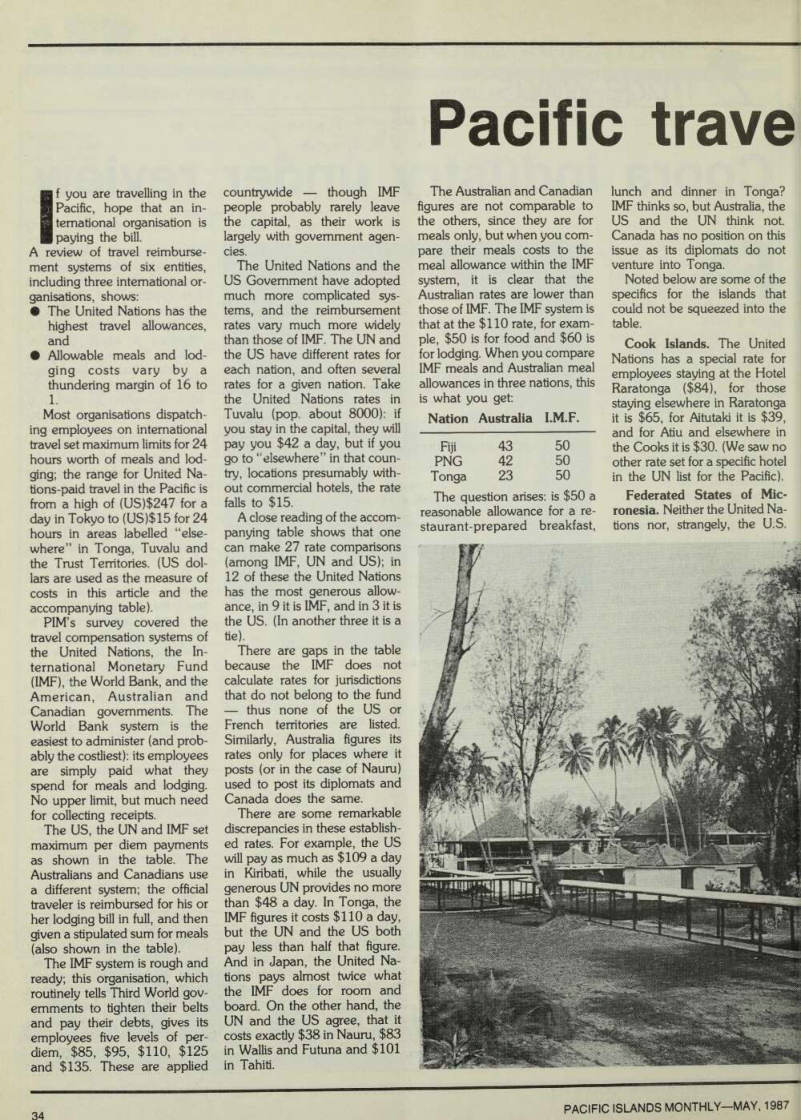
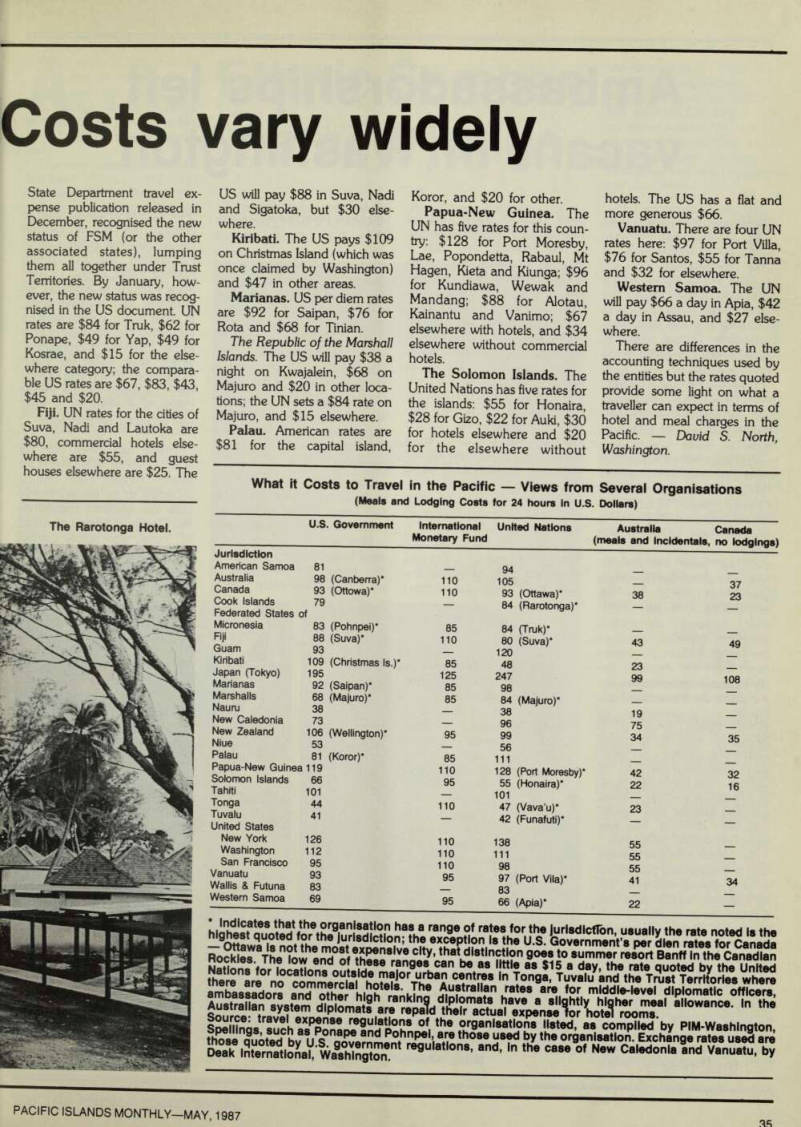
The Rarotonga Hotel.
U.S. Government International United Nations Australia Canada
Monetary Fund
(meals and Incidentals, no lodgings) Jurisdiction American Samoa 81 94 Australia
98 (Canberra)*
110 105 37 23 Canada 93 (Ottowa)* Cook Islands 79 Federated States of 110
93 (Ottawa)*
84 (Rarotonga)*
38 Micronesia 83 (Pohnpei)* 85
84 (Truk)*
Fiji Guam 88 (Suva)* 93 110
80 (Suva)*
120 43 49 Kiribati 109 (Christmas Is.)* 85 48 23
Japan (Tokyo)
Marianas 195
92 (Saipan)*
125 85 247 98 99 108 Marshalls Nauru 68 (Majuro)* 38 85
84 (Majuro)*
38 1Q — New Caledonia 73 96 i y 75 34 New Zealand Niue
106 (Wellington)*
53 95 99 56 35 Palau 81 (Koror)* 85 111 Papua-New Guinea 119 Solomon Islands 66 Tahiti 101 110 95 128 (Port Moresby)* 55 (Honaira)* 101 42 22 32 16
Tonga
Tuvalu United States 44 41 110
47 (Vava’u)*
42 (Funafuti)*
23 — New York 126 110 138 55 55 55 41
Washington
112 110 111 San Francisco 95 110 98 Vanuatu Wallis & Futuna 93 83 95 97 (Port Vila)* 83 34 Western Samoa 69 95 66 (Apia)* 22 Rockies \he n ?owo^°of 1hK n8,V6 Clty ’ tha \l l8t,nct,on goes to summer resort Banff In the Canadian
dljfloriwS^i? repaid
Deak Intern^ WMWngtor? nt re9u,at,on8 ’ and ’ ,n the ca8e of Naw Caledonia and Vanuatu, by