‘Seaspeak’ breaks
p. 54 · Read in the full issue
with Bislama
Vatu
Beachmasters. By Thea Astley. Published by Penguin Books Australia, Ringwood (Vic.), 1985. 185 pp. ISBN 0 14 00 7912 2. Price $A6.95.
The point of the title of this novel is, to me, opaque. Webs ter’s Third New International Dictionary (1966) offers two definitions for the term beachmaster “an officer in charge of disembarkation of troops and munitions” and “a bull fur seal on its breeding ground”.
Since neither of these mean ings is appropriate to Astley’s book, one must assume an intended connotation which is sufficiently idiosyncratic to have baffled at least one reader.
The locale for Beachmasters is the island of Kristi, in the soon-to-be-independent Trini tas a territory whose joint colonial masters are Britain and France. When Trinitas is on the brink of attaining independence there is an abortive attempt to bring about the secession of Kristi from the nation-to-be.
This attempt is led by Tom my Narota, a charismatic per son of ethnically mixed paren tage. His ill-fated rebellion is backed and to some extent instigated by French planter interests, with the connivance of the French colonial adminis tration and its shadowy associ ate, the Salamander Corpora tion, and with the dubious aid of a few Australian opportun ists.
Despite Astley’s disclaimer “While the revolution (does she mean ‘rebellion’?) in this novel may have recent historical para llels, the islands and the charac ters are fictional” the para llels between the settings and events of Beachmasters and the context and events of the attempt, in 1980, to bring about the secession of Santo from the soon-to-be-independent Vanuatu are far too close to be merely coincidental.
Anyone who doubts this con tention should read both Astley’s novel and John
Beasant’s The Santo Rebellion: An Imperial Reckoning (Hcine mann, 1984, reviewed in PIM May ’B5).
One of the devices used by Astley, presumably to add some South Pacific flavor to her prose, consists of inserting occasional words and phrases in a pidgin-style language she calls Seaspeak, which has ob vious parallels with Bislama (the pidgin/creole linguistic system which functions as a lingua franca in Vanuatu).
She says, apropos her orthography for Seaspeak, “The pidgin used throughout generally follows the South Pacific French spelling”. That she has not followed at all closely or consistently the con ventional French-style spelling for Bislama the only lan guage of its kind in the region for which there is a French orthographic style is indi cated by these examples, in which the Seaspeak spellings are followed, in parentheses, by the French-style Bislama spell ings used by J.B.M. Guy (Manuel de Bichelamar,) Pacific Linguistics, A.N.U., Canberra, (1974) and/or J-M. Charpentier (Le Pidgin Bislama(n) et le Multilinguisme aux Nouuelles Hebrides, SELAF, Paris, 1979):-man bush (man bus), man solwata (man solwota), aeland (aelan), longtai’m bifor (longtaem bifo), long we (long-we), louklouk (lukluk), and wai’te falla (waet fala).
While this lack of authenticity of linguistic detail in an area in which the author is claiming to be authentic is, in itself, a relatively minor matter, it may well be symptomatic of a more
extensive lack of detailed know ledge of relevant value struc tures, locales and events.
The central figure in Beachmasters is Gavi Salway, a youth of ethnically mixed parentage, whose immaturity and ambivalence lead him into an involvement with Narota’s rebellion which has drastic con sequences for himself and others.
The ethnically mixed ances tries of both young Salway and Tommy Narota are crucial to the continually recurring theme of the problems and frustrations consequent on having such ancestry, with the ambivalent allegiances it entails, in the colonial context.
These problems and frustra tions, however, are presented in terms which appear to owe more to the value structures of the novelist’s own sociey than to those of an individual caught between two cultures in colo nial Melanesia.
The treatment given in this novel to both the individual and the collective problems, ten sions, frustrations, and crises on the road to independence in a fictional colonial context that has obvious parallels to a recent actual instance does not display as high a level of informed understanding of this kind of situation as has been man ifested by Doris Lessing and V.S. Naipaul.
Nevertheless, Astley’s novel, as a rather less than optimal example of its genre, should be read and thought about by all who are concerned with cross cultural understanding in the Pacific region today.— David Walsh.
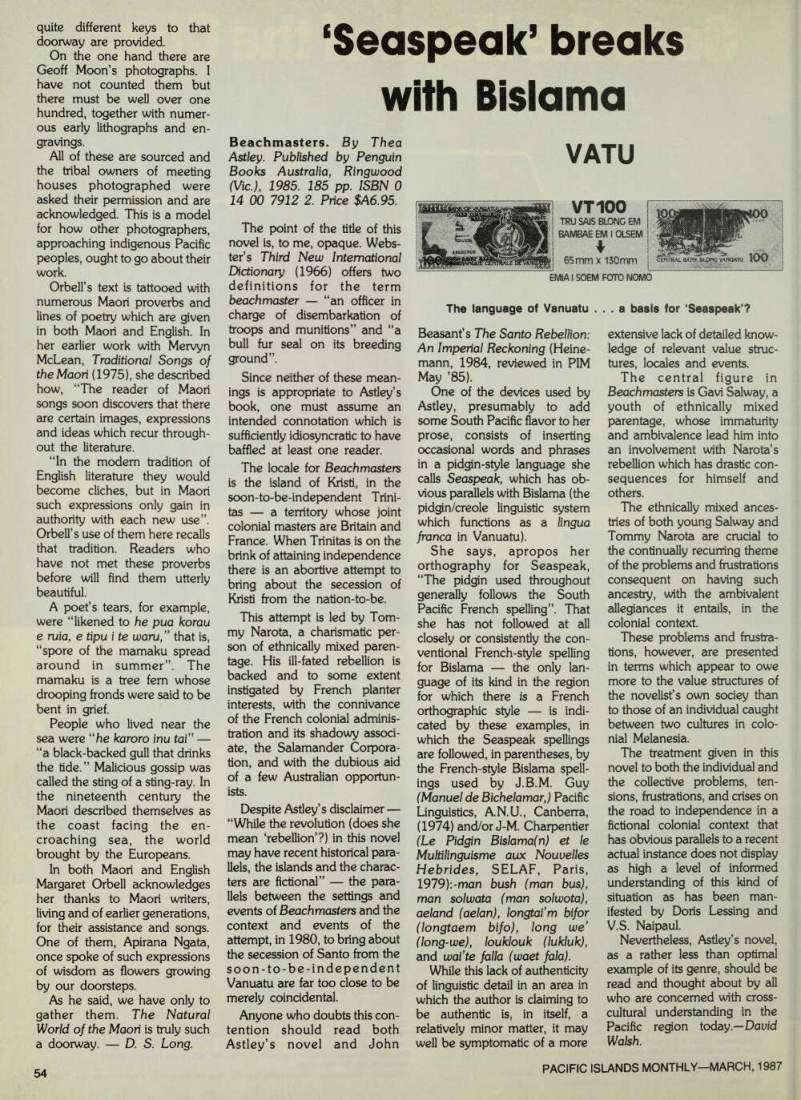
The language of Vanuatu ... a basis for ‘Seaspeak’?