Doorway to a
pp. 49-54 · Read in the full issue

books
Doorway to a world of harmony
The Natural World of the Maori. By Margaret Orbell and Geoff Moon. Published by Col lins, Auckland, 1985. 230 pp.
Isbn 0-00-21 7219-4.
NZ544.95.
It has often been said that a nation knows itself only when it knows its own history. New Zealand has completely rewrit ten its history over the past thirty years.
It was once thought that the Maori reached New Zealand in 1350 A.D. in a great fleet.
Archaeological evidence of settlement as early as 900 A.D. has now been discovered.
Polynesian settlers probably reached New Zealand in a number of different canoes over a number of centuries and gradually became the Maori after reaching New Zealand.
Some tribal traditions of found ing canoes may even refer to internal migrations within New Zealand.
Maori history up to the arrival of Europeans has been seen in two phases, with a watershed set around 1500. It has been thought that an ‘Archaic’ or ‘Mao-hunter’ period evolved into a ‘Classic’ Maori culture.
Archaeologists announced in October 1985 a series of new discoveries which push the ‘classic’ phase back as much as four hundred years. On the other hand the tribes on the Chatham Islands may have still been ‘Archaic’ when they were joined by European sealers and shore-whalers.
Even the pages of European discovery are under seige. It was once thought that Abel Tasman’s landfall in 1642 and Cook’s in 1769 ushered in the next stage in New Zealand’s history. Now the wreck of what
is probably an earlier Portu guese arrival has been located, which may explain certain ano malous exhibits in Wellington’s Dominion Museum.
Last year the Auckland Uni versity Press was to publish James Belich’s The New Zea land Wars and the Victorian Interpretation of Racial Con flict. Belich establishes that a number of British victories were in fact defeats, never admitted at the time. He shows how the Maori actually won one of New Zealand’s four wars over sovereignty.
New Zealanders have rather liked the idea of their colonial wars as bouts of gentlemanly fisticuffs. That myth has hidden the realities of the most effective resistance ever staged by a tribal people against European colonialism which in some respects continues.
By the year 2040, when New Zealand celebrates the bi centenary of the signing of the Treaty of Waitangi, demog raphers expect the population to be at least 50 per cent Maori and Polynesian. By then Maori will certainly be one of New Zealand’s two official lan guages.
Against this background Mar garet Orbell and Geoff Moon have given us The Natural World of the Maori, a study of how New Zealand’s Polynesian settlers adapted to the temper ate islands they discovered.
The Natural World of the Maori tells one of the most fascinating stories in recent hu man history. New Zealand was the last significant landmass to be inhabited by our species.
Because it is so recent, in the Maori oral tradition we find the best account we have of this quintessential human process.
A little over a thousand years ago groups of Polynesian col onisers began sending planned expeditions to the south.
They outfitted their great ocean-going canoes with all the resources they might need to establish themselves on a re mote, uninhabited atoll.
Kumara, taro, yam, gourd, ti and paper mulberry were all packed for transplanting into new gardens. But this time it was different. Sailing out of the tropics they landed in the late Palaeozoic.
It was the Austrian geologist Eduard Suess who first observed that South America, southern Africa, India, Austra lia, Antarctica and New Zealand all seem to have shared an identical flora and fauna in the remote geological past. He guessed that once they formed one super continent, which he called Goondwanaland.
The theory of continental drift has been developed to explain the subsequent move ment of these landmasses over millions of years. A thousand
years ago only New Zealand held this ancient biota intact Isolated in the southern ocean it had become a land of living fossils.
This is to enormously over simplify a much more complex story but there is a grain of truth in the idea that these voyagers had sailed back over 100 million years.
We struggle to imagine how different this land they disco vered must have seemed. As they entered the Goondawana land forest of early ferns, araucarian pines and podo carps they would have come across giant land snails, rat sized insects they called weta (filling the ecological niche of mice), worms half an inch thick and almost five feet long, flight less birds taller than men, the world’s only remaining Rhyn chocephalia the tuatara, a vesti gial dinosaur, frogs without a tadpole stage, peripatus, the missing link between seg mented worms and the jointed legged invertebrates ... the list goes on and on.
And for these tropical people there was the equally strange temperate climate with its pro nounced seasonal cycles. But it wasn’t completely strange and we can imagine that after the initial shock of discovery they must have seized on what was familiar.
Van Balgooy showed in 1971 that of the 113 genera of plants found in the Marquesas, for instance, 28 could be found in New Zealand. Distantly re lated birds and plants were given the names of their tropical cousins. As Orbell tells us, “The great flightless birds that browsed on trees at the edges of the forests looked like larger versions of the domestic fowls, or moa, that had been left behind in tropical Polynesia, so they were called after them.”
The Natural World of the Maori has a section on taniwha, for instance. These were “dra gons, creatures with great pow ers that can travel through the earth and the water . . . There were many stories of man eating taniwha that had been challenged and conquered by heroic ancestors.”
It is too easy to dismiss such ‘legends.’ Anthropologists studying Eskimo cratch cradle patterns (a game Europeans and Maori all played, too) disc
overed that one, called Kili faiciaq, represented the mam moth, which has been extinct for about 10,000 years. Early European visitors to New Zea land did not at first believe stories about the moa.
Out of all this grew a central Maori attitude: “When two things resembled one another (they thought) there must be a connection between them.
“This is the theme which emerges from The Natural World of the Maori “affinities were felt to exist between all living things.” A vision of “an underlying harmony in the world” transforms the maori language into a kind of im mense poem. “A beating heart could be compared to tremb ling flax leaves.”
Gurnard, a type of fish, and the reptile tuatara look a bit alike. A story explains how they once lived together in the sea.
“Long-tailed cuckoos, arriving from over the ocean, were sometimes thought to be re ptiles which had returned to the
water, entered cocoons, then emerged” as birds.
Geoff Moon’s photographs reveal what Orbell states ex plicitly in an epilogue; “In modem, western society we speak of nature and the natural world and we contrast this, at least by implication, with culture, by which we mean human activities and thought.
In traditional times the Maori did not think in these terms, for they did not see their existence as something separate and opposed to the world around them . . . Though Maori thought and imagery were shaped by ideas brought here from tropical Polynesia and also very much by the conditions existing in this country, they were generally similar to those of other traditional peoples “It is more difficult for us now, despite all the information that we have, to understand that everything is related, and that if we fail to show respect for our mother the earth, we do so
at our peril... a realisation of the interconnectedness and the sacredness of things is more important for our survival than it has ever been.”
It is this spiritual dimension te taha wairua which emerges so powerfully from this book. Our oral traditions are in retreat all around the Pacific.
The Natural World of the Maori is a magic reminder of the cost. (You may wish to look up the original meaning of that term ‘magic.’) In the Maori tradition we have possibly the single greatest extant tribal tradition; the distillation of a great body of learning under almost unique conditions. The very sort of thing a people without a history might continue to ignore, or a people, discovering the truth of their history, might wish to recover.
The Natural World of the Maori is not a personal account of the world it describes.
Rather, it is a kind of doorway to such an experience. Two
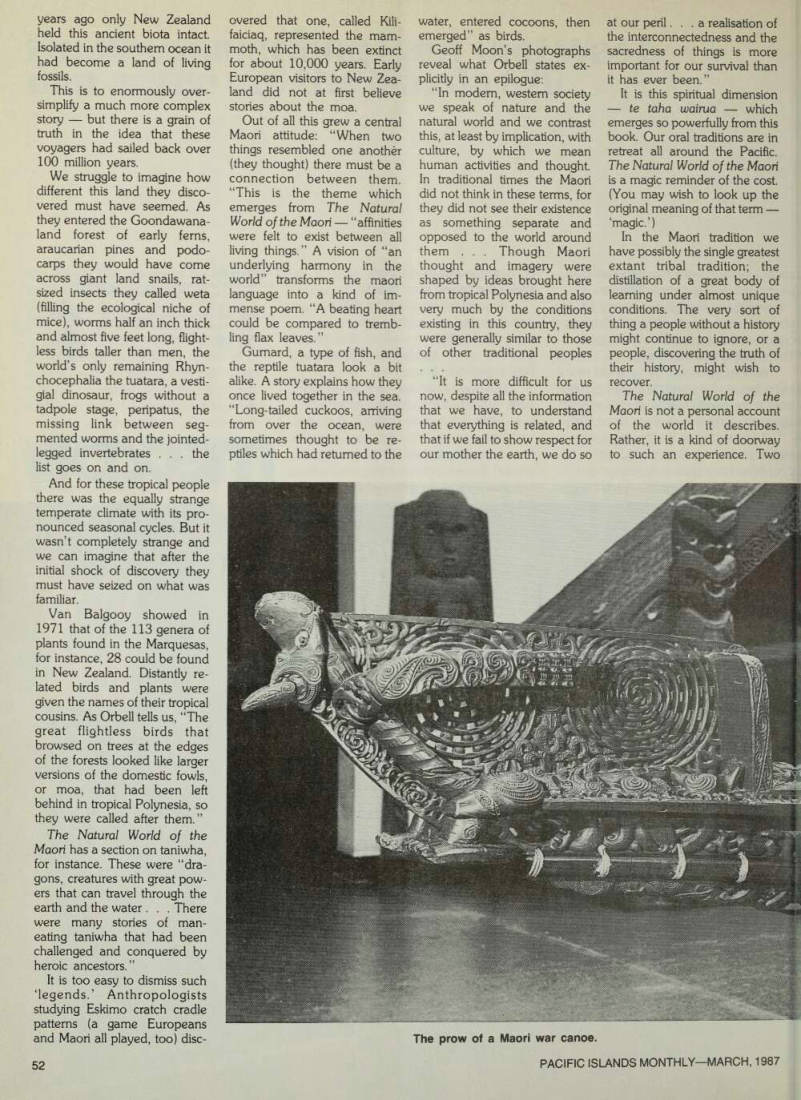
The prow of a Maori war canoe.
quite different keys to that doorway are provided.
On the one hand there are Geoff Moon’s photographs. I have not counted them but there must be well over one hundred, together with numer ous early lithographs and en gravings.
All of these are sourced and the tribal owners of meeting houses photographed were asked their permission and are acknowledged. This is a model for how other photographers, approaching indigenous Pacific peoples, ought to go about their work.
Orbell’s text is tattooed with numerous Maori proverbs and lines of poetry which are given in both Maori and English. In her earlier work with Mervyn McLean, Traditional Songs of the Maori (1975), she described how, “The reader of Maori songs soon discovers that there are certain images, expressions and ideas which recur through out the literature.
“In the modem tradition of English literature they would become cliches, but in Maori such expressions only gain in authority with each new use”.
Orbell’s use of them here recalls that tradition. Readers who have not met these proverbs before will find them utterly beautiful.
A poet’s tears, for example, were “likened to he pua korau e ruia, e tipu i te warn,” that is, “spore of the mamaku spread around in summer”. The mamaku is a tree fem whose drooping fronds were said to be bent in grief.
People who lived near the sea were “he karoro inu tai”
“a black-backed gull that drinks the tide.” Malicious gossip was called the sting of a sting-ray. In the nineteenth century the Maori described themselves as the coast facing the en croaching sea, the world brought by the Europeans.
In both Maori and English Margaret Orbell acknowledges her thanks to Maori writers, living and of earlier generations, for their assistance and songs.
One of them, Apirana Ngata, once spoke of such expressions of wisdom as flowers growing by our doorsteps.
As he said, we have only to gather them. The Natural World of the Maori is truly such a doorway. D. S. Long.