Food for the people:
pp. 47-48 · Read in the full issue
A growing crisis
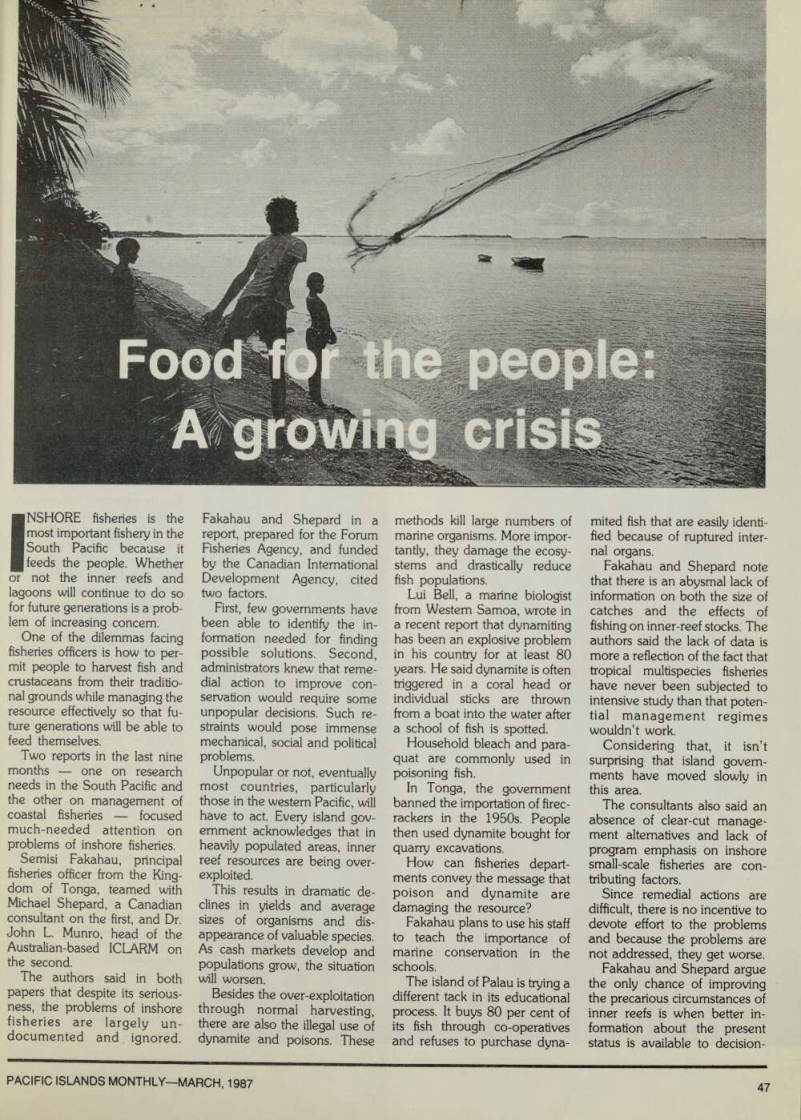
INSHORE fisheries is the most important fishery in the South Pacific because it feeds the people. Whether or not the inner reefs and lagoons will continue to do so for future generations is a prob lem of increasing concern.
One of the dilemmas facing fisheries officers is how to per mit people to harvest fish and crustaceans from their traditio nal grounds while managing the resource effectively so that fu ture generations will be able to feed themselves.
Two reports in the last nine months one on research needs in the South Pacific and the other on management of coastal fisheries focused much-needed attention on problems of inshore fisheries.
Semisi Fakahau, principal fisheries officer from the King dom of Tonga, teamed with Michael Shepard, a Canadian consultant on the first, and Dr.
John L. Munro, head of the Australian-based ICLARM on the second.
The authors said in both papers that despite its serious ness, the problems of inshore fisheries are largely un documented and ignored.
Fakahau and Shepard in a report, prepared for the Forum Fisheries Agency, and funded by the Canadian International Development Agency, cited two factors.
First, few governments have been able to identify the in formation needed for finding possible solutions. Second, administrators knew that reme dial action to improve con servation would require some unpopular decisions. Such re straints would pose immense mechanical, social and political problems.
Unpopular or not, eventually most countries, particularly those in the western Pacific, will have to act. Every island gov ernment acknowledges that in heavily populated areas, inner reef resources are being over exploited.
This results in dramatic de clines in yields and average sizes of organisms and dis appearance of valuable species.
As cash markets develop and populations grow, the situation will worsen.
Besides the over-exploitation through normal harvesting, there are also the illegal use of dynamite and poisons. These
methods kill large numbers of marine organisms. More impor tantly, they damage the ecosy stems and drastically reduce fish populations.
Lui Bell, a marine biologist from Western Samoa, wrote in a recent report that dynamiting has been an explosive problem in his country for at least 80 years. He said dynamite is often triggered in a coral head or individual sticks are thrown from a boat into the water after a school of fish is spotted.
Household bleach and para quat are commonly used in poisoning fish.
In Tonga, the government banned the importation of firec rackers in the 19505. People then used dynamite bought for quarry excavations.
How can fisheries depart ments convey the message that poison and dynamite are damaging the resource?
Fakahau plans to use his staff to teach the importance of marine conservation in the schools.
The island of Palau is trying a different tack in its educational process. It buys 80 per cent of its fish through co-operatives and refuses to purchase dyna
mited fish that are easily identi fied because of ruptured inter nal organs.
Fakahau and Shepard note that there is an abysmal lack of information on both the size of catches and the effects of fishing on inner-reef stocks. The authors said the lack of data is more a reflection of the fact that tropical multispecies fisheries have never been subjected to intensive study than that poten tial management regimes wouldn’t work.
Considering that, it isn’t surprising that island govern ments have moved slowly in this area.
The consultants also said an absence of clear-cut manage ment alternatives and lack of program emphasis on inshore small-scale fisheries are con tributing factors.
Since remedial actions are difficult, there is no incentive to devote effort to the problems and because the problems are not addressed, they get worse.
Fakahau and Shepard argue the only chance of improving the precarious circumstances of inner reefs is when better in formation about the present status is available to decision
makers. There is also a need for original, practical research.
Despite the seriousness of the situation, they see reason for optimism. They cite some good scientific work done in western Pacific nations such as Papua New Guinea.
They said countries in terested in strengthening their approaches to inshore manage ment should form a working group of technical experts. This pool of people could exchange valuable information.
It is worth noting that there has been a major restructuring
of fisheries administrations in the region. In 1980, only two of 10 programs surveyed were headed by nationals. By 1985, only two were headed by ex patriates.
Because of the transition, local administrators have been reoccupied with organisational tasks. They are now just getting into the important new work at hand.
Despite the overall severity of the problem, some countries have done well in documenting catches from inshore areas. Fiji stands out for its accurate fi gures. The fisheries administra
tion believes that precise figures are necessary to measure the effectiveness of their programs, Fakahau and Shepard said it is important to capitalise on the interest created by these reports and convene a meeting to plan ways of improving manage ment of inshore resources. ow other recommendations .., oro . ’ ® enc °urage co-opera tive work in stock cessment, statistical data collection and training between island admin istrations; • That the South Pacific
Commission expand its prog ram to provide advice to island fisheries departments on collec tion of catch statistics. • That research organisa tions such as the USP Institute of Marine Resources in Suva and the International Centre for Living Aquatic Resources Man agement in Townsville, Austra lia, be encouraged to undertake original research work on the population dynamics of inner reef fisheries.
An underlying premise is that the public, especially fishing communities, have faith in selected management prog rams. These regimes must be consistent with traditional prac tice, and must be supported by the public. Without that sup port, any program will fail.
In the study on monitoring and managing coastal resources in the Pacific, Dr Munro and Fakahau wrote that steps must be taken to limit entry into fisheries and prevent overhar vesting.
The authors analyse avail able management options using both direct and indirect methods. Some of the possibili ties include traditional custom rights, annual licences, mini mise size limits, seasonal clo sures, closed areas, gear restric tions and exclusive access.
They said that statistical sys tems have failed in the tropics because of dispersed landings.
Numbers of species and unre corded subsistence catches.
A point emphasised in their report is that conservation of the environment is a prere quisite to managing fisheries. If pollution of a lagoon or destruc tion of reefs are permitted, the best management will not im prove yields.
Their final assessment under lines the urgency of the problem.
“. . .island states of the Pacific have an enormous de pendency on their marine en vironment and resources. In some cases, they are virtually the only resources which can be exploited. It is most important that governments do not delay in making the difficult political and administrative decisions needed to ensure the wide use of these resources.” Mike Lane