political ambition
p. 55 · Read in the full issue
Rise and fall of political ambition
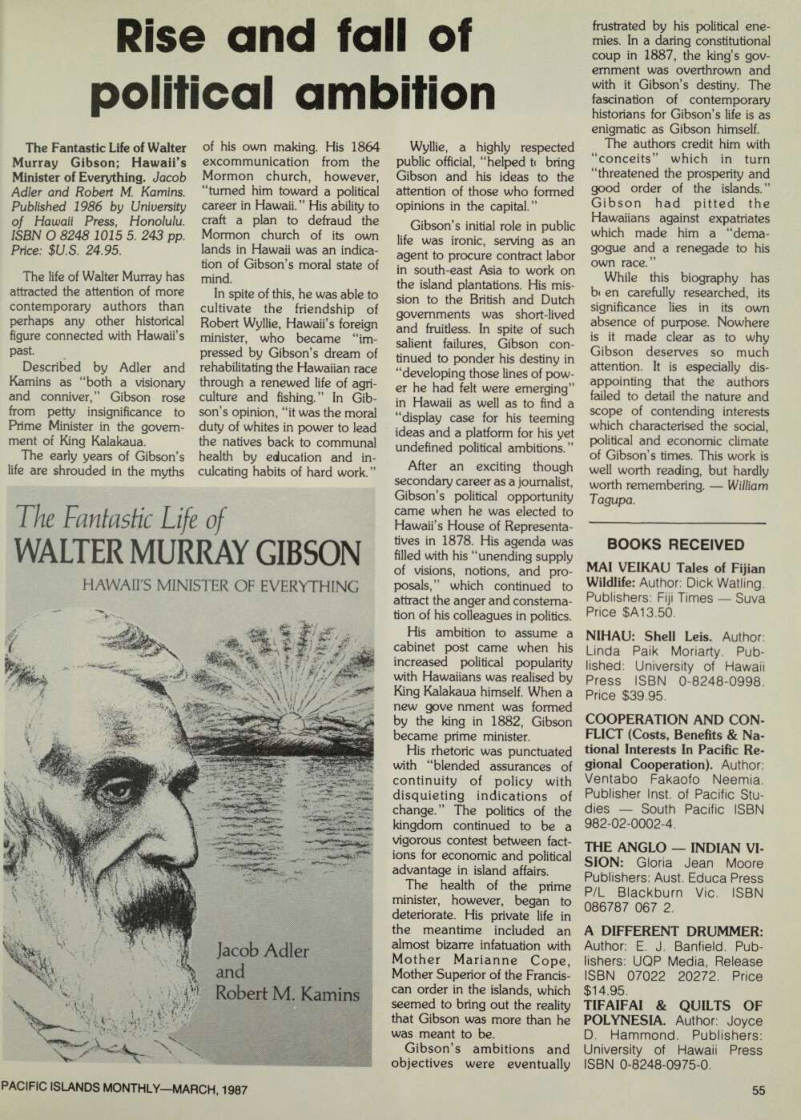
The Fantastic Life of Walter Murray Gibson; Hawaii’s Minister of Everything. Jacob Adler and Robert M. Kamins.
Published 1986 by University of Hawaii Press, Honolulu.
ISBN O 8248 1015 5. 243 pp.
Price: SU.S. 24.95.
The life of Walter Murray has attracted the attention of more contemporary authors than perhaps any other historical figure connected with Hawaii’s past.
Described by Adler and Kamins as “both a visionary and conniver,” Gibson rose from petty insignificance to Prime Minister in the govern ment of King Kalakaua.
The early years of Gibson’s life are shrouded in the myths
of his own making. His 1864 excommunication from the Mormon church, however, “turned him toward a political career in Hawaii.” His ability to craft a plan to defraud the Mormon church of its own lands in Hawaii was an indica tion of Gibson’s moral state of mind, In spite of this, he was able to cultivate the friendship of Robert Wyllie, Hawaii’s foreign minister, who became “im pressed by Gibson’s dream of rehabilitating the Hawaiian race through a renewed life of agri culture and fishing.” In Gib son’s opinion, “it was the moral duty of whites in power to lead the natives back to communal health by education and in culcating habits of hard work. ”
Wyllie, a highly respected public official, “helped t( bring Gibson and his ideas to the attention of those who formed opinions in the capital.”
Gibson’s initial role in public life was ironic, serving as an agent to procure contract labor in south-east Asia to work on the island plantations. His mis sion to the British and Dutch governments was short-lived and fruitless. In spite of such salient failures, Gibson con tinued to ponder his destiny in “developing those lines of pow er he had felt were emerging” in Hawaii as well as to find a “display case for his teeming ideas and a platform for his yet undefined political ambitions.”
After an exciting though secondary career as a journalist, Gibson’s political opportunity came when he was elected to Hawaii’s House of Representa tives in 1878. His agenda was filled with his “unending supply of visions, notions, and pro posals,” which continued to attract the anger and consterna tion of his colleagues in politics.
His ambition to assume a cabinet post came when his increased political popularity with Hawaiians was realised by King Kalakaua himself. When a new gove nment was formed by the king in 1882, Gibson became prime minister.
His rhetoric was punctuated with “blended assurances of continuity of policy with disquieting indications of change.” The politics of the kingdom continued to be a vigorous contest between fact ions for economic and political advantage in island affairs.
The health of the prime minister, however, began to deteriorate. His private life in the meantime included an almost bizarre infatuation with Mother Marianne Cope, Mother Superior of the Francis can order in the islands, which seemed to bring out the reality that Gibson was more than he was meant to be.
Gibson’s ambitions and objectives were eventually
frustrated by his political ene mies. In a daring constitutional coup in 1887, the king’s gov ernment was overthrown and with it Gibson’s destiny. The fascination of contemporary historians for Gibson’s life is as enigmatic as Gibson himself.
The authors credit him with “conceits” which in turn “threatened the prosperity and good order of the islands. ”
Gibson had pitted the Hawaiians against expatriates which made him a “dema gogue and a renegade to his own race.”
While this biography has b< en carefully researched, its significance lies in its own absence of purpose. Nowhere is it made clear as to why Gibson deserves so much attention. It is especially dis appointing that the authors failed to detail the nature and scope of contending interests which characterised the social, political and economic climate of Gibson’s times. This work is well worth reading, but hardly worth remembering. William Tagupa.