building activity lift-off
pp. 38-43 · Read in the full issue

Power for people fires building activity lift-off
Electricity genera
tion in New Zealand is substantially hydro power or geo-thermally based. Over the past thirty years, national hydro-power construction has almost entirely been the preserve of the Minis ter of Works and Development constructing with day labor and by sub-contract.
However an exception was a SNZIO9.B m contract let early in 1984, to the chagrin of the shortly-incoming Labor Gov ernment, for part of the Clyde Dam in South Island to a joint venture of Ed Zublin (West Germany) and W. Williamson
Construction Co. Ltd. (Christ church).
As a result of expanded in house design capacity and own work-force, the policy of reser ving hydro-power construction to the Ministry became self perpetuating with the result the private sector, with exceptions, was handicapped in exporting construction services in the energy area due to lack of job experience, it also led to ill thought out proposals in 1985 that the Ministry go off-shore as a general contractor.
However with the current program of privatisation, the Ministry is to be split into two
divisions: policy/regulatory and commercial operations, with the latter authorised to compete for pnvately funded contracts and presumably private contractors reciprocally able to tender for construction work of the
so H L undertaken
within the Ministry.
Whilst the new policy is still hazy, being currently under Parliamentary discussion, seeptics will argue that the rationalisation is only windowdressing as the design element must be independent to ensure effective competition. But the first steps have been taken to open up hydro-power construe-
tion to competitive tendering by contractors, There , , imited d . vatel ed electricity sup pi y
ind J
sal J a s J on ' a , T North , sland which could sell its surplus to the grid, h Hawaii privately-owned electric P ower generation and distribution is in vogue. Bing ham Engineering (Salt Lake Utah) has submitted plans J° r Hydro-Power |y ant ($U.5.9.0 m.) on Wailua ™ ver ’ Kauai, Also in Kauai, the company proposes a 6.0 MW plant
($U.5.12.0 m.) On Hanalei ver - Callahan Co. (Millbrae, California) has withdrawn an application for a 3.7 MW Hydro-Electric Plant in East Maui as the Environmental Impact Statement (EIS) was not accepted. An upgraded EIS may be submitted.
The Company has also proposed a Hydro-Power Plant ($U.5.10.0 m. approx.) on Lumahai River, Kauai, and a further plant ($U.5.6.0 m.) to serve Keanae, Maui.
On Hawaii (Big Island), Kamoa Wind Energy Partners (California-based) plan 37 Wind Turbine Generators (SUS.IO.O m.) to be supplied by Mitsubishi Heavy Industries Ltd. (Japan). A projected out-
put of 32 million kw hours will be sold to the Hawaii Electric Light Co.
An innovative development, for the ocean water system for which bids recently closed with the Division of Public Works, State Department of Accoun ting and Government Services, is the combined Ocean Ther mal Energy Conversion (OTEC) and Hawaii Ocean Sci ence and Technology Park (HOST) Project at Keahole Point, Big Island. The warm winter intake is 60 feet below ocean surface and the cold water pipe extends to a depth of 2100 ft.
Design is complete by Hawaiian Electric Co. Inc. for an Underwater Electric Power Cable layed up to 7000 ft deep across Alenuihaha Channel, between Big Island and Maui, eventually linking up with Oahu. The feasibility study was funded for 5U.5.27.0 m. over
eight years by the U.S. Depart ment of Energy and the Energy Division, State Department of Planning and Economic Deve lopment.
As it is believed that no U.S. contractor has the requisite ex perience of sub-marine power cable laying to undertake the project, there will be a major opening for a high-technology offshore specialist contractor.
To survey proposed, planned and current energy deve lopments in the Pacific Islands, the following resume details some of the relatively larger projects: Cook Islands: Construction start-up mid-1986 of 1.7 MW wood-fuelled, steam-powered Generating Plant (SNZI2.O m. approx.), near Matavera, de signed and constructed by Sedep (Tahiti).
Department of Energy plans small wood-fuelled, steam
powered Generating Plant (SNZO.2S m.) on Mauke Isld, funded by New Zealand Gov ernment.
Fiji: The Fiji Electricity Authority is starting survey and designs for a 350 kW Hydro- Electric Plant (SF2.O m. approx.) involving a run-off riv er scheme plus construction of a weir across Naibili Creek in Somosomo, Taveuni, for which the consultants are Auckland based. Construction start-up is anticipated by mid-1987.
Application to Asian Deve lopment Bank for technical assistance to draw up 10-year Power Development Plan to 1995. Loan application for $U.5.4.7 m. to fund Rural Electrification program on Viti Levu.
Transmission lines are plan ned over 1986-90 under Deve lopment Plan 9 for Nadrau- Navau-South Coast and for Navau-Cunningham Rd, Vatu koula-Nadrau and Vudu-Vatu koula. Mini-Hydro Power Pro jects are planned over 1986-90 at Vaturu, Wainikasou and Wainisavuleuv, all on Viti Levu.
Guam: Considerable defence expenditure involves power supply. Such projects include the following: • Navy Public Works Center (Navy PWC) plans Wharves Power improvement for 1989 in the cost range SU.S.I. 0-5.0 m. the project includes replace ment of existing 2000/2500 KVA transformers and switchgear with new 3750 KVA equipment and construction of a new 3750 KVA substation; • Navy PWC also plans Con denser System and Boiler Plant modifications (5U.5.1.0-5.0 m.) for 1988, designed in Hon olulu; • Bids open date pending for Re-instrumentation (5U.5.1.0- 5.0 m.) for Boiler Units 4 and 5 at Piti Power Station.
Kiribati: With limited natural resources, power supply is necessarily oil-based. The Public Utilities Board closed tenders early 1987 for a 1 MW diesel generator (SAI.O m. approx, including mechanical workshop) at Tarawa. The con sultants are in Sydney.
Marshall Islands: Power plant upgrade (SU.S.IO.O+ m.) plan
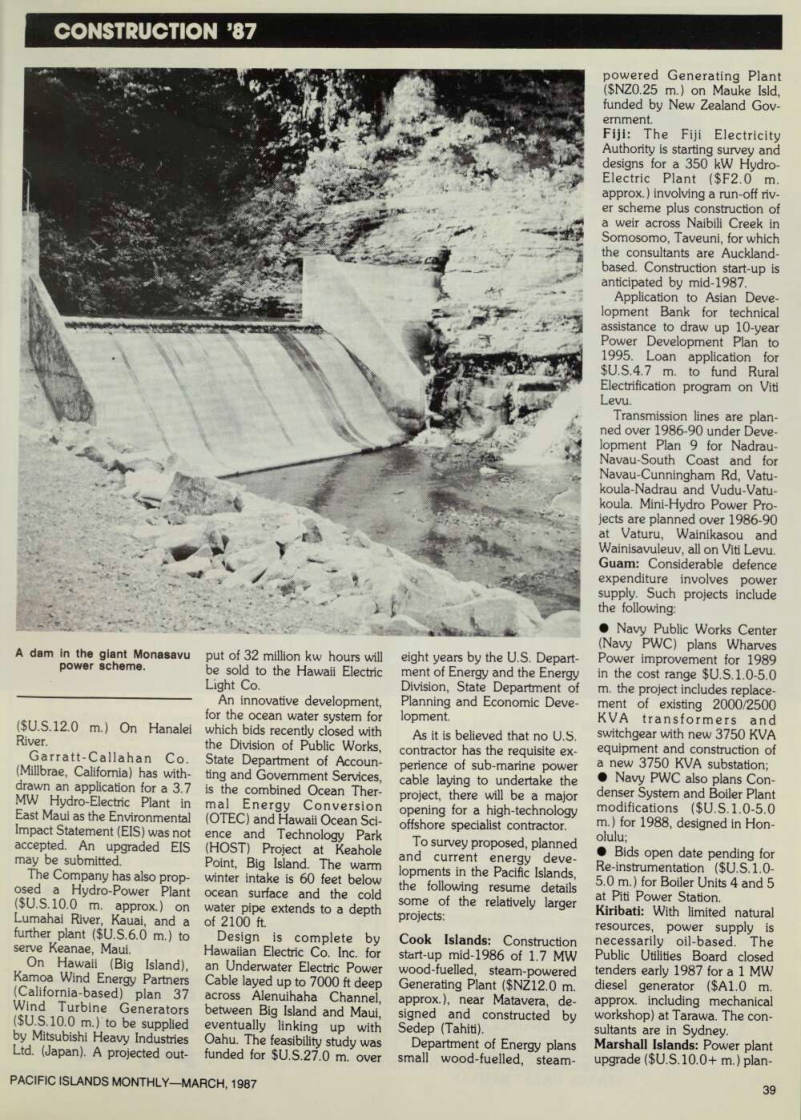
A dam in the giant Monasavu power scheme.
ned for 1988 by U.S. Army Engineer District (Honolulu) at Kwajalein Missile Range. Pro ject comprises a 52,880 sq ft building equipped with 20,000 kW diesel generators.
Norther Marianas: Two 1.6 MW Caterpillar Generators are on order, for which site prepa ration is being undertaken by the Department of Public Works (DPW).
DPW has just gone to con tract for installation of 15 emergency generators at diffe rent locations on Saipan.
Papua New Guinea: Construc tion start-up was scheduled early 1987 for the civil works contract (K 29.4 m.) of Yonki Dam on the Ramu River in the Eastern Highlands. The con tractor is Hyundai Engineering and Construction Co. Ltd. (South Korea) and the consul ting engineers, the Snowy Mountains Engineering Corporation (Australia).
Tenders are closed but con tract not yet awarded for the electrical and mechanical Plant
contract for Yonki Dam. The tenderers (in ascending order of value from K 6.68 m. to K 11.20 m.) were: Progres International (Yugoslavia, out of Sydney); Elin-Union AG (Vienna); Mitsui and Co. (Aust.) Ltd. (Sydney); Toyomenka Kaisha Ltd. (Tokyo); and Chiyoda Chemi cal Engineering and Construc tion Co. (Tokyo).
Application by PNG Electric ity Commission to Asian Deve lopment Bank for technical assistance for 2 MW run-of river schemes sited on Luwini Creek.
Project on appraisal by sth European Development Fund of the European Economic Community for four small Hyd ro-Electric Plants (K 4.0 m.) with transmission lines from existing grids under Diesel Power Re placement Program.
Construction started in April 1986 by PNG Electricity Com mission on a Mini-Hydro Scheme (K 3.0 m. approx.) at Lake Hargy and a similar pro
ject (K 0.9 m. approx.) at Tim putz.
Other power-oriented pro jects include: • Tenders closed for (1) civil works and (2) electrical equip ment for switchroom/switch yards of Ramu Grid Reinforce ment Project which will be funded by Asian Development Bank; • Tenders closed for two 12 MW generating plants at Lae and one at Mt Hagen, also for the Ramu Grid Reinforcement Project; • Tenders closed for 1250 kW Diesel Generating Set and 11KV Station Switchgear at Wewak, with option for a second Generating Set until October 1987.
Pared-down development program to achieve 60,000 ton nes per day copper output by OKTedi Mining Ltd. includes 50 MW Hydro-Electric Power Plant (K 45.0 m.) Consultants for the entire project: Davy McKee Pacific Pty. Ltd. (Mcl
bourne) in association with BHP Engineering (Sydney).
Solomon Islands: The S. 1.
Electricity Authority called ten ders, closed February 16,1987, for a 2000 KV diesel engine generating set at Lungga (Hon iara) and 3 x 2000 KV diesel generating sets for a Power Station at Noro, New Georgia (Western Province), for which the civil engineers are locally based and the electrical/ mechanical engineers in Bris bane. Overall contract value is estimated at $59.5 m. approx.) Tenders closed in Suva with the South Pacific Bureau for Economic Co-operation (SPEC) for a Biogas Generating Plant at Tambea-Honiara on Guadalcanal. The plant was designed in Italy.
Tenders have similarly closed with SPEC for a Charcoal Gasi fier Generating Plant at Vangu na, New Georgie Group. This was designed in Holland.
The S. I. Electricity Authority has applied to the Asian Deve
lopment Bank (Manila) for a $U.5.3.0 m. loan to fund a Dendrothermal Plant of 3 MW capacity.
Tonga: Tenders were sche duled to be called late 1986 by SPEC (Suva) for a 100 kW Steam Engine and Switchboard, designed in Italy.
True (Federated States of Micronesia): Contract award to John Holland International Pty.
Ltd. (Melbourne) for design/ construction/management/ financing of Doublon Island Power Generating Facilities, in cluding 9 MW plant, submarine cables and 1.5 m. gal. tank farm. Consultants: Barrett Con sulting Group (Honolulu).
Vanuatu: Tenders open date pending with SPEC (Suva) for a 25 kW Gasifier Generating Plant, designed in Holland.
Western Samoa: A tentative $U.5.5.0 m. loan has been requested from the Asian Deve lopment Bank by the Electric Power Corporation for the 5 MW Afiamalu Pump-Assisted Hydropower project. The con sultants are located in Bristol, UK, in conjunction with mechanical and electrical en gineers in Auckland.
Overall cost is $U.5.15.0- 16.0 m. co-financed by the European Investment Bank.
The project includes a 3.5 m. cubic metre reservoir, intake and pumping station and 66 KV transmission line.
The Electric Power Corpora tion also plans 11 km of 0.7-1.0 metre diameter pipeline con struction (5U.5.3.0-4.0 m.).
Project deferred to about 1991 for Wood Gasifier Gen-
A temporary access shaft in the Monasavu low pressure tunnel.
erating Plant planned by SPEC (Suva) and designed in Hol land.
Trade balances in the Pacific Islands were hard hit post-1979 by escalation in oil prices. Only since 1984 have marginal im provements in balances of pay ments reflected a fall in the real cost of imported fuels.
Consequently the push is on to develop alternative sources of energy and to reduce de pendency on fossil fuels. The limited recognition of this fact in both Australia and New Zea land has resulted in opportuni ties lost to Japan, South Korea and other international sup pliers.
The Australian attitude is de monstrated by its drastically falling market share in Papua New Guinea for both general construction and electric equip ment in particular. Suppliers of electricals from Australia approached the post-1974 market on an “as-of-right” basis and lost out to new sources of competition.
In New Zealand the con ventional wisdom is that “we know what’s going on; we have agents in the island markets and we visit them regularly.”
This is still not enough to achieve full market penetration.
Net profitability is frequently determined not by the jobs that a suppliers wins, but by those where someone else’s timing was better.
It is to identify those poten tially missed job opportunities, even though sometimes amounting to only a few in
number, that a regular market information flow is needed from independent outside sources.
Secondly, it is rare for on the-spot agents to perform as effectively as the principals do in their domestic market with out continuing close super vision predicated on as com plete a knowledge as possible of new project activity.
“On-the-spot” representa tion belies the fact that deve lopments in the island countries are often funded, designed and constructed from outside, with
the result the local agent is presented with a fait accompli by the time he follows-up the prospect.
Lastly, periodic sales visits are fully productive only when directed with the right timing at specific targets and this requires forward information. Little can be more wasteful than visiting an off-shore location to find that a once-of contract was recently placed elsewhere.
The reserve bank building under construction in Suva