industry recovers
pp. 28-34 · Read in the full issue

Construction ’87
Tourism leads the way as construction industry recovers
THE year 1986 witness ed an unprecedented upturn in proposed and planned tourist accommodation from Invercar gill at the southern tip of South Island, New Zealand, to Hon olulu and the Neighbour Islands in Hawaii.
Similar expansion plans were announced also in many Pacific Island countries including Guam, the Northern Marianas, Fiji and several smaller locales.
Everywhere this economic stimulus is identically based, catering for visitor growth originating from the United States and Japan. Due to the incidence of terrorism, North Americans are reordering their travel patterns away from Europe to the Paific, at least in the short-term.
The impact on the Hawaiian economy has brought forward a welter of major resort deve lopments with a capital expend iture of the order of two to three billion dollars on completion over a time-frame of between two to five years.
Several would have been operational even earlier but for the complicated planning con trols applicable in Hawaii which often require permits frim three or four different authorities (in some instances even up to six) before construction can com mence.
The Hawaiian tourist upsurge is predicated on the growing number of mainland visitors who wish to take an off-shore holiday without leaving the security of the United States. It also draws on an increasing
The islands construction industry is ready for an upturn.
In the following two articles, JOHN JACKSON of Pacific Economics Ltd, publishers of the Pacifecon survey of development activity, examines the scene.
number of Japanese tourists who feel at home in facilities substantially provided by Hawaiian-Japanese business and frequently funded from Japan.
Japanese tourists are also the mainstay of the hospitality in dustry in Guam, where both visitor accommodation and the construction market is largely Japanese-controlled. The new ly self-governing Northern Marianas are fast becoming a holiday satellite for Japan.
Mainland U.S. tourists seek ing ap overseas holiday are visiting New Zealand in droves, frequently stopping in Fiji en route and also visiting Austra lia on the round trip. The Australian segment became almost mandatory with the America’s Cup battle in Fremantle, the port for Perth, early this year, Japanese tourists are also flocking to New Zealand (fre quently via Australia) in grow ing numbers lured by spacious
ness, inexpensive sporting faci lities and a relaxed atmosphere.
The current impact in New Zealand is a building boom in hotels, motels and tourist associated infrastructure, parti cularly in the South Island below Oamaru.
For example, in Queens town, which serves the Coronet Peak ski area, hundreds of visitor bedrooms are under construction or on the planning boards. The thermal areas in North Island are also a focus of new development.
In Wellington (the capital city), as well as Auckland (the largest metropolis) and Christ church (the gateway to the
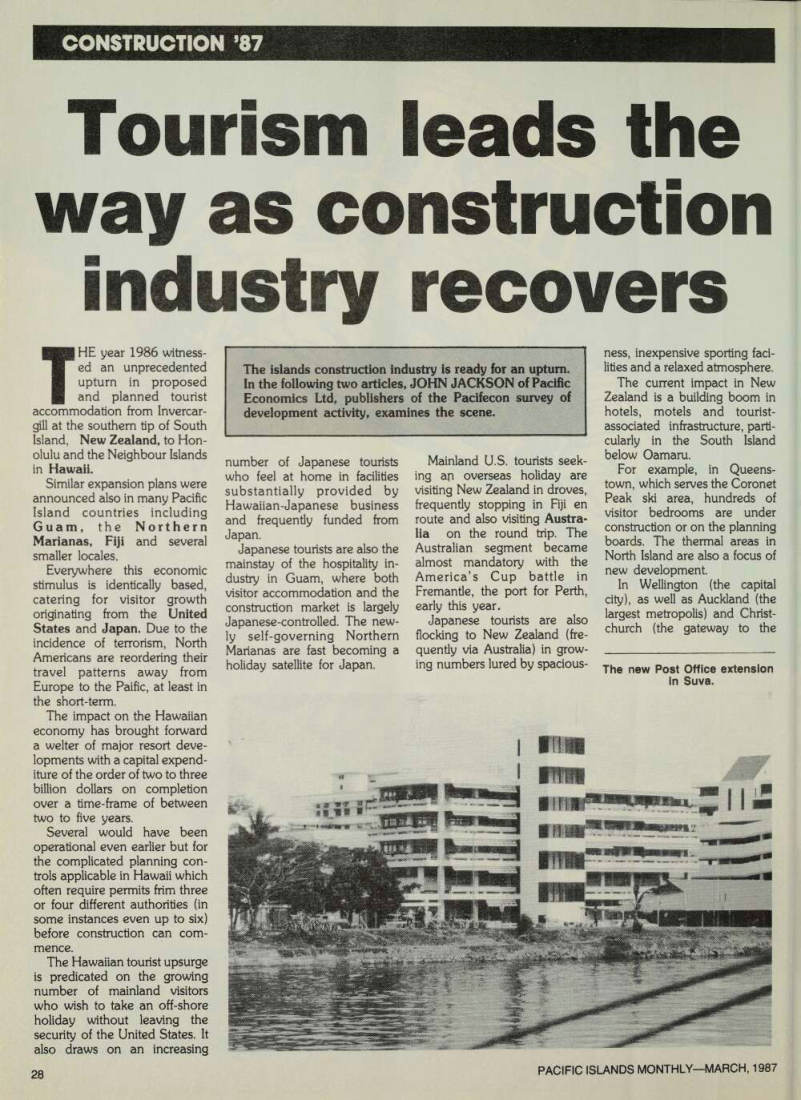
The new Post Office extension In Suva.
south), the major hotel groups are competitively extending their market coverage at some risk of over-saturating.
For example, in the govern ment-owned Tourist Hotel Corporation (which was origin ally chartered to undertake re sort development in more re mote areas possessing tourist potential), the drive is on to obtain a foothold in major cities, such as Christchurch, so that visitors from overseas can travel throughout New Zealand switching from one hotel within the chain to another on just one centrally-booked schedule.
To survey proposed, planned and current tourist deve lopments in the Pacific Islands, the following resume details some of the relatively larger projects; American Samoa: Negotia tions were terminated last October for purchase by Aiga Tasi Inc (Houston, Tx) of the A.S. Government’s controlling shareholding in the Rainmaker Hotel at Utulei. USs3sm ex penditure overall was proposed for rehabilitation and 100-room expansion, to be designed in Honolulu. A new request may be published for proposals.
Cook Islands: Plans are tentative at this stage for altera tions and 100-room additions (NZ$B-9m approx) to The Rarotongan Hotel at Arorangi,
Rorotonga. The design consult ants are located in Suva.
The Infrastructure Office of the C.I. Government is asses sing proposals from two un named companies to establish a Hotel in Ngatangiia Lagoon, Avana. Enjoy Enterprises started construction in May 1986 of a three-storey hotel (NZs4m approx) in Avarua.
Fiji: Proposals closed in November 1986 Suva City Council for a 154-room hotel and convention centre on re
claimed land on Suva waterfront. The project was ori ginally to have been a joint venture with the recently col lapsed Malaysian Overseas In vestment Corporation.
The successful proposer is Tokyo Hotels International (Tokyo, Japan).
Motibhai & Co Ltd (a major trading house with operations in Australia) has approval in principle for a 14-level hotel (Fsl2m approx) on Victoria
Pde, Suva, which is being de signed in Sydney.
The Regent of Fiji plans a 300-room hotel at Denaru by about 1988/9 to share facilities with the existing site. There are also longer-term proposals for 500-rooms in six to eight village blocks at Denaru.
The planned Vulani Island Resort, located in the Sabeto River Delta, 7km from Nadi Airport, includes necessary in frastructure to form a 275 acre island with four hotel sites and 170 half-acre residential lots.
Stage 1 (resort) is estimated at F$ 15.5 m approx; Stage 2 (con struction of 250-room hotel) at about Fs3om. The developers are Sigatoka-based with archi tects in Suva.
Construction commenced in June of the Moonraker Hotel at Lautoka, designed by Murray Cockbum Partnership (Suva), and built by Reddy Construct ion Co Ltd (Lautoka). Work was to start early in 1987 on upgrading (F52.25m approx) the Mountain View Resort (formerly the Sunlover Hotel).
Architect is Media Ten and the builder, Narain Construction Co Ltd (both of Suva).
The Natadola Beach Resort, planned for a number of years
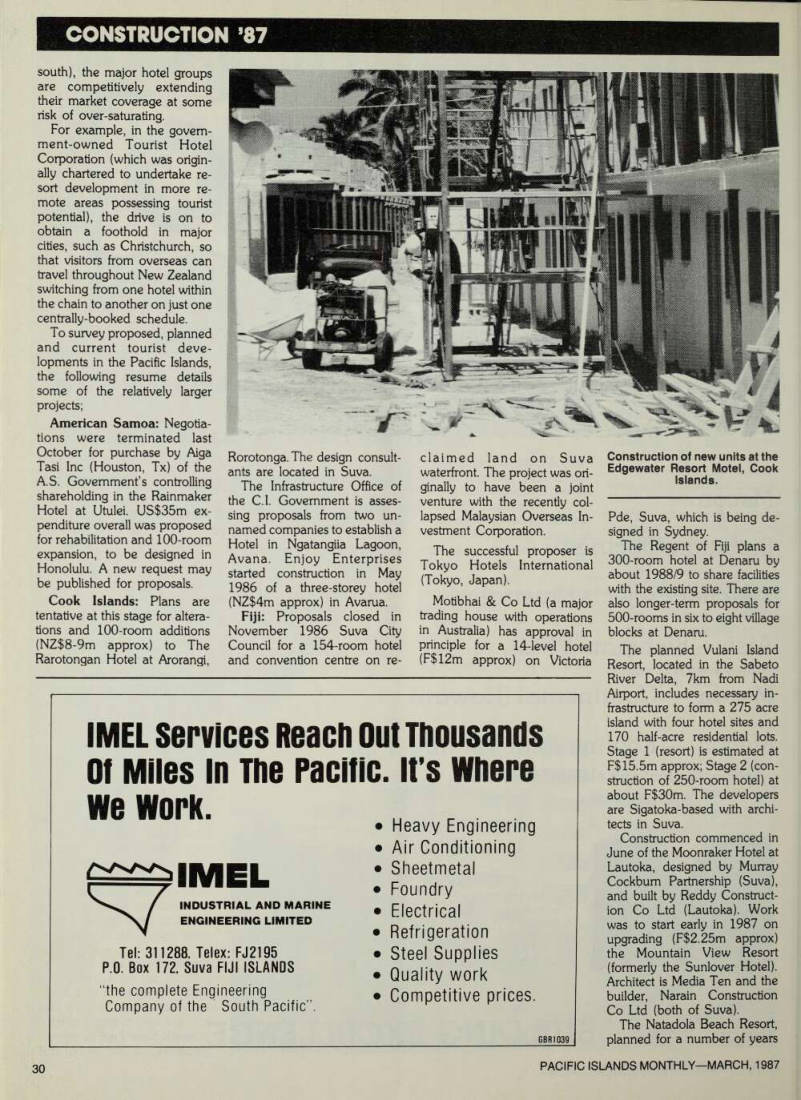
Construction of new units at the Edgewater Resort Motel, Cook Islands.
The 300-room Fiji Sheraton Resort at Den is due for completion this year.
by White Industries Ltd (Austra lia) as a 3000-room deve lopment between Nadi and Sigatoka, has been held up by land acquistion.
Also slow to evolve is the Saweni Beach Tourist Resort planned from Sydney to in clude three hotel and eight condominium sites.
Proposals for a 320-room hotel on the beach at Deuba were deferred pending take over of the Pacific Harbour Resort complex.
And an even less fortunate project has been the grandiose Vunaniu Bay Resort (U.S.s6sm approx) on the Cor al Coast of Viti Levu, with Grand Pacific Inc (Honolulu) stalling a mortgagee sale forced by the site contractor from Mainland China early in 1986.
The developer claims that the concept is viable and the pro ject going ahead, with head works, sports club and forma tion of golf course scheduled to start early in 1987.
Guam: Projects announced during 1985 included; • Fujita Corporation (Tokyo): Hotel Resort (USsls6m overall), possibly at Harmon Cliffline, including 300-room hotel; • Guam Dai-Ichi Hotel: 12storey, 132-room additions (USslom overall); • Guam Hotel Okura: 100room additions; • Pacific Island Hotel: 272room additions (USs2sm over all) in two medium rise build ings plus a building to house public rooms including re staurants; • Reef Hotel: accommoda tion extensions.
A major project commenced early in 1985 was the 450room Nauru Pacific Star Hotel.
Designed by Guam consultants, the USs49.2m construction contract was awarded to a Japanese joint venture.
Kiribati: The tourist deve lopment program of the Minis try of Natural Resources Deve lopment includes upgrading of
Housing on the move ... sections of a prefabricated house from J.
S. Hill’s House Factory’ in Fiji heads to a site.
the Captain Cook Hotel on Kiritimati.
Marshall Islands: The übi quitous Nauru Government has proposed a small resort hotel on Jaluit as an off-shore invest ment.
Northern Marianas: The Hyatt Regency is currently seeking a Coastal Resources Management permit for exten sions at Garapan on Saipan.
The Surf Hotel has just signed a lease agreement with the Marianas Public Land Corporation for a 3.3 ha site adjacent to the existing facility for construction of 250-400 rooms (up to nine storeys) at an extimated construction cost of US$l5-20m.
A formerly proposed 600room hotel resort (USsllsm approx) at Laulau Beach, Saipan is being re-evaluated by the new owners of the site. The Concept was formulated by Honolulu architects for the ori ginal Hawaii-based, joint deve loper.
The Marianas Public Land Corporation is considering applications for a 25-year lease of a 7ha hotel site on the former U.S. Navy Reserve at Loran Point, San Antonio, Saipan, from Hilton International, the New Osaka Hotel (Osaka, Japan) and Harmon Corpora tion (Tamuning, Guam).
Papua New Guinea: PNG International Hotels Pty Ltd has approval from the Lands Board for a five-star hotel (K42m approx) on Ela Beach, Port Moresby.
The shareholding breaks down: Mr. Scott Ba’a Ure, Country Party Deputy Premier (28%); Mr. Subramaniam
Segaran, Malaysia (27%); Tusi tala Pty Ltd (20%) and the Asian Development Bank, Manila (25%).
Tonga: Proposals were announced in October 1986 for the Crown Prince Hotel of 170 rooms in Nukualofa, adjacent to the NZ High Commissioners residence. World Resources Corporation (Honolulu) also published proposals about the same time for a full-service beach resort in Tonga.
Vanuatu: Renovations con tinue progressively of the Hotel Le Lagon in Port Vila. The general contractor is an Hawaiian-Japanese joint ven ture based in Honolulu.
Western Samoa: Aggie Grey’s Hotel Ltd has applied to the Enterprises Incentives Board for expansion and up grading in Apia.
The Government of Nauru has proposed a seven-storey hotel at Tiafau, subject to the development of an adequate water supply, as another off shore investment.
Designs are in progress by Suva architects for upgrading the Tusitala Hotel in Apia.
Construction start-up is sche duled for about now of the 280-room Phase 1 of the Royal Samoan Hotel at-Taumeasina.
The project is funded from Honolulu, designed in Seattle and will be built by a U.S.owned but Saudi Arabian based general contractor.
All-in-all, tourism is now an intra-regional growth market for the English-speaking Pacific Basin, an area in which trade movements previously have tended to be one-way and largely predicated on goods rather than services.
Work on the Monasavu foundations.