Can Wingti[?] hold on?
pp. 14-24 · Read in the full issue
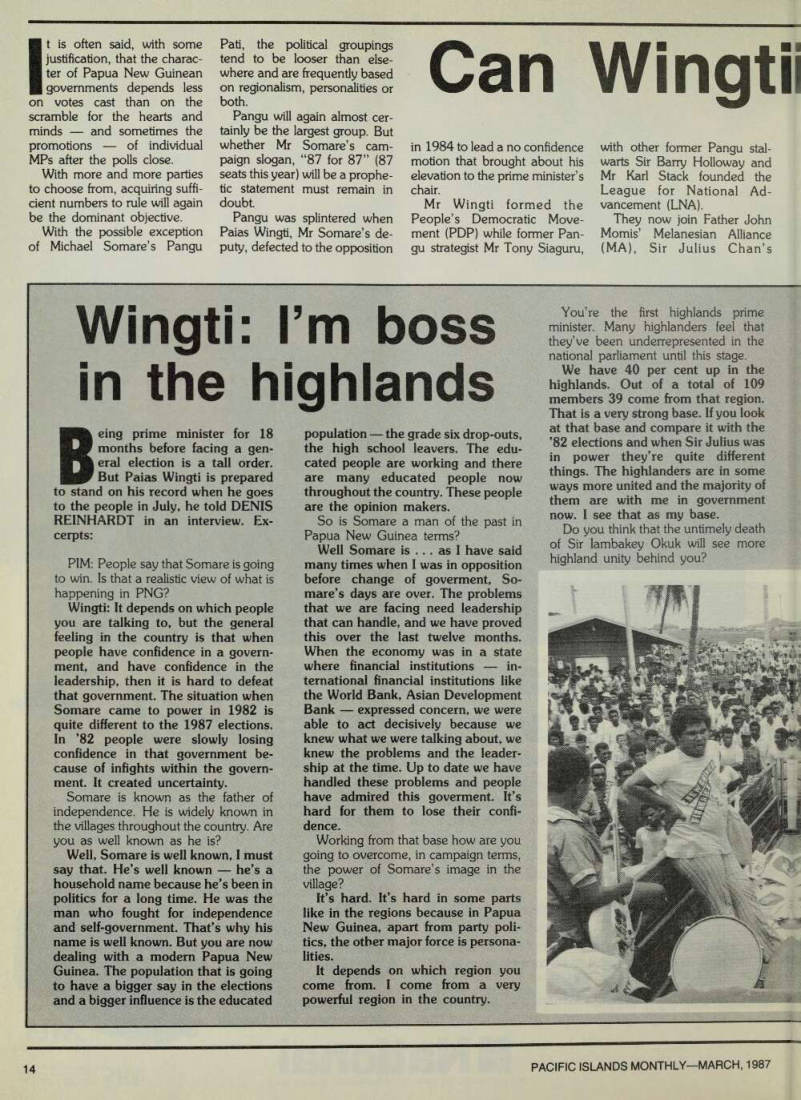
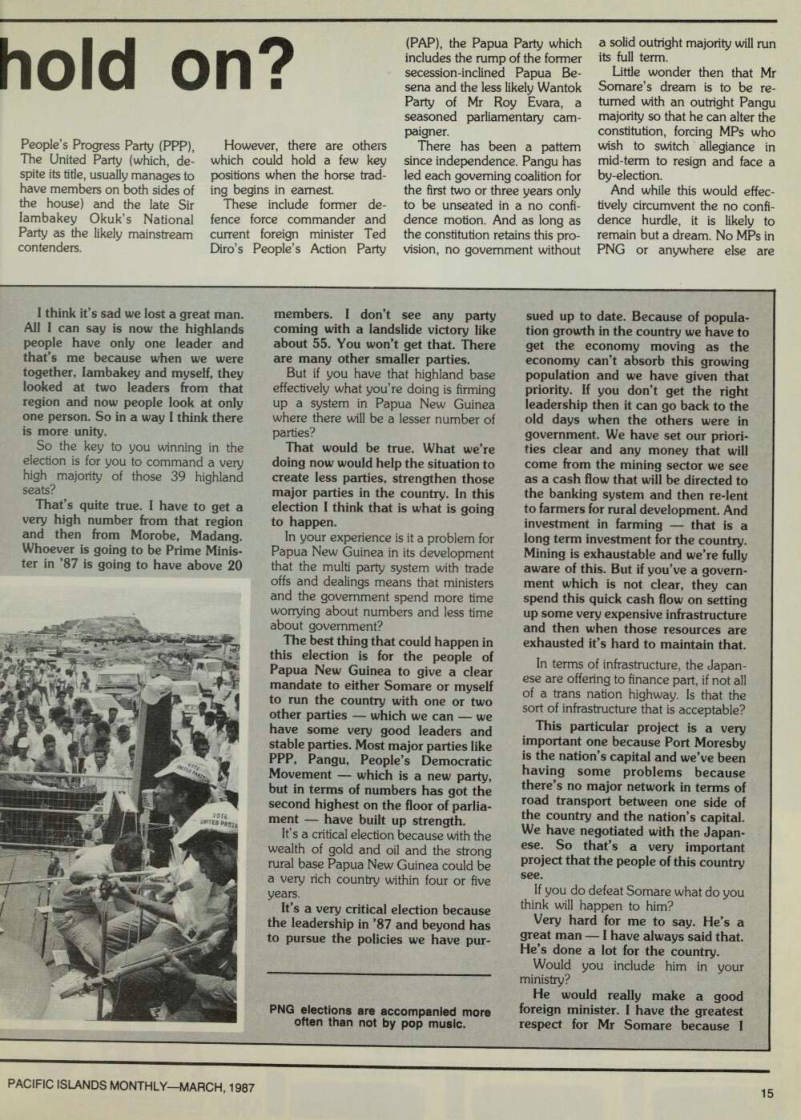

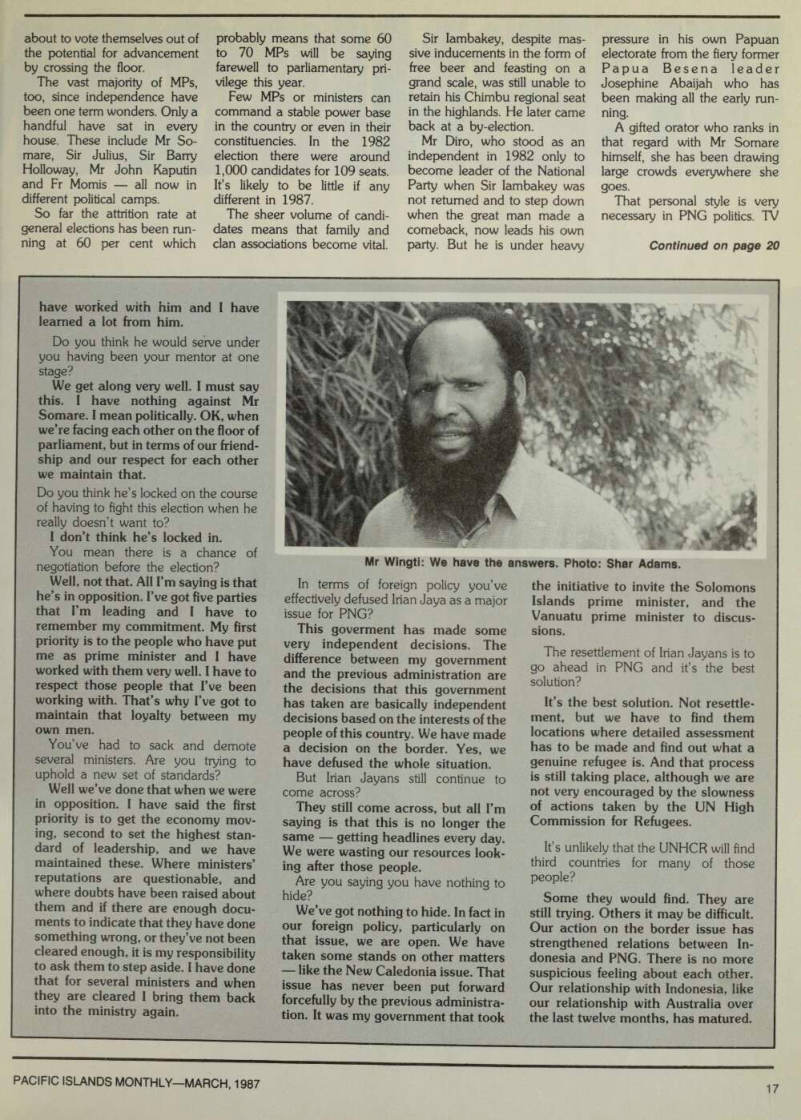
It is often said, with some justification, that the charac ter of Papua New Guinean governments depends less on votes cast than on the scramble for the hearts and minds and sometimes the promotions of individual MPs after the polls close.
With more and more parties to choose from, acquiring suffi cient numbers to rule will again be the dominant objective.
With the possible exception of Michael Somare’s Pangu
Pati, the political groupings tend to be looser than else where and are frequently based on regionalism, personalities or both.
Pangu will again almost cer tainly be the largest group. But whether Mr Somare’s cam paign slogan, “87 for 87” (87 seats this year) will be a prophe tic statement must remain in doubt Pangu was splintered when Paias Wingti, Mr Somare’s de puty, defected to the opposition
in 1984 to lead a no confidence motion that brought about his elevation to the prime minister’s chair.
Mr Wingti formed the People’s Democratic Move ment (PDP) while former Pan gu strategist Mr Tony Siaguru,
with other former Pangu stal warts Sir Barry Holloway and Mr Karl Stack founded the League for National Ad vancement (LNA).
They now join Father John Momis’ Melanesian Alliance (MA), Sir Julius Chan’s
People’s Progress Party (PPP), The United Party (which, despite its title, usually manages to have members on both sides of the house) and the late Sir lambakey Okuk’s National Party as the likely mainstream contenders.
However, there are others which could hold a few key positions when the horse trad ing begins in earnest These include former de fence force commander and current foreign minister Ted Diro’s People’s Action Party
(PAP), the Papua Party which includes the rump of the former secession-inclined Papua Besena and the less likely Wantok Party of Mr Roy Evara, a seasoned parliamentary campaigner.
There has been a pattern since independence. Pangu has led each governing coalition for the first two or three years only to be unseated in a no confidence motion. And as long as the constitution retains this provision, no government without
a solid outright majority will run its full term, Little wonder then that Mr Somare’s dream is to be re turned with an outright Pangu majority so that he can alter the constitution, forcing MPs who wish to switch allegiance in mid-term to resign and face a by-election, And while this would effec tively circumvent the no confi dence hurdle, it is likely to remain but a dream. No MPs in PNG or anywhere else are
about to vote themselves out of the potential for advancement by crossing the floor.
The vast majority of MPs, too, since independence have been one term wonders. Only a handful have sat in every house. These include Mr Somare, Sir Julius, Sir Barry Holloway, Mr John Kaputin and Fr Momis all now in different political camps.
So far the attrition rate at general elections has been running at 60 per cent which
probably means that some 60 to 70 MPs will be saying farewell to parliamentary pri vilege this year, Few MPs or ministers can command a stable power base in the country or even in their constituencies. In the 1982 election there were around 1,000 candidates for 109 seats, It’s likely to be little if any different in 1987.
The sheer volume of candi dates means that family and clan associations become vital.
Sir lambakey, despite mas sive inducements in the form of free beer and feasting on a grand scale, was still unable to retain his Chimbu regional seat in the highlands. He later came back at a by-election.
Mr Diro, who stood as an independent in 1982 only to become leader of the National Party when Sir lambakey was not returned and to step down when the great man made a comeback, now leads his own party. But he is under heavy
pressure in his own Papuan electorate from the fiery former Papua Bcsena leader Josephine Abaijah who has been making all the early run ning.
A gifted orator who ranks in that regard with Mr Somare himself, she has been drawing large crowds everywhere she goes.
That personal style is very necessary in PNG politics. TV
Continued on page 20
Continued from page 17 will have little impact on this election. It is unlikely that it will have achieved the necessary penetration in time, though it will without doubt be a major force in future campaigns.
So far, however, the stayers have been the people who have walked their constituen cies meeting the people in their villages.
This makes Mr Somare, un doubtedly one of the South Pacific’s finest orators, virtually certain to retain his seat and his
leadership of the largest party.
To see The Chief address a large crowd (the larger the better) in pidgin is to watch a master of a craft that TV has elsewhere rendered obsolete.
Mr Wingti has a slightly quie ter approach. He is better in smaller groups, sitting down among the people and talking in a more conversational style.
He appeals to the educated voter while seeking to present an image of well-schooled wis dom to the more traditional villager.
It was a highly successful
formula in 1982, but he may have lost some credibility as a result of the unrest that fol lowed the death of Sir lam bakey last year.
That untimely death leaves a power vacuum in PNG politics.
The densely populated high lands constituencies will have a vital say in who forms the government. In the past, Sir lambakey was seen as the natural leader of the highlands.
Now Mr Wingti, by virtue of his position as prime minister, may be able to take on that mantle.
He has competition. The re
nowned highlands business man, Mr Paul Fora, intends to stand against him. And, in the neighbouring Chimbu eleco rate, sitting MP and former Pangu minister Mr John Nilkare is running again.
And in the Eastern Highlands he will have to contend with Mr John Giheno who earned wide respect as Pangu’s foreign and then police minister.
In that same area Sir Barry Holloway is seen as a natural reselection but, as a naturalised citizen, he has never sought to
take on the role of highlands strongman.
Mr Nilkare ran a clever cam paign last time, hiking the steep slopes of Chimbu while Sir lambakey was throwing grand stand parties. An educated man who can also respond to an audience, he could well fill the gap. But in the hugely compli cated world of highlands politics with its ever shifting clan alliances, nobody is guaranteed a seat in Parliament.
Elsewhere, the PPP has nev er really established itself nationwide. Seen as a New
Ireland-based group led by the politically astute Sir Julius Chan, the party has had mixed fortunes of late.
The New Island provincial government has been lost by PPP to a Pangu-MA grouping which could even herald diffi culties for Sir Julius in his own electorate. However, this was accompanied by a very strong showing in the Milne Bay pro vincial election in January.
MA has strength in North Solomons and Morobe, but here the waters have been muddied by the candidacy of
fiery Morobe premier Utula Samana. A speaker in the So mare mould, he has decided to stay with his Morobe Indepen dent Group (MIG). His massive personal following must make him favourite to be elected but as a new boy in the national parliament he may need some time to establish a power base.
MA’s leader Fr Momis has been something of a political chameleon since he founded the party with Mr Kaputin in the run up to the 1982 campaign.
At that time he castigated Sir lambakey’s alleged self-seeking
approach to politics but then backed him at least publicly in opposition.
Fr Momis and Mr Kaputin have had more than one falling out since then the first was when Mr Kaputin refused to join the Somare ministry in the post poll trade-offs.
Mr Kaputin, a Tolai from New Britain, was a highly effec tive finance minister in the Chan administration of 1980- 82 and has won much respect for transforming the minerals
Continued on page 24
Continued from page 21 and energy portfolio of the current government into a ma jor ministry. He’ll want to be in the government but won’t settle for a junior portfolio.
Mr Siaguru’s LNA is untried at the polls, as is Mr Wingti’s new outfit. It’s possible that he (Mr Siaguru) and his colleagues may suffer some backlash after “deserting” The Chief. But if he can pick up even a handful of
seats he will be a force in the new parliament All the former Somare minis ters are, ironically perhaps, at an advantage in the election.
As ministers they were less able to visit their constituencies than they are now as opposition MPs. And the voters like to see their MPs as, at an approaching election, the MPs like to see the people. Mr Siaguru may well be the com ing force in PNG politics.
A former Pangu kingmaker he knows the ways of political infighting as well as any. It may be significant that Mr Somare still has a high regard for his abilities (see interview).
The problems facing Mr Wingti are those which faced Sir Julius in 1982 to be seen as a natural choice for prime minister. He has worked hard to achieve the image, travelling constantly throughout the country to get himself more
closely identified with the voters.
But to catch Mr Somare is a daunting task. The man from the Sepik is still papa bilong kantri (father of the country), the man who delivered inde pendence. While The Chief re mains in political life, he’s vir tually assured of that title and all that it implies.
Michael Somare is a hard act to follow.