small screen
p. 12 · Read in the full issue
All eyes on the small screen
Fiji Television, due to begin broadcasting in September this year, has already embarked on a project to introduce the people of Fiji to the new elec tronic medium and to give them a taste of what’s to come.
The embryo station, owned until January by the Kerry Packer group when it was sold with Packer’s other extensive TV interests to the Alan Bond organisation for A 51.05 billion, has already started a commun ity video service.
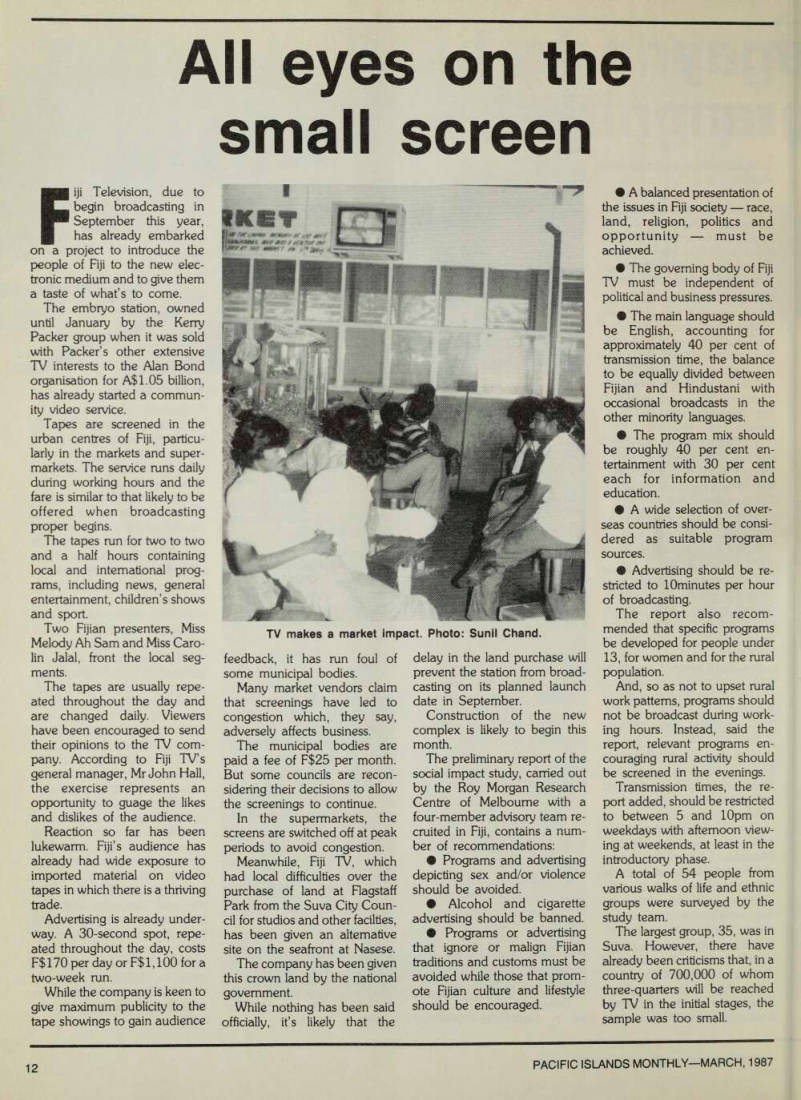
Tapes are screened in the urban centres of Fiji, particu larly in the markets and super markets. The service runs daily during working hours and the fare is similar to that likely to be offered when broadcasting proper begins.
The tapes run for two to two and a half hours containing local and international prog rams, including news, general entertainment, children’s shows and sport.
Two Fijian presenters, Miss Melody Ah Sam and Miss Caro lin Jalal, front the local seg ments.
The tapes are usually repe ated throughout the day and are changed daily. Viewers have been encouraged to send their opinions to the TV com pany. According to Fiji TV’s general manager, Mr John Hall, the exercise represents an opportunity to guage the likes and dislikes of the audience.
Reaction so far has been lukewarm. Fiji’s audience has already had wide exposure to imported material on video tapes in which there is a thriving trade.
Advertising is already under way. A 30-second spot, repe ated throughout the day, costs Fsl7o per day or Fsl,loo for a two-week run.
While the company is keen to give maximum publicity to the tape showings to gain audience
feedback, it has run foul of some municipal bodies.
Many market vendors claim that screenings have led to congestion which, they say, adversely affects business.
The municipal bodies are paid a fee of Fs2s per month.
But some councils are recon sidering their decisions to allow the screenings to continue.
In the supermarkets, the screens are switched off at peak periods to avoid congestion.
Meanwhile, Fiji TV, which had local difficulties over the purchase of land at Flagstaff Park from the Suva City Coun cil for studios and other facilties, has been given an alternative site on the seafront at Nasese.
The company has been given this crown land by the national government.
While nothing has been said officially, it’s likely that the
delay in the land purchase will prevent the station from broad casting on its planned launch date in September.
Construction of the new complex is likely to begin this month.
The preliminary report of the social impact study, carried out by the Roy Morgan Research Centre of Melbourne with a four-member advisory team re cruited in Fiji, contains a num ber of recommendations: • Programs and advertising depicting sex and/or violence should be avoided. • Alcohol and cigarette advertising should be banned. • Programs or advertising that ignore or malign Fijian traditions and customs must be avoided while those that prom ote Fijian culture and lifestyle should be encouraged.
• A balanced presentation of the issues in Fiji society race, land, religion, politics and opportunity must be achieved. • The governing body of Fiji TV must be independent of political and business pressures. • The main language should be English, accounting for approximately 40 per cent of transmission time, the balance to be equally divided between Fijian and Hindustani with occasional broadcasts in the other minority languages. • The program mix should be roughly 40 per cent en tertainment with 30 per cent each for information and education. • A wide selection of over seas countries should be consi dered as suitable program sources. • Advertising should be re stricted to lOminutes per hour of broadcasting.
The report also recom mended that specific programs be developed for people under 13, for women and for the rural population.
And, so as not to upset rural work patterns, programs should not be broadcast during work ing hours. Instead, said the report, relevant programs en couraging rural activity should be screened in the evenings.
Transmission times, the re port added, should be restricted to between 5 and 10pm on weekdays with afternoon view ing at weekends, at least in the introductory phase.
A total of 54 people from various walks of life and ethnic groups were surveyed by the study team.
The largest group, 35, was in Suva. However, there have already been criticisms that, in a country of 700,000 of whom three-quarters will be reached by TV in the initial stages, the sample was too small.
TV makes a market impact. Photo: Sunil Chand.