Wind of change many
pp. 10-11 · Read in the full issue
shift testing program
The shelling and sinking late last year of the Southern Raider by a French gunboat in the Indian Ocean as a punishment for entering a previously un known “prohibited zone” around the islands of St Paul and Amsterdam triggered fresh speculation over the possible relocation of the nuclear testing program from Moruroa to the Kerguelen islands.
Other evidence supporting the theory includes the sightings in Australia of huge French weather balloons which have drifted from the Kerguelens.
Despite repeated denials, France now has compelling reasons for considering such a transfer.
But these reasons have nothing to do with, as has often been suggested, the growing threat to French colonial rule in the Pacific as represented by the independence movements in Tahiti and the action by the South Pacific Forum to bring New Caledonia under UN scru tiny.
For, as prime minister Mr Jacques Chirac has often de clared, he will never allow any outside interference in France’s internal affairs including the external territories.
In any case, France has long held the answer to local trou bles send in more troops.
On the the other hand, there exists at Moruroa a series of problems that cannot be solved by the garde mobile.
These have to do with the geological structure of the atoll and with the far reaching clima tic changes taking place in the southern hemisphere. Taken together, these argue strongly for moving the tests.
An atoll can best be likened to a submerged tower of porous coral, resting on a foundation of brittle basalt rock.
The Americans never envis aged using Bikini or Enewetok atolls for underground testing and took their program to the Nevada desert The British, who had used Christmas island for atmospher ic testing in 1957-58, likewise estimated the risks as too great and gratefully accepted the US offer to share the Nevada site.
When, in 1972-73, furious
France’s nuclear weapons testing centre at Moruroa atoll may be moved south to the French anarctic possessions in the Kerguelen islands, report MARIE-THERESE and BENGT DANIELSSON. The inevitable denials by the French military, they say, serves only to confirm the widespread view of a change in the wind.
international pressure made the French government realise that it could not with impunity con tinue to poison the Pacific re gion, the most acceptable course would have been to follow the American example.
Sadly for us living here in the islands, President Giscard D’E staing, who came to power in
1974, rejected this solution. He feared that too many French voters might regard testing in France as dangerous.
So Giscard decided to use Moruroa for underground, or rather underwater, testing.
However, Moruroa combines the general fragility and permeability of all atolls with
the specific fault of being too small for the very ambitious French testing program.
The circumference of the narrow reef surrounding the central lagoon is only 53 kilometres and about half of it was at that time covered with housing units, observation tow ers, bunkers, warehouses and so on.
There was also an airstrip and a wharf. This left, for the projected program of eight to ten bombs per year, a 23kilometre stretch on the south coast.
The minimum interval be tween the test pits deemed necessary by the engineers was 500 metres which meant that the whole available reef area would be used up in five years. And so it was.
Thus, by 1980, huge por tions of the reef had subsided and dozens of fissures and cracks bore witness to the ex tensive subsurface damage the atoll had suffered.
In addition, several badly calculated blasts had acci dentally pierced the outer slopes of the atoll at varying depths.
The worst of these accidents occurred on July 25, 1979 and the volume of rock tom out on this occasion was, according French disaster expert Haroun Tazieff, around one million cubic metres.
But it was still politically taboo to take the tests to France and so the army engineers came up with another solution.
They would drill bomb shafts under the 40-metre deep la goon but it was even then obvious that it would take only a few more years before the whole atoll looked like a Swiss cheese.
The supreme boss of the testing program, Admiral Pages (later to be the main instigator of the Rainbow Worrier out rage) was not unduly con cerned as there were several other uninhabited or sparesely
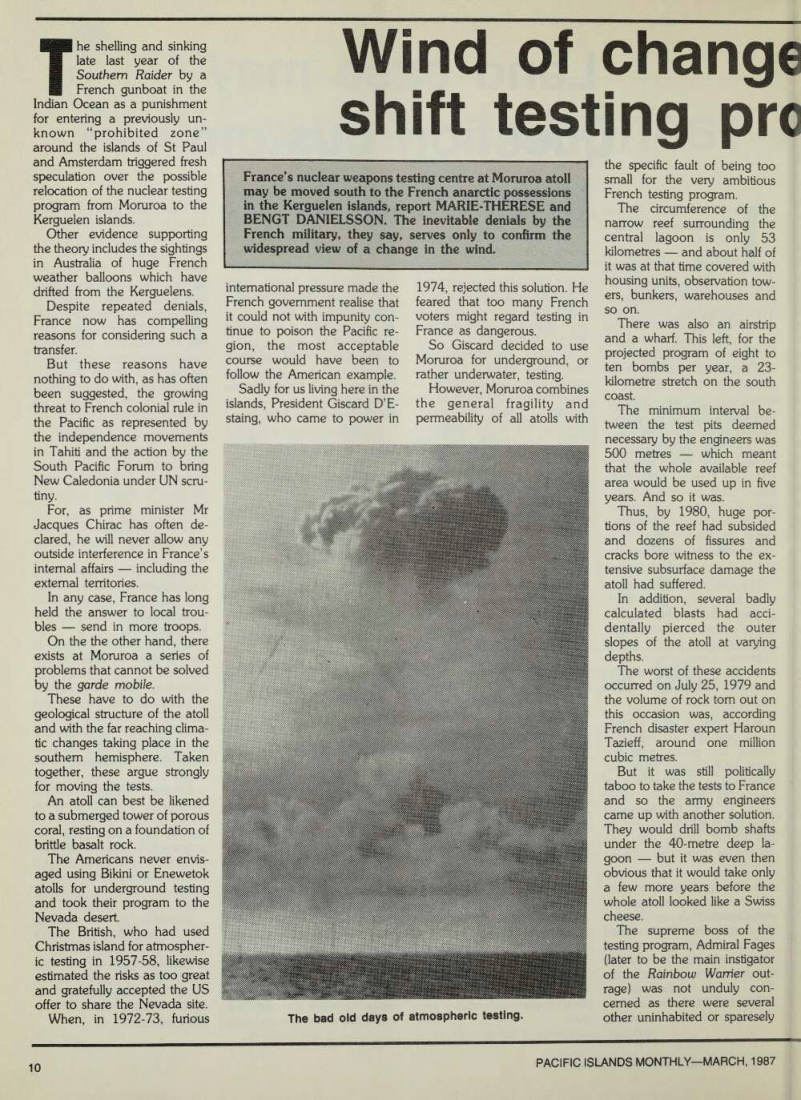
The bad old days of atmospheric testing.
habited atolls in the immediate vicinity.
The Atomic Test Centre already held a long lease on minuscule Fangataufa, 40 km south of Moruroa, where the first French hydrogen bomb of 2.5 megatonne yield had been detonated on August 24, 1968.
Though the atoll had been heavily contaminated by this “super bang”, it was again used between 1973 and 1975 for the first arduous and not very successful experiments in reef drilling, during which work bri gades of Polynesians and fore ign legionnaires were em ployed.
The admiral now sent the workers in to widen the passage blasted in 1966 so that barges with drilling rigs could enter the Fangataufa lagoon.
At slightly greater distances to the west, north and east of Moruroa were at least a dozen more useable atolls.
That they had belonged from time immemorial to the indi genous people whose title was confirmed in colonial law, did not appear to worry the admiral.
But there came a new and totally unforseen complication.
On November 28 and, again, in the night of March 11-12, 1981, Mororua was struck by tropical cyclones.
Until then French Polynesia had been relatively cyclone-free and none of the Tuamotus had suffered serious damage since 1906.
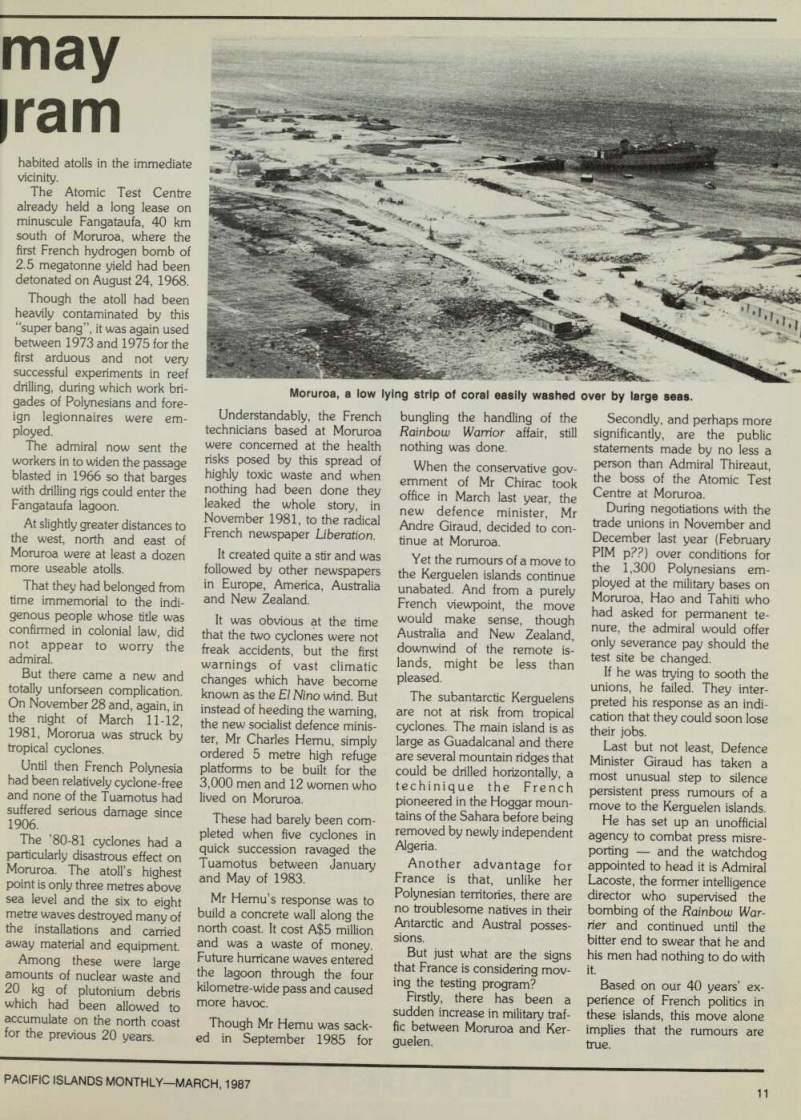
The ’BO-81 cyclones had a particularly disastrous effect on Moruroa. The atoll’s highest point is only three metres above sea level and the six to eight metre waves destroyed many of the installations and carried away material and equipment.
Among these were large amounts of nuclear waste and 20 kg of plutonium debris which had been allowed to accumulate on the north coast for the previous 20 years.
Understandably, the French technicians based at Moruroa were concerned at the health risks posed by this spread of highly toxic waste and when nothing had been done they leaked the whole story, in November 1981, to the radical French newspaper Liberation.
It created quite a stir and was followed by other newspapers in Europe, America, Australia and New Zealand.
It was obvious at the time that the two cyclones were not freak accidents, but the first warnings of vast climatic changes which have become known as the El Nino wind. But instead of heeding the warning, the new socialist defence minis ter, Mr Charles Hemu, simply ordered 5 metre high refuge platforms to be built for the 3,000 men and 12 women who lived on Moruroa.
These had barely been com pleted when five cyclones in quick succession ravaged the Tuamotus between January and May of 1983.
Mr Hemu’s response was to build a concrete wall along the north coast. It cost Ass million and was a waste of money.
Future hurricane waves entered the lagoon through the four kilometre-wide pass and caused more havoc.
Though Mr Hemu was sack ed in September 1985 for
bungling the handling of the Rainbow Warrior affair, still nothing was done.
When the conservative gov ernment of Mr Chirac took office in March last year, the new defence minister, Mr Andre Giraud, decided to con tinue at Moruroa.
Yet the rumours of a move to the Kerguelen islands continue unabated. And from a purely French viewpoint, the move would make sense, though Australia and New Zealand, downwind of the remote is lands, might be less than pleased.
The subantarctic Kerguelens are not at risk from tropical cyclones. The main island is as large as Guadalcanal and there are several mountain ridges that could be drilled horizontally, a techinique the French pioneered in the Hoggar moun tains of the Sahara before being removed by newly independent Algeria.
Another advantage for France is that, unlike her Polynesian territories, there are no troublesome natives in their Antarctic and Austral posses sions.
But just what are the signs that France is considering mov ing the testing program?
Firstly, there has been a sudden increase in military traf fic between Moruroa and Ker guelen.
Secondly, and perhaps more significantly, are the public statements made by no less a person than Admiral Thireaut, the boss of the Atomic Test Centre at Moruroa.
During negotiations with the trade unions in November and December last year (February FIM p??) over conditions for the 1,300 Polynesians em ployed at the military bases on Moruroa, Hao and Tahiti who had asked for permanent te nure, the admiral would offer only severance pay should the test site be changed.
If he was trying to sooth the unions, he failed. They inter preted his response as an indi cation that they could soon lose their jobs.
Last but not least, Defence Minister Giraud has taken a most unusual step to silence persistent press rumours of a move to the Kerguelen islands.
He has set up an unofficial agency to combat press misre porting and the watchdog appointed to head it is Admiral Lacoste, the former intelligence director who supervised the bombing of the Rainbow Wor rier and continued until the bitter end to swear that he and his men had nothing to do with it.
Based on our 40 years’ ex perience of French politics in these islands, this move alone implies that the rumours are true.
Moruroa, a low lying strip of coral easily washed over by large seas.