in the highlands
pp. 14-17 · Read in the full issue

Wingti: I’m boss in the highlands
Being prime minister for 18 months before facing a gen eral election is a tall order.
But Paias Wingti is prepared to stand on his record when he goes to the people in July, he told DENIS REINHARDT in an interview. Ex cerpts: PIM: People say that Somare is going to win. Is that a realistic view of what is happening in PNG?
Wingti: It depends on which people you are talking to, but the general feeling in the country is that when people have confidence in a govern ment, and have confidence in the leadership, then it is hard to defeat that government. The situation when Somare came to power in 1982 is quite different to the 1987 elections.
In ’B2 people were slowly losing confidence in that government be cause of infights within the govern ment. It created uncertainty.
Somare is known as the father of independence. He is widely known in the villages throughout the country. Are you as well known as he is?
Well, Somare is well known, I must say that. He’s well known he’s a household name because he’s been in politics for a long time. He was the man who fought for independence and self-government. That’s why his name is well known. But you are now dealing with a modern Papua New Guinea. The population that is going to have a bigger say in the elections and a bigger influence is the educated
population the grade six drop-outs, the high school leavers. The edu cated people are working and there are many educated people now throughout the country. These people are the opinion makers.
So is Somare a man of the past in Papua New Guinea terms?
Well Somare is ... as I have said many times when I was in opposition before change of government, So mare’s days are over. The problems that we are facing need leadership that can handle, and we have proved this over the last twelve months.
When the economy was in a state where financial institutions in ternational financial institutions like the World Bank, Asian Development Bank expressed concern, we were able to act decisively because we knew what we were talking about, we knew the problems and the leader ship at the time. Up to date we have handled these problems and people have admired this government. It’s hard for them to lose their confi dence.
Working from that base how are you going to overcome, in campaign terms, the power of Somare’s image in the village?
It’s hard. It’s hard in some parts like in the regions because in Papua New Guinea, apart from party poli tics, the other major force is persona lities.
It depends on which region you come from. I come from a very powerful region in the country.
You’re the first highlands prime minister. Many highlanders feel that they’ve been underrepresented in the national parliament until this stage.
We have 40 per cent up in the highlands. Out of a total of 109 members 39 come from that region.
That is a very strong base. If you look at that base and compare it with the ’B2 elections and when Sir Julius was in power they’re quite different things. The highlanders are in some ways more united and the majority of them are with me in government now. 1 see that as my base.
Do you think that the untimely death of Sir lambakey Okuk will see more highland unity behind you?
I think it’s sad we lost a great man.
All I can say is now the highlands people have only one leader and that’s me because when we were together, lambakey and myself, they looked at two leaders from that region and now people look at only one person. So in a way I think there is more unity.
So the key to you winning in the election is for you to command a very high majority of those 39 highland seats?
That’s quite true. I have to get a very high number from that region and then from Morobe, Madang.
Whoever is going to be Prime Minis ter in ’B7 is going to have above 20
members. 1 don’t see any party coming with a landslide victory like about 55. You won’t get that. There are many other smaller parties.
But if you have that highland base effectively what you’re doing is firming up a system in Papua New Guinea where there will be a lesser number of parties?
That would be true. What we’re doing now would help the situation to create less parties, strengthen those major parties in the country. In this election I think that is what is going to happen.
In your experience is it a problem for Papua New Guinea in its development that the multi party system with trade offs and dealings means that ministers and the government spend more time worrying about numbers and less time about government?
The best thing that could happen in this election is for the people of Papua New Guinea to give a clear mandate to either Somare or myself to run the country with one or two other parties which we can we have some very good leaders and stable parties. Most major parties like PPP, Pangu, People’s Democratic Movement which is a new party, but in terms of numbers has got the second highest on the floor of parlia ment have built up strength.
It’s a critical election because with the wealth of gold and oil and the strong rural base Papua New Guinea could be a very rich country within four or five years.
It’s a very critical election because the leadership in ’B7 and beyond has to pursue the policies we have pur
sued up to date. Because of popuia> tion growth in the country we have to get the economy moving as the economy can’t absorb this growing population and we have given that priority. If you don’t get the right leadership then it can go back to the old days when the others were in government. We have set our priori ties clear and any money that will come from the mining sector we see as a cash flow that will be directed to the banking system and then re-lent to farmers for rural development. And investment in farming that is a long term investment for the country.
Mining is exhaustable and we’re fully aware of this. But if you’ve a govern ment which is not clear, they can spend this quick cash flow on setting up some very expensive infrastructure and then when those resources are exhausted it’s hard to maintain that.
In terms of infrastructure, the Japan ese are offering to finance part, if not all of a trans nation highway. Is that the sort of infrastructure that is acceptable?
This particular project is a very important one because Port Moresby is the nation’s capital and we’ve been having some problems because there’s no major network in terms of road transport between one side of the country and the nation’s capital.
We have negotiated with the Japan ese. So that’s a very important project that the people of this country see.
If you do defeat Somare what do you think will happen to him?
Very hard for me to say. He’s a great man I have always said that.
He’s done a lot for the country.
Would you include him in your ministry?
He would really make a good foreign minister. I have the greatest respect for Mr Somare because I
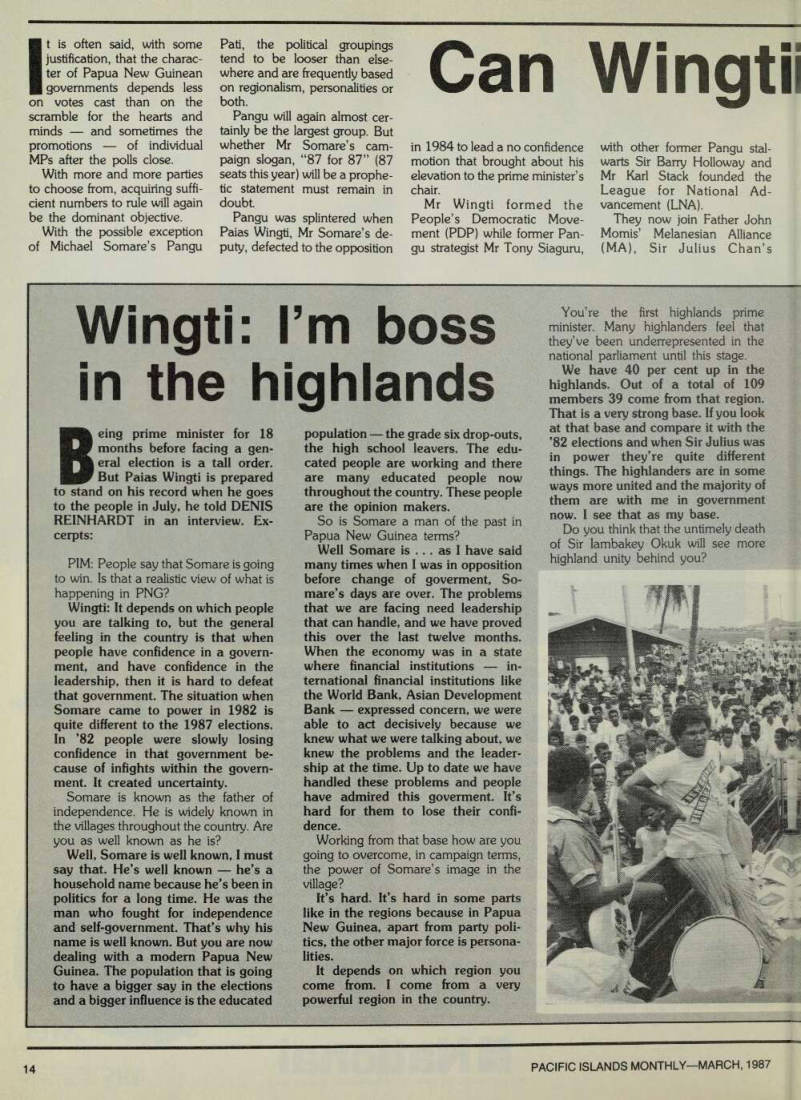
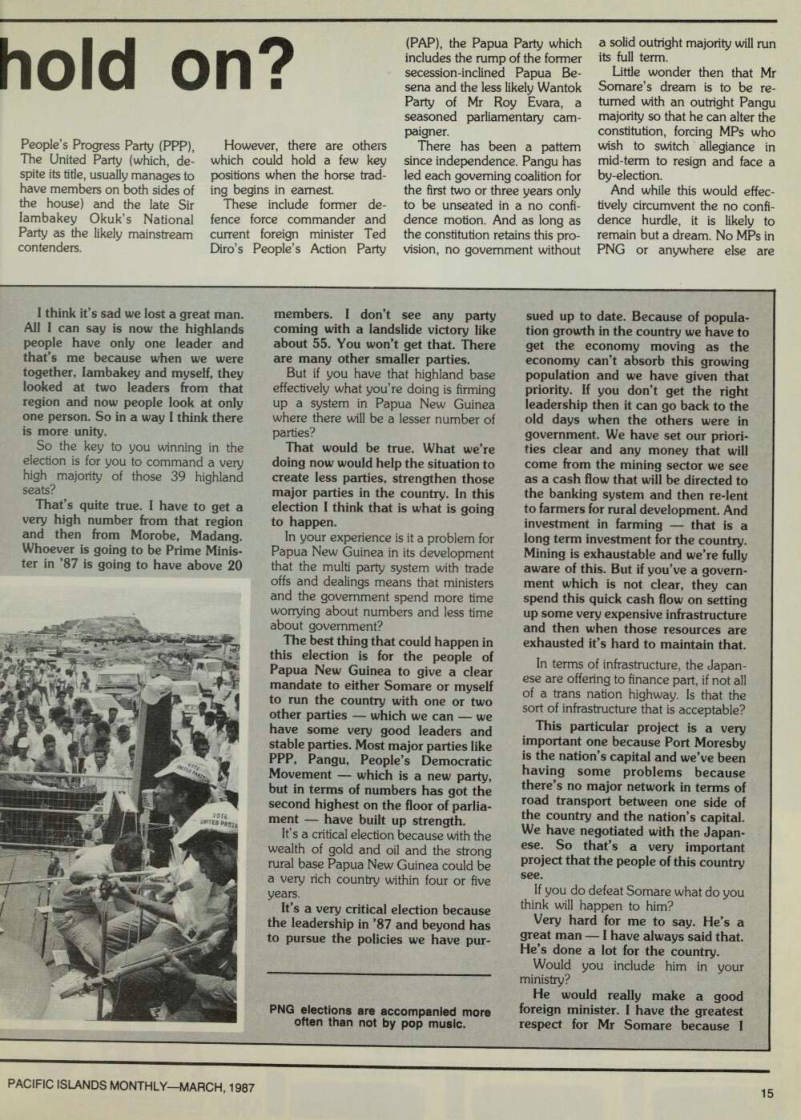
PNG elections are accompanied more often than not by pop music.
have worked with him and I have learned a lot from him.
Do you think he would serve under you having been your mentor at one stage?
We get along very well. I must say this. I have nothing against Mr Somare. I mean politically. OK, when we’re facing each other on the floor of parliament, but in terms of our friend ship and our respect for each other we maintain that.
Do you think he’s locked on the course of having to fight this election when he really doesn’t want to?
I don’t think he’s locked in.
You mean there is a chance of negotiation before the election?
Well, not that. All I’m saying is that he’s in opposition. I’ve got five parties that I’m leading and I have to remember my commitment. My first priority is to the people who have put me as prime minister and I have worked with them very well. I have to respect those people that I’ve been working with. That’s why I’ve got to maintain that loyalty between my own men.
You’ve had to sack and demote several ministers. Are you trying to uphold a new set of standards?
Well we’ve done that when we were in opposition. I have said the first priority is to get the economy mov ing, second to set the highest stan dard of leadership, and we have maintained these. Where ministers’ reputations are questionable, and where doubts have been raised about them and if there are enough docu ments to indicate that they have done something wrong, or they’ve not been cleared enough, it is my responsibility to ask them to step aside. I have done that for several ministers and when they are cleared I bring them back into the ministry again.
In terms of foreign policy you’ve effectively defused Irian Jaya as a major issue for PNG?
This goverment has made some very independent decisions. The difference between my government and the previous administration are the decisions that this government has taken are basically independent decisions based on the interests of the people of this country. We have made a decision on the border. Yes, we have defused the whole situation.
But Irian Jayans still continue to come across?
They still come across, but all I’m saying is that this is no longer the same—getting headlines every day.
We were wasting our resources looking after those people.
Are you saying you have nothing to We’ve got nothing to hide. In fact in our foreign policy, particularly on that issue, we are open. We have taken some stands on other matters like the New Caledonia issue. That issue has never been put forward forcefully by the previous administration. It was my government that took
the initiative to invite the Solomons Islands prime minister, and the Vanuatu prime minister to discus sions.
T . . , T • i resettlement of h™ Japans is to 9 °, ahead m PNG and lts the best S ° U ° n ' It’s the best solution. Not resettle ment, but we have to find them locations where detailed assessment has to be made and find out what a genuine refugee is. And that process * s still taking place, although we are not very encouraged by the slowness °f actions taken by the UN High Commission for Refugees, ti , ... . , , TT „ , , * s un l^e *hat the UNHCR will find third countries for many of those people?
Some they would find. They are still trying. Others it may be difficult, Our action on the border issue has strengthened relations between In donesia and PNG. There is no more suspicious feeling about each other, Our relationship with Indonesia, like our relationship with Australia over the last twelve months, has matured.
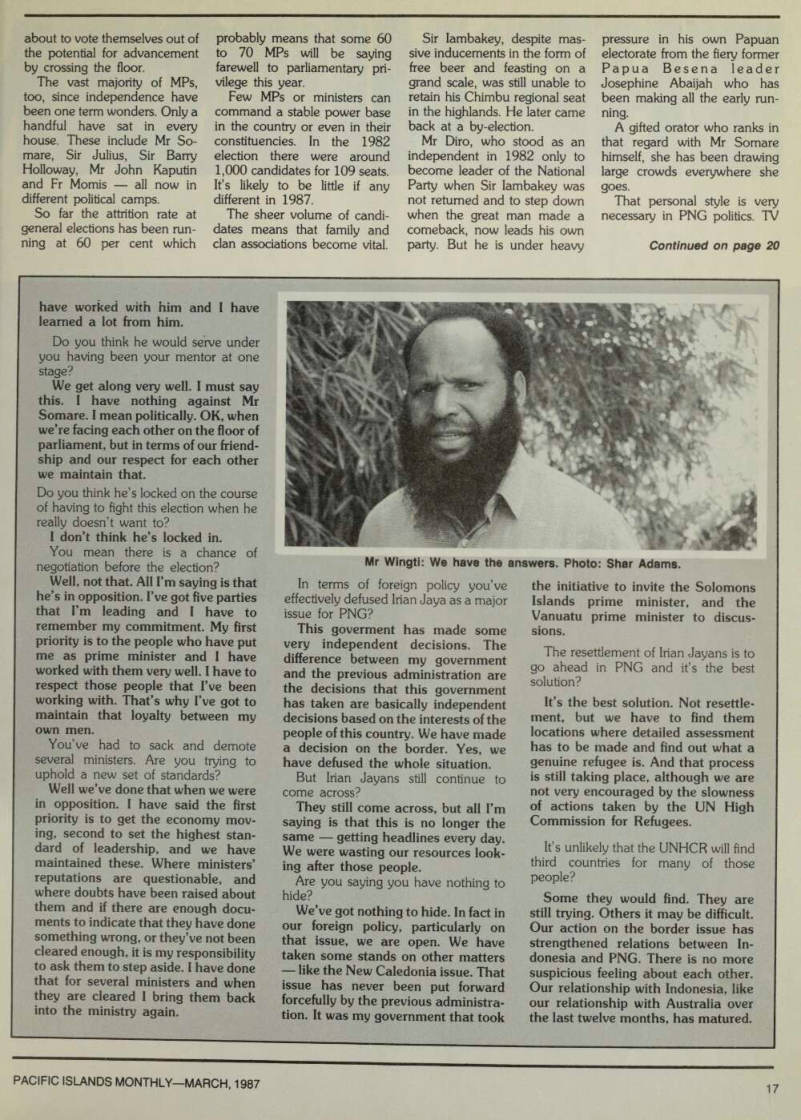
Mr Wingti: We have the answers. Photo: Shar Adams.