An attempt to keep
pp. 40-42 · Read in the full issue

Australia’s Monroe doctrine:
An attempt to keep the islands English
French accusations of Australian ambitions in the Pacific are not new.
Since before Australia became a nation, French settlers in the region have sus pected the English speakers of wanting them out. Whatever the current think ing, there was once good reason for French suspicians. Chris Coulthard- Clark recalls Australia’s own Monroe doctrine.
From the time of British settlement, Australian colonists lived in apprehension of designs that other powers might have on their distant outpost in the Pacific in the event of a war in Europe. During the late nineteenth century, the rush for Pacific island territories by Bri tain’s rivals Germany and France even gave rise to an Australian version of the “Mon roe Doctrine”, promulgated at an intercolonial convention at Sydney in 1883.
As one recent historian has noted: “Unlike its American model . . . Australian spread eagleism did not in any signifi cant degree reflect an aggres sive and self-righteous demo cratic morality. Even imperial patriotism, the desire to extend the area of British civilisation and order, was but a minor ingredient in Australian mo tives. The chief object of the colonial policy of annexation was simply defensive, to ex clude all other foreign powers from the region.”
Without an underpinning of notions of manifest destiny, Australia’s “Monroe Doctrine” became largely irrelevant or at least inoperable once the island groups of principal con cern to it had been snapped up by colonising powers and their fate decided. This was a process which was completed by the 1890 s.
France might well have been surprised, therefore, to discover in 1902 an Australian army officer, Major William Bridges, spying against its possession of
New Caledonia. Under the guise of repre senting the Sydney-based firm of Dalgety & Co. Ltd., which had nickel-mining interests on the island, Bridges spent some five weeks during May and June under orders to carry out “a careful and complete Military Survey of New Caledonia gener ally and of Noumea in particular”.
Although undisclosed records may prove to the contrary, there is no evidence that the local authorities became aware of Bridges’ real identity and purpose. Had they done so, however, they may have been prompted to speculate about the possible military intentions of the new federal government in Australia, then into only the second year of its existence.
Could it be that the former colonial policy of exclusion was not a dead letter, that it had been revived or taken on new impetus with nationhood? Could Australia actually be contemplating an attempt at military seizure of New Caledonia?
The answers the French might have arrived at in response to such questions could well have been misleading, for the presence of an Australian officer on the island owed nothing to any initiative of the Australian government. In fact, Bridges’ despatch had come about in response to a request from the War Office in London directly to the British commander of the Commonwealth military forces, Major General Sir Edward Hutton. Nor is there any evidence that the Australian govern ment was ever advised that one of its soldiers had been sought for such employ ment.
Hutton contrived to keep the govern ment in the dark by placing Bridges on sick leave and arranging for his cover through the old-boy network of Sydney Anglophiles. As it chanced, the managing director of Dalgetys was both a militia officer in the New South Wales Lancers regiment and a son of the founder of the Colonial Sugar Refining Co., Sir Edward Knox.
In these circumstances Bridges’ status in the local forces was incidental to the fact that on this occasion he was a servant of the British, not the Australian authorities.
The use of local officers on special undertakings of this nature was not without precedent, least of all in Bridges’ case.
Later references by Bridges to a visit he made to Samoa in mid-1898, ostensibly on leave, and the fact that he met on this trip with the rebel chief, Tupua Tamasese Lealofi, just six months before civil war erupted there between factions backed by Britain, the United States and Germany, indicates that he had probably been involved previously in a secret mission similar to that on which he was engaged in New Caledonia.
Whether his participation in this earlier mission had been with the knowledge of
the New South Wales government of the day is not known, but seems unlikely. That Bridges’ demonstrated commitment to im perial policies transcended his loyalties to his country of adoption (he was bom in Scotland into the family of a Royal Navy officer) made him a very suitable accom plice for General Hutton’s purposes.
Viewed in the context of Anglo-French relations of the period, British espionage against France’s overseas possessions (attention which France no doubt recipro cated) was quite understandable. In the face of strained relations in which military action against each other in some quarter was at least thinkable, even if outright war was not actually likely, it can well be imagined that colonial assets such as New Caledonia would come in for scrutiny.
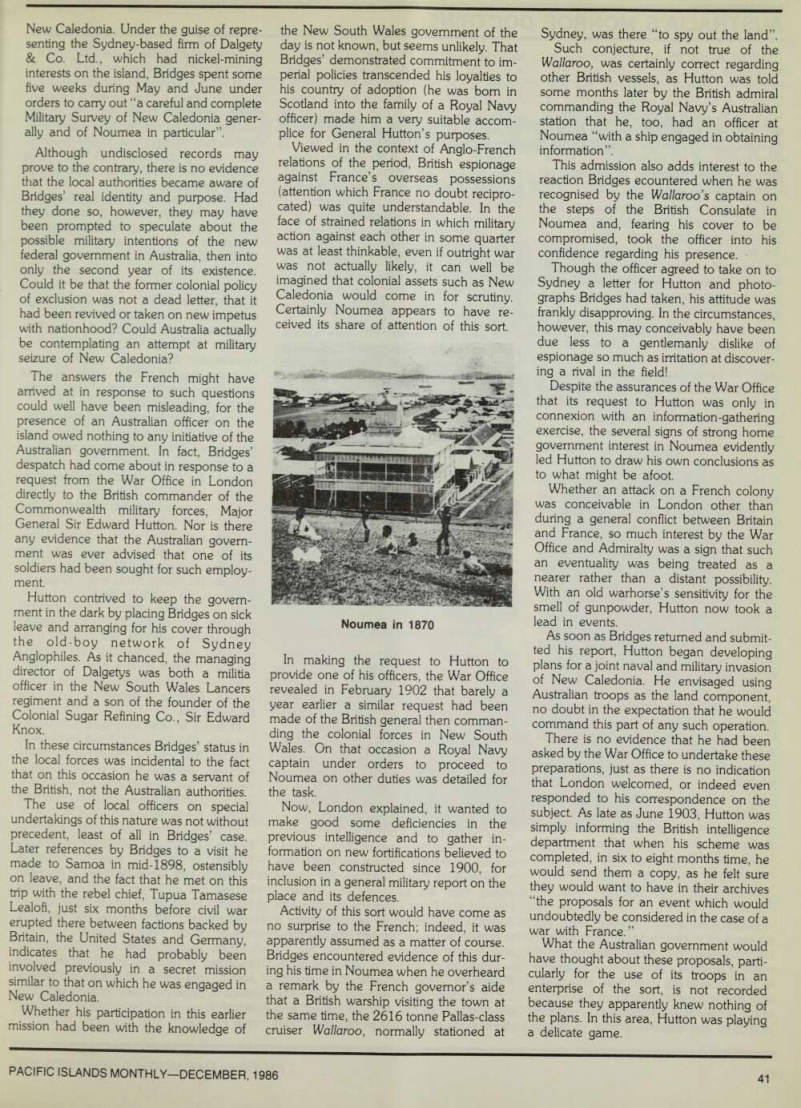
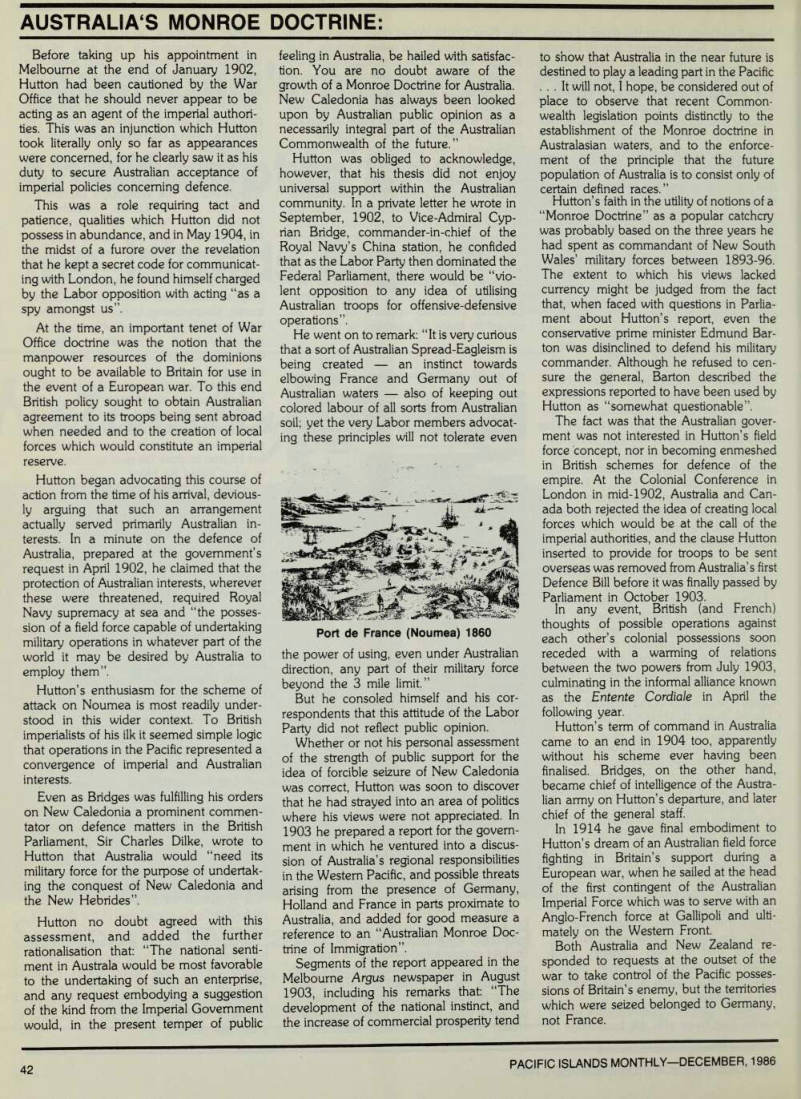
Certainly Noumea appears to have re ceived its share of attention of this sort.
In making the request to Hutton to provide one of his officers, the War Office revealed in February 1902 that barely a year earlier a similar request had been made of the British general then comman ding the colonial forces in New South Wales. On that occasion a Royal Navy captain under orders to proceed to Noumea on other duties was detailed for the task.
Now, London explained, it wanted to make good some deficiencies in the previous intelligence and to gather in formation on new fortifications believed to have been constructed since 1900, for inclusion in a general military report on the place and its defences.
Activity of this sort would have come as no surprise to the French; indeed, it was apparently assumed as a matter of course.
Bridges encountered evidence of this dur ing his time in Noumea when he overheard a remark by the French governor’s aide that a British warship visiting the town at the same time, the 2616 tonne Pallas-class cruiser Wallaroo, normally stationed at
Sydney, was there “to spy out the land”.
Such conjecture, if not true of the Wallaroo, was certainly correct regarding other British vessels, as Hutton was told some months later by the British admiral commanding the Royal Navy’s Australian station that he, too, had an officer at Noumea “with a ship engaged in obtaining information”.
This admission also adds interest to the reaction Bridges ecountered when he was recognised by the Wallaroo’s captain on the steps of the British Consulate in Noumea and, fearing his cover to be compromised, took the officer into his confidence regarding his presence.
Though the officer agreed to take on to Sydney a letter for Hutton and photo graphs Bridges had taken, his attitude was frankly disapproving. In the circumstances, however, this may conceivably have been due less to a gentlemanly dislike of espionage so much as irritation at discover ing a rival in the field!
Despite the assurances of the War Office that its request to Hutton was only in connexion with an information-gathering exercise, the several signs of strong home government interest in Noumea evidently led Hutton to draw his own conclusions as to what might be afoot.
Whether an attack on a French colony was conceivable in London other than during a general conflict between Britain and France, so much interest by the War Office and Admiralty was a sign that such an eventuality was being treated as a nearer rather than a distant possibility.
With an old warhorse’s sensitivity for the smell of gunpowder, Hutton now took a lead in events.
As soon as Bridges returned and submit ted his report, Hutton began developing plans for a joint naval and military invasion of New Caledonia. He envisaged using Australian troops as the land component, no doubt in the expectation that he would command this part of any such operation.
There is no evidence that he had been asked by the War Office to undertake these preparations, just as there is no indication that London welcomed, or indeed even responded to his correspondence on the subject. As late as June 1903, Hutton was simply informing the British intelligence department that when his scheme was completed, in six to eight months time, he would send them a copy, as he felt sure they would want to have in their archives “the proposals for an event which would undoubtedly be considered in the case of a war with France.”
What the Australian government would have thought about these proposals, parti cularly for the use of its troops in an enterprise of the sort, is not recorded because they apparently knew nothing of the plans. In this area, Hutton was playing a delicate game.
Noumea in 1870
Before taking up his appointment in Melbourne at the end of January 1902, Hutton had been cautioned by the War Office that he should never appear to be acting as an agent of the imperial authori ties. This was an injunction which Hutton took literally only so far as appearances were concerned, for he clearly saw it as his duty to secure Australian acceptance of imperial policies concerning defence.
This was a role requiring tact and patience, qualities which Hutton did not possess in abundance, and in May 1904, in the midst of a furore over the revelation that he kept a secret code for communicat ing with London, he found himself charged by the Labor opposition with acting “as a spy amongst us”.
At the time, an important tenet of War Office doctrine was the notion that the manpower resources of the dominions ought to be available to Britain for use in the event of a European war. To this end British policy sought to obtain Australian agreement to its troops being sent abroad when needed and to the creation of local forces which would constitute an imperial reserve.
Hutton began advocating this course of action from the time of his arrival, devious ly arguing that such an arrangement actually served primarily Australian in terests. In a minute on the defence of Australia, prepared at the government’s request in April 1902, he claimed that the protection of Australian interests, wherever these were threatened, required Royal Navy supremacy at sea and “the posses sion of a field force capable of undertaking military operations in whatever part of the world it may be desired by Australia to employ them”.
Hutton’s enthusiasm for the scheme of attack on Noumea is most readily under stood in this wider context. To British imperialists of his ilk it seemed simple logic that operations in the Pacific represented a convergence of imperial and Australian interests.
Even as Bridges was fulfilling his orders on New Caledonia a prominent commen tator on defence matters in the British Parliament, Sir Charles Dilke, wrote to Hutton that Australia would “need its military force for the purpose of undertak ing the conquest of New Caledonia and the New Hebrides”.
Hutton no doubt agreed with this assessment, and added the further rationalisation that: “The national senti ment in Australa would be most favorable to the undertaking of such an enterprise, and any request embodying a suggestion of the kind from the Imperial Government would, in the present temper of public
feeling in Australia, be hailed with satisfac tion. You are no doubt aware of the growth of a Monroe Doctrine for Australia.
New Caledonia has always been looked upon by Australian public opinion as a necessarily integral part of the Australian Commonwealth of the future.”
Hutton was obliged to acknowledge, however, that his thesis did not enjoy universal support within the Australian community. In a private letter he wrote in September, 1902, to Vice-Admiral Cyp rian Bridge, commander-in-chief of the Royal Navy’s China station, he confided that as the Labor Party then dominated the Federal Parliament, there would be “vio lent opposition to any idea of utilising Australian troops for offensive-defensive operations”.
He went on to remark: “It is very curious that a sort of Australian Spread-Eagleism is being created an instinct towards elbowing France and Germany out of Australian waters also of keeping out colored labour of all sorts from Australian soil; yet the very Labor members advocat ing these principles will not tolerate even
the power of using, even under Australian direction, any part of their military force beyond the 3 mile limit.”
But he consoled himself and his cor respondents that this attitude of the Labor Party did not reflect public opinion.
Whether or not his personal assessment of the strength of public support for the idea of forcible seizure of New Caledonia was correct, Hutton was soon to discover that he had strayed into an area of politics where his views were not appreciated. In 1903 he prepared a report for the govern ment in which he ventured into a discus sion of Australia’s regional responsibilities in the Western Pacific, and possible threats arising from the presence of Germany, Holland and France in parts proximate to Australia, and added for good measure a reference to an “Australian Monroe Doc trine of Immigration”.
Segments of the report appeared in the Melbourne Argus newspaper in August 1903, including his remarks that: “The development of the national instinct, and the increase of commercial prosperity tend
to show that Australia in the near future is destined to play a leading part in the Pacific . . . It will not, I hope, be considered out of place to observe that recent Common wealth legislation points distinctly to the establishment of the Monroe doctrine in Australasian waters, and to the enforce ment of the principle that the future population of Australia is to consist only of certain defined races.”
Hutton’s faith in the utility of notions of a “Monroe Doctrine” as a popular catchcry was probably based on the three years he had spent as commandant of New South Wales’ military forces between 1893-96.
The extent to which his views lacked currency might be judged from the fact that, when faced with questions in Parlia ment about Hutton’s report, even the conservative prime minister Edmund Bar ton was disinclined to defend his military commander. Although he refused to cen sure the general, Barton described the expressions reported to have been used by Hutton as “somewhat questionable”.
The fact was that the Australian gover nment was not interested in Hutton’s field force concept, nor in becoming enmeshed in British schemes for defence of the empire. At the Colonial Conference in London in mid-1902, Australia and Can ada both rejected the idea of creating local forces which would be at the call of the imperial authorities, and the clause Hutton inserted to provide for troops to be sent overseas was removed from Australia’s first Defence Bill before it was finally passed by Parliament in October 1903.
In any event, British (and French) thoughts of possible operations against each other’s colonial possessions soon receded with a warming of relations between the two powers from July 1903, culminating in the informal alliance known as the Entente Cordiale in April the following year.
Hutton’s term of command in Australia came to an end in 1904 too, apparently without his scheme ever having been finalised. Bridges, on the other hand, became chief of intelligence of the Austra lian army on Hutton’s departure, and later chief of the general staff.
In 1914 he gave final embodiment to Hutton’s dream of an Australian field force fighting in Britain’s support during a European war, when he sailed at the head of the first contingent of the Australian Imperial Force which was to serve with an Anglo-French force at Gallipoli and ulti mately on the Western Front.
Both Australia and New Zealand re sponded to requests at the outset of the war to take control of the Pacific posses sions of Britain’s enemy, but the territories which were seized belonged to Germany, not France.
Port de France (Noumea) 1860