books
pp. 43-46 · Read in the full issue


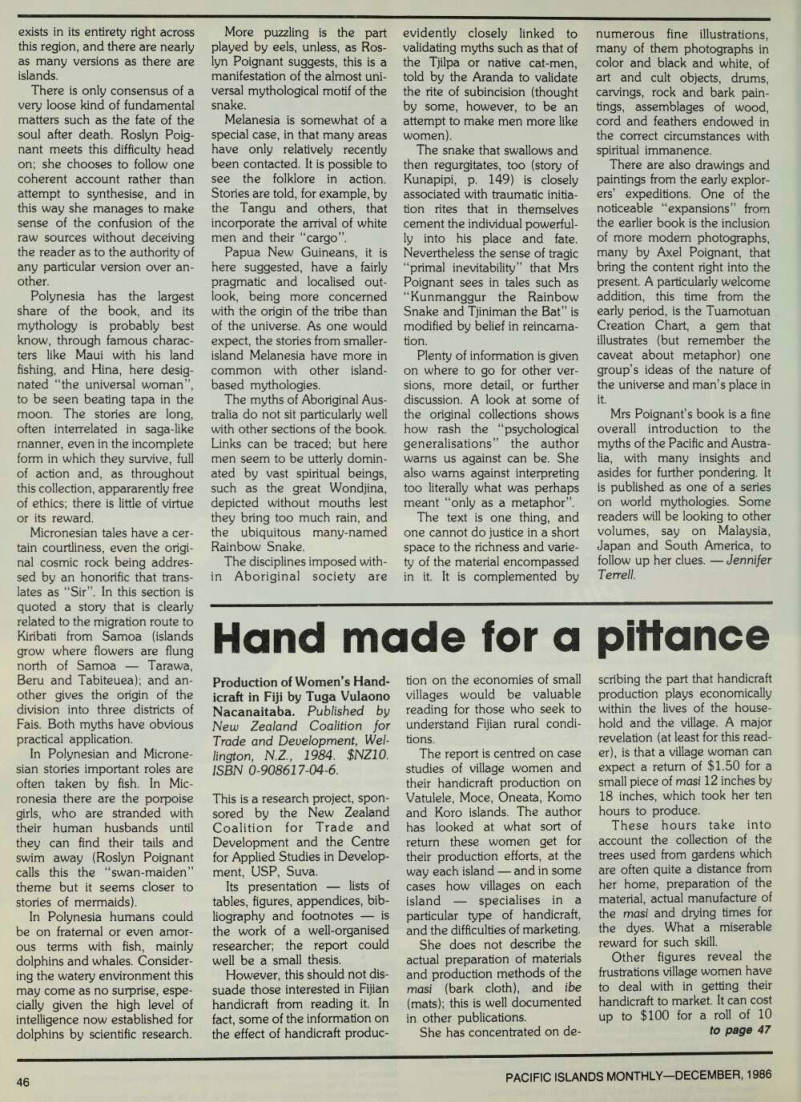
Oceanic and Australasian Mythology. By Roslyn Poig nant. Library of the Worlds Myths and Legends. Flatham, Middlesex, Newnes Books, 1985.
Myths have long been recog nised as keys to human preoccupations.
Rosalyn Poignant is an authority on the mythology of the Pacific Islands and Australa sian region, and Oceanic and Australasian Mythology is an expansion of an earlier book on the subject published some twenty years ago.
It has been extensively re vised to take account of deve lopments during that time, for example in island autonomy and respect for indigenous cul ture. The Land Rights move ment in Australia has focused attention on Aboriginal myths, linked as they are to every detail of the landscape.
In the Pacific islands leaders have asserted their independ ence of thinking on issues such as the nuclear threat. All this has made the study of myths far from esoteric, for, as Mrs Poig nant points out, they can be sensitive indicators of group and even national identity.
It is important, therefore, that they should be rightly under stood as far as possible accor ding to the perceptions of the people who produced and were influenced by them, and this book goes a long way towards bringing this about.
A general introduction covers the prehistory of the area, tak ing account of recent advances in knowledge about settlement of the Pacific; followed by an outline of European discovery with its often drastic consequ ences both for populations and their mythologies.
The worst effects of contact were eventually tempered by attempts to save both the people, physically and spiritual ly, and their stories, which from quite early on caught the im agination and were sporadically recorded.
William Ellis, a pioneer mis-
sionary in Tahiti, thought the fables of the Tahitians were comparable to “the dazzling mythologies of the east.”
Having laid the historical background, and sketched in the present, Mrs Poignant goes on to discuss, for each of the areas into which the book is divided, the pre-contact culture and cosmic beliefs, which she interweaves with examples of the stories themselves. Her own
narrative art is consummate, and the net result is informative and entertaining.
The book falls fairly naturally into sections: Polynesia, Micronesia; Melanesia and Australia. The area divisions cannot be hard and fast, and story elements, notorious will o’ the wisps, cross the artificial boundaries - The Trobrianders, for exampie, knew of a very dangerous
island of women just beyond their immediate locality that recalls the island of women of the Marquesan Kae story. Such is the stuff of comparative mythology. But the author does find it possible to make some interesting distinctions, A major problem in the mythology of the Pacific Is lands, especially of Polynesia, it is bewildering diversity. It has been said that no one story
exists in its entirety right across this region, and there are nearly as many versions as there are islands.
There is only consensus of a very loose kind of fundamental matters such as the fate of the soul after death. Roslyn Poig nant meets this difficulty head on; she chooses to follow one coherent account rather than attempt to synthesise, and in this way she manages to make sense of the confusion of the raw sources without deceiving the reader as to the authority of any particular version over an other.
Polynesia has the largest share of the book, and its mythology is probably best know, through famous charac ters like Maui with his land fishing, and Hina, here desig nated “the universal woman”, to be seen beating tapa in the moon. The stories are long, often interrelated in saga-like manner, even in the incomplete form in which they survive, full of action and, as throughout this collection, appararently free of ethics; there is little of virtue or its reward.
Micronesian tales have a cer tain courtliness, even the origi nal cosmic rock being addres sed by an honorific that trans lates as “Sir”. In this section is quoted a story that is clearly related to the migration route to Kiribati from Samoa (islands grow where flowers are flung north of Samoa Tarawa, Bern and Tabiteuea); and an other gives the origin of the division into three districts of Fais. Both myths have obvious practical application.
In Polynesian and Microne sian stories important roles are often taken by fish. In Mic ronesia there are the porpoise girls, who are stranded with their human husbands until they can find their tails and swim away (Roslyn Poignant calls this the “swan-maiden” theme but it seems closer to stories of mermaids).
In Polynesia humans could be on fraternal or even amor ous terms with fish, mainly dolphins and whales. Consider ing the watery environment this may come as no surprise, espe cially given the high level of intelligence now established for dolphins by scientific research.
More puzzling is the part played by eels, unless, as Ros lyn Poignant suggests, this is a manifestation of the almost uni versal mythological motif of the snake.
Melanesia is somewhat of a special case, in that many areas have only relatively recently been contacted. It is possible to see the folklore in action.
Stories are told, for example, by the Tangu and others, that incorporate the arrival of white men and their “cargo”.
Papua New Guineans, it is here suggested, have a fairly pragmatic and localised out look, being more concerned with the origin of the tribe than of the universe. As one would expect, the stories from smaller island Melanesia have more in common with other island based mythologies.
The myths of Aboriginal Aus tralia do not sit particularly well with other sections of the book.
Links can be traced; but here men seem to be utterly domin ated by vast spiritual beings, such as the great Wondjina, depicted without mouths lest they bring too much rain, and the übiquitous many-named Rainbow Snake.
The disciplines imposed with in Aboriginal society are
evidently closely linked to validating myths such as that of the Tjilpa or native cat-men, told by the Aranda to validate the rite of subincision (thought by some, however, to be an attempt to make men more like women).
The snake that swallows and then regurgitates, too (story of Kunapipi, p. 149) is closely associated with traumatic initia tion rites that in themselves cement the individual powerful ly into his place and fate.
Nevertheless the sense of tragic “primal inevitability” that Mrs Poignant sees in tales such as “Kunmanggur the Rainbow Snake and Tjiniman the Bat” is modified by belief in reincarna tion.
Plenty of information is given on where to go for other ver sions, more detail, or further discussion. A look at some of the original collections shows how rash the “psychological generalisations” the author warns us against can be. She also warns against interpreting too literally what was perhaps meant “only as a metaphor”.
The text is one thing, and one cannot do justice in a short space to the richness and varie ty of the material encompassed in it. It is complemented by
numerous fine illustrations, many of them photographs in color and black and white, of art and cult objects, drums, carvings, rock and bark pain tings, assemblages of wood, cord and feathers endowed in the correct circumstances with spiritual immanence.
There are also drawings and paintings from the early explor ers’ expeditions. One of the noticeable “expansions” from the earlier book is the inclusion of more modem photographs, many by Axel Poignant, that bring the content right into the present. A particularly welcome addition, this time from the early period, is the Tuamotuan Creation Chart, a gem that illustrates (but remember the caveat about metaphor) one group’s ideas of the nature of the universe and man’s place in it.
Mrs Poignant’s book is a fine overall introduction to the myths of the Pacific and Austra lia, with many insights and asides for further pondering. It is published as one of a series on world mythologies. Some readers will be looking to other volumes, say on Malaysia, Japan and South America, to
follow up her clues.
Jennifer
Terrell.