a spymaster
pp. 38-39 · Read in the full issue

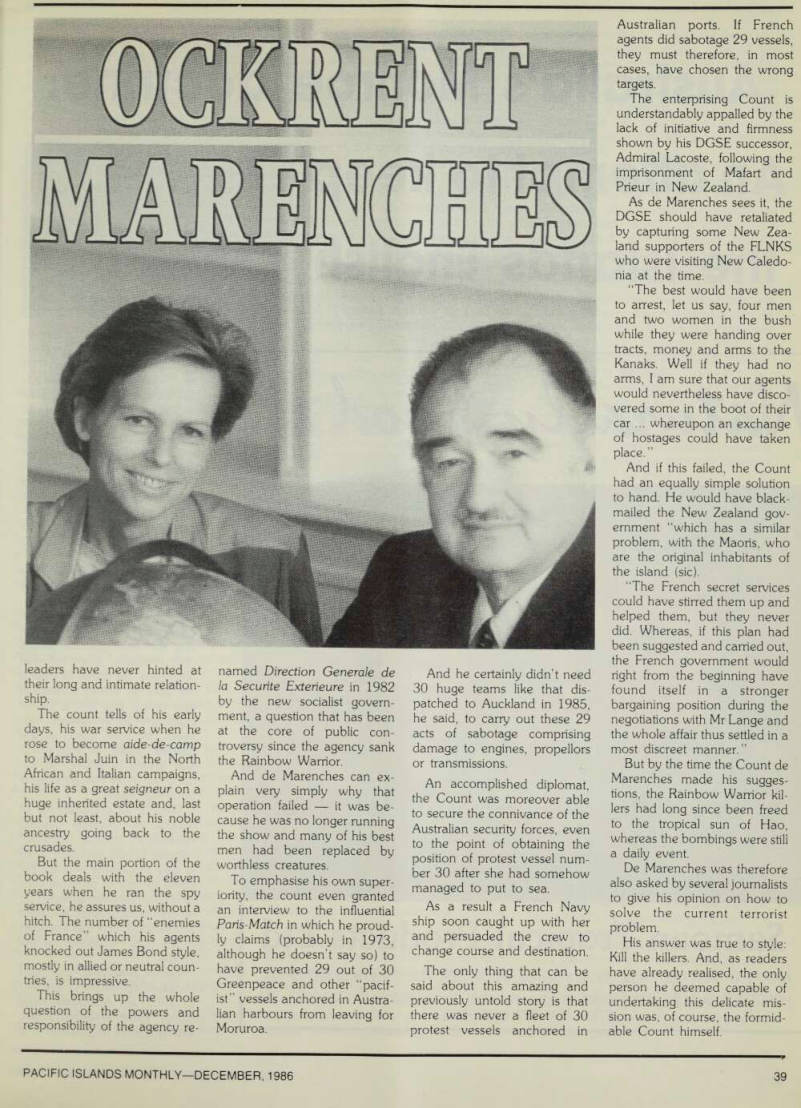
Confessions of a spymaster
Did French agents sabotage 29 foreign vessels in Australian harbours long before the notorious Rainbow Warrior scandal? MARIE-THERESE and BENGT DANIELSSON, recently returned from Paris,report that a former French espionage chief says that they did but that, as in the case of the Auckland bombing it may have gone very wrong.
In Paris recently we experi enced a strong sense of what the French call deja vu. We recalled the 1961 scenes of screaming ambulances racing through the streets with heavily armed police and troops guar ding all public buildings.
That was when French diehards from Algeria vented their anger over the loss of what they considered their home by killing innocent people in the streets of Paris.
Once again, it is France’s involvement with the Arab world that has sparked off simi lar terrorist incidents.
It was France’s continued arms sales to Iraq that had made her the mortal enemy of Iran, Iraq’s bitter opponent in the protracted Gulf War.
During those agitated weeks in Paris there also gushed forth a steady flow of books and articles about another category of terrorist the French secret agents working for the various intelligence services with which France is so richly endowed.
Incredibly enough at least
for us the authors of these colourful and highly critical accounts agreed on one point: that while an Arab bomb throw er is invariably labelled a terror ist, his French counterpart is always a patriot and often even a national hero.
This highly dubious distinc tion was most forcefully argued by two public men who, during the De Gaulle and Pompidou era, helped formulate French policy.
The first, Deputy Alain Peyrefitte, has been a cabinet minister no fewer than seven times but today exerts his pow er mainly by writing editorials and features in the widely read right-wing newspaper Le Figaro.
As a measure of his philoso
phy, he consistently calls the pro-independence Kanaks of New Caledonia terrorists.
However, he sees nothing wrong in the activities of French agents and was the first promin ent French politician to travel to Hao after the release of Major Alain Mafart and Captain Dominique Prieur.
Incidentally his son, Benoit, is press officer at the French Ato mic Test Centre (CEP) and is, among other things, entrusted with the strategic task of trans lating into French for publication in a military news letter all our contributions to
Pim.
So far, no translation rights have come our way, but we mind this less than the numer ous errors these French ver sions contain.
Another public servant who has made an even bigger splash in the French media in recent months has been the former boss (1970-81) of the agency for foreign intelligence opera tions (then called the SDECE),
Count Alexandre de Maren ches. And he did so by plunging into the still murky waters of the Rainbow Warrior scandal.
The normal rule for agents is silence, so there were a few gasps of surprise when de Marenches came out of the dark by publishing his memoirs as told to right wing journalist Christine Ockrent who had also been able to put questions to him.
The book, Dans le Secret des Princes curiously enough alludes not so much to his work as a spymaster but to his activities since he resigned (or was forced to) in 1981 when the socialists came to power.
As his awe-struck ghost writer explains, the Count has spent his life since then advising free of charge the leaders of the free world, most notably President Reagan, Mrs Thatch er and the kings of Spain and Morocco of communist plots.
We must conclude that it is exclusively out of gratitude to the benevolent count that these
leaders have never hinted at their long and intimate relationship- The count tells of his early days, his war service when he rose to become aide-de-camp to Marshal Juin in the North African and Italian campaigns, his life as a great seigneur on a huge inherited estate and, last but not least, about his noble ancestry going back to the crusades.
But the main portion of the book deals with the eleven years when he ran the spy service, he assures us, without a hitch. The number of enemies of France which his agents knocked out James Bond style, mostly in allied or neutral countries, is impressive.
This brings up the whole question of the powers and responsibility of the agency re-
named Direction Generate de la Securite Exterieure in 1982 by the new socialist govern ment, a question that has been at the core of public con troversy since the agency sank the Rainbow Warrior.
And de Marenches can ex plain very simply why that operation failed it was be cause he was no longer running the show and many of his best men had been replaced by worthless creatures, To emphasise his own super iority, the count even granted an interview to the influential Paris-Match in which he proud ly claims (probably in 1973, although he doesn’t say so) to have prevented 29 out of 30 Greenpeace and other “pacif ist” vessels anchored in Austra- Han harbours from leaving for Moruroa.
And he certainly didn’t need 30 huge teams like that dis patched to Auckland in 1985, he said, to carry out these 29 acts of sabotage comprising damage to engines, propellers or transmissions.
An accomplished diplomat, the Count was moreover able to secure the connivance of the Australian security forces, even to the point of obtaining the position of protest vessel num ber 30 after she had somehow managed to put to sea.
As a result a French Navy ship soon caught up with her and persuaded the crew to change course and destination.
The only thing that can be said about this amazing and previously untold story is that there was never a fleet of 30 protest vessels anchored in
Australian ports. If French agents did sabotage 29 vessels, they must therefore, in most cases, have chosen the wrong targets.
The enterprising Count is understandably appalled by the lack of initiative and firmness shown by his DGSE successor, Admiral Lacoste, following the imprisonment of Mafart and Prieur in New Zealand.
As de Marenches sees it, the DGSE should have retaliated by capturing some New Zea land supporters of the FLNKS who were visiting New Caledo nia at the time.
“The best would have been to arrest, let us say, four men and two women in the bush while they were handing over tracts, money and arms to the Kanaks. Well if they had no arms, I am sure that our agents would nevertheless have disco vered some in the boot of their car ... whereupon an exchange of hostages could have taken place.”
And if this failed, the Count had an equally simple solution to hand. He would have black mailed the New Zealand gov ernment “which has a similar problem, with the Maoris, who are the original inhabitants of the island (sic).
“The French secret services could have stirred them up and helped them, but they never did. Whereas, if this plan had been suggested and carried out, the French government would right from the beginning have found itself in a stronger bargaining position during the negotiations with Mr Lange and the whole affair thus settled in a most discreet manner.”
But by the time the Count de Marenches made his sugges tions, the Rainbow Warrior kil lers had long since been freed to the tropical sun of Hao, whereas the bombings were still a daily event.
De Marenches was therefore also asked by several journalists to give his opinion on how to solve the current terrorist problem.
His answer was true to style: Kill the killers. And, as readers have already realised, the only person he deemed capable of undertaking this delicate mis sion was, of course, the formid able Count himself.