haven
pp. 44-45 · Read in the full issue
The last haven on earth
The arrival of the first Cook Islands Internatio nal 767 flight at Raroton ga on August 16 marked what many hope is the start of a new era in the country’s tour ism industry.
With it came the first load of Australian visitors to travel direct from Sydney and the prospect of another 211 a week on the new service.
For an industry which had watched with alarm the 20 per cent decline of New Zealand visitors in the first six months of this year, it was a welcome sight.
Amid an enthusiastic recep tion for the flight, Cook Islands Prime Minister, Sir Thomas Davis, told inaugural guests and those who braved the rain to welcome them, that the service will provide a key role in the development of tourism and trade. Transport came first, he said.
The airline is wholly owned by the Cook Islands Govern ment who have signed an agreement with Ansett Airlines to provide a Boeing 767 and crew, and to operate, manage and market the new venture.
Using the slogan “we’re just one big happy family,” Cook Islands International has started with weekly Sydney and Auck land flights and has announced plans to extend operations to the United States.
But before that happens, the ratio of airline seats to accommodation available de mands that more hotel/motel rooms be built.
The Cook Islands are cur rently serviced by four Air New Zealand flights a week (two from Auckland and one from Auckland via Nadi and back from Papeete), two Air Nauru flights which originate in Auck land but reach Rarotonga via Niue and Pago Pago and one Polynesian Airlines flight from Apia which starts in Brisbane.
The bulk of the 29,000 visi tors arrive on Air New Zealand and Cook Islands International and the Tourist Authority esti mates that with a 70 per cent load factor, these two airlines can bring 47,000 people to the country each year.
On the current averages of
1.8 people staying 10 nights in each room, the Cook Islands would need 261,000 room nights of accommodation avail able and be running at 100 per cent room occupancy.
There are now 540 rooms in the Cooks, which works out at 197,000 room nights.
The figures can, however, be deceptive. Any calculation would need to take account of an average of 13 per cent of arrivals being Cook Islanders.
That being so. the Tourist Authority’s director, Chris Wong, estimates that with 10 per cent growth in 1986 an average length of stay of 10 days and a targetted room
occupancy of 76 per cent and 1.8 people per room, the Cook Islands would need 180 new rooms within the next year.
There was an immediate need for an 80-100 room hotel to complement the Raroton gan, he said, and proposals for this were being examined.
Ansett Airlines are in the queue of potential investors.
Their stake in Cook Islands International demands the buil ding of more hotel rooms of international standard.
The 150-room Rarotongan resort is the only hotel in the Cook Islands in this bracket, followed by the 25-unit Aitutaki resort. Tamure resort, and 173-
room Edgewater Resort Motel (on completion of upgrading).
The rest of the accommoda tion is in the form of small motels with self-contained units. Developed in harmony with local conditions and the demands of New Zealand visi tors, the motels represent about half of the accommodation available.
But with the drive to attract Australians to the Cooks advertised as “The Last Haven on Earth" it is recognised that changes are needed to cater for this market accus-
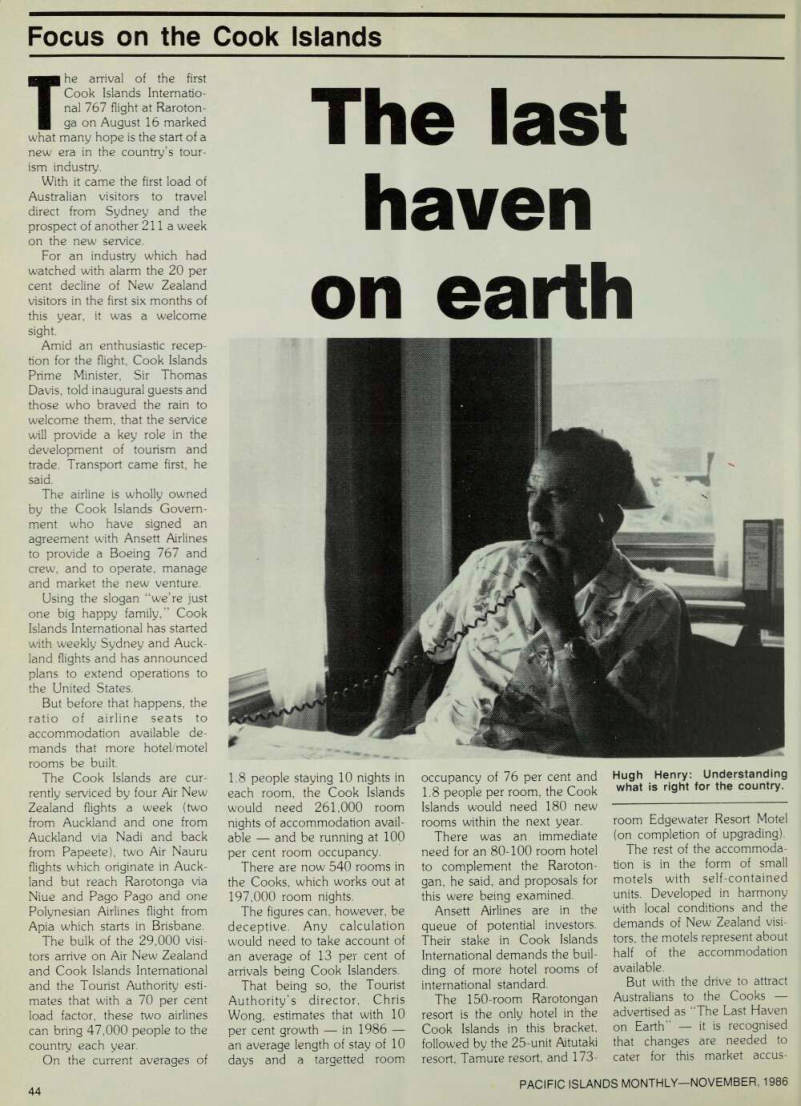
Hugh Henry: Understanding what is right for the country.
tomed to four-star treatment in other island destinations.
Gearing up for the new mar ket has not been easy. The mushrooming restaurant trade there are now 17 on Raro tonga has been plagued with the problem of irregular and controlled booze supplies from the Government owned Liquor Bond.
And for the hotels and their developers, the problems of availability of land, labor shor tages and high costs, are major hurdles to be cleared.
Plans for a 300-room hotel on reclaimed land in the Muri Lagoon were well-advanced but collapsed after local opposi tion and questions were raised about the investors.
There were also plans to add another 100 rooms to the 60 per cent Government-owned Rarotongan at a cost of SNZIS million. But these have been stalled by. among other things, difficulties with the 226 regis tered owners of the land the hotel needs.
Added to this is the general agreement among planners and operators that the Cook Islands does not need mass-tourism.
For Hugh Henry. President of the Cook Islands Chamber of Commerce, and leading tour operator. the concept that needs to be accepted is under standing what is right for the
country.
“We’re not the Ritz, Las Vegas. New York or Surfers.
We are as God made us ... a small dot in the middle of the Pacific existing in a peaceful, friendly and God-fearing coun try,” he said.
All that the country could offer the visitor was the chance to share the Cook Islands way of life.
Henry’s theme of the offer of a restful holiday is shared by Chris Wong at the Tourist Authority. For Australians in particular, the Cook Islands were a new destination and offered something they would enjoy.
Renowned for their hospital ity. Cook Islanders were keen to show what this was all about.
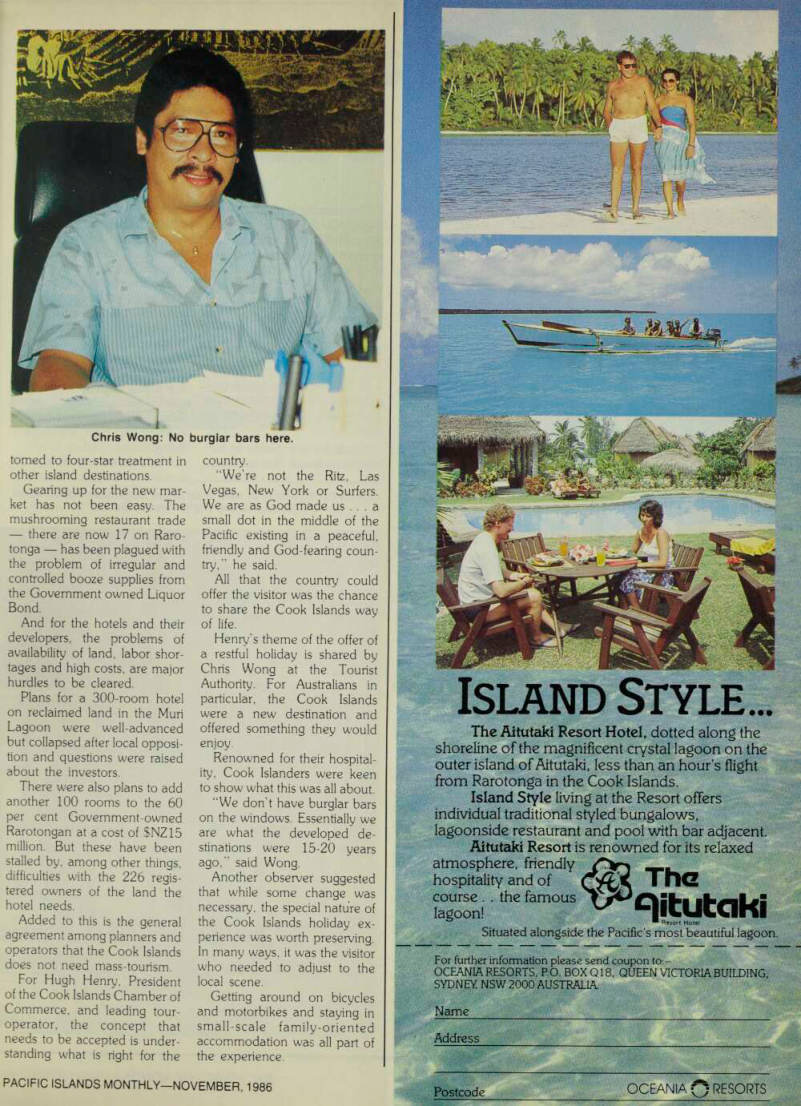
“We don't have burglar bars on the windows. Essentially we are what the developed de stinations were 15-20 years ago," said Wong.
Another observer suggested that while some change was necessary, the special nature of the Cook Islands holiday ex perience was worth preserving.
In many ways, it was the visitor who needed to adjust to the local scene.
Getting around on bicycles and motorbikes and staying in small-scale family-oriented accommodation was all part of the experience.
Chris Wong: No burglar bars here.