With Progress
pp. 41-42 · Read in the full issue
Problems
Very small, remote, resource-poor and trade-dependent. Such is the common description of the Cook Islands economy.
And with budgetary aid from New Zealand running at NZ$lO.5 million a year or between 35 and 40 per cent of Government revenue the economic reality is that the Cook Islands are still very much under the wing of New Zealand.
As testimony to this, Cook Islanders still have the right to New Zealand passports, the New Zealand dollar is used as curren cy, and the bulk of trade in exports, imports and tourists runs between Auck land and Rarotonga.
It follows that the economic problems of New Zealand have had a flow-on effect to the Cook Islands, with imported inflation more often higher than that recorded in New Zealand and a decline in the number of visitors from that country.
The New Zealand market has tradi tionally provided over 40 per cent of the tourists who make their way to the Cook Islands each year.
But in 1986 this previously solid market took a sharp downturn with a 21 per cent fall in the first six months compared to the same period last year.
While the number of visitors from other countries has increased, the collapsing New Zealand market is a matter of some concern for the tourism industry and the Government.
It has caused a four per cent decline in the total number of visitors in the first six months of 1986 and prompted a re-think on marketing strategies and the industry in general.
While the tourism planners are projec ting a 10 per cent a year growth rate for the industry, their plans are constrained pri marily by the economic realities of the country.
The same constraints have applied to the productive sectors of the economy and to attempts to diversify, improve living conditions and expand employment.
Significant progress, however, has been made with the development of off-shore banking and tax haven facilities.
The raw facts are daunting. The Cook Islands are made up of 15 islands spread over two million square kilometres of
ocean with a total land area of 240 square kilometres (59,318 acres), most of which is relatively infertile being either moun tainous or coral atoll based.
Population is small, estimated in 1985 at 17,700, with about 9000 people living in Raratonga. Heavy out-migration (it was estimated that 8000 departed for New Zealand between 1972 and 1982) has compounded the problems of shortage of skilled and general labor.
On top of this is the fact that the Cook Islands are one of the most remote nations
from the Pacific’s metropolitan markets resulting in high transport and service costs.
The close economic ties with New Zealand have therefore been vital in maintaining economic stability. Since the Cook Islands gained self-governing status from New Zealand in 1965, locally pro duced goods have had duty-free access to New Zealand markets.
While exports of fresh fruit and vege tables to New Zealand have dwindled over the last decade partly due to the demise
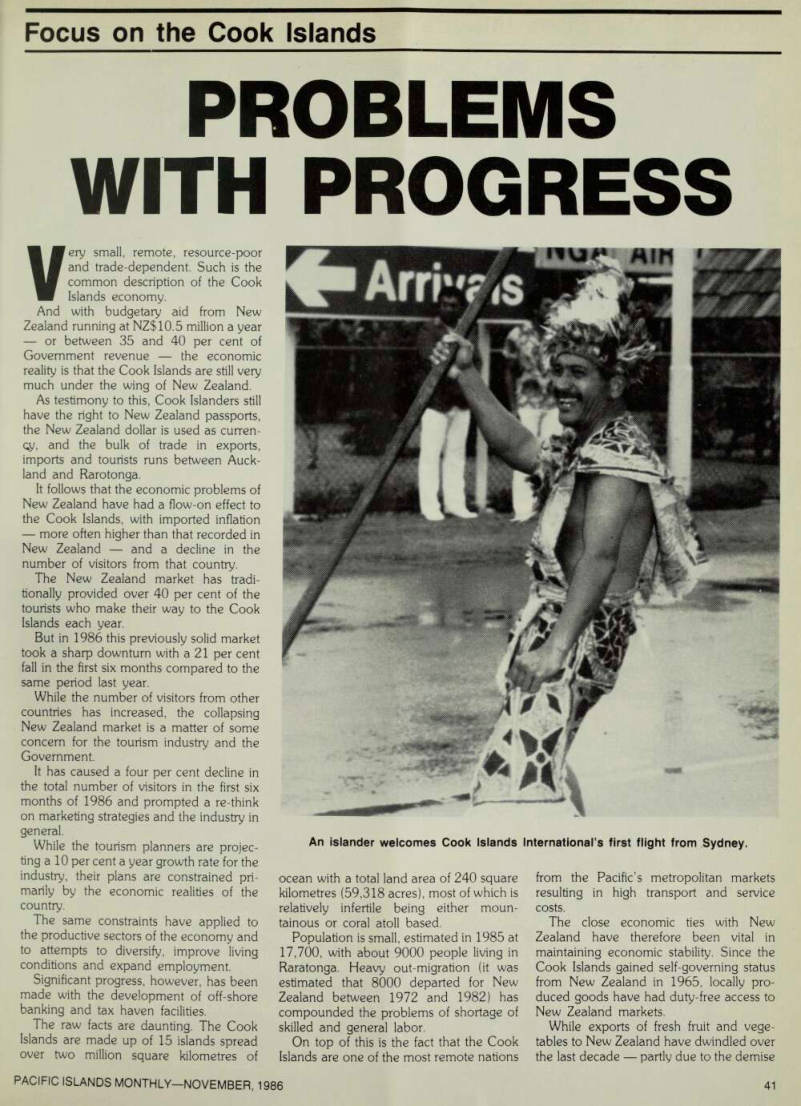
An islander welcomes Cook Islands International’s first flight from Sydney.
of the fruit juice industry there has been a significant increase in clothing and footwear exports to the extent that last year these items represented over half of total exports to New Zealand.
New Zealand still takes over 75 per cent of the country’s exports, with Tahiti, Japan and the United Kingdom absorbing a large part of the remainder.
And with the bulk of imports still being loaded in New Zealand, the dominant feature of Cook Islands trade remains on a
line drawn between Rarotonga and Auck land.
How far the start of Cook Islands International direct air link with Sydney will change that remains to be seen.
It is, however, expected that the Cook Islands will maintain close links with New Zealand. It goes far beyond the realities of trade and economics. Cook Islanders share a common ancestry with the Maoris. They are also citizens of New Zealand.
For its part, the New Zealand Govern
merit continues to prop up the Govern ment with $lO million a year in budgetary aid and by mutual agreement provides assistance in defence.
Judging by the enthusiastic welcome given to the New Zealand military in July when they showed how they would defend the country, that assistance is still much appreciated.
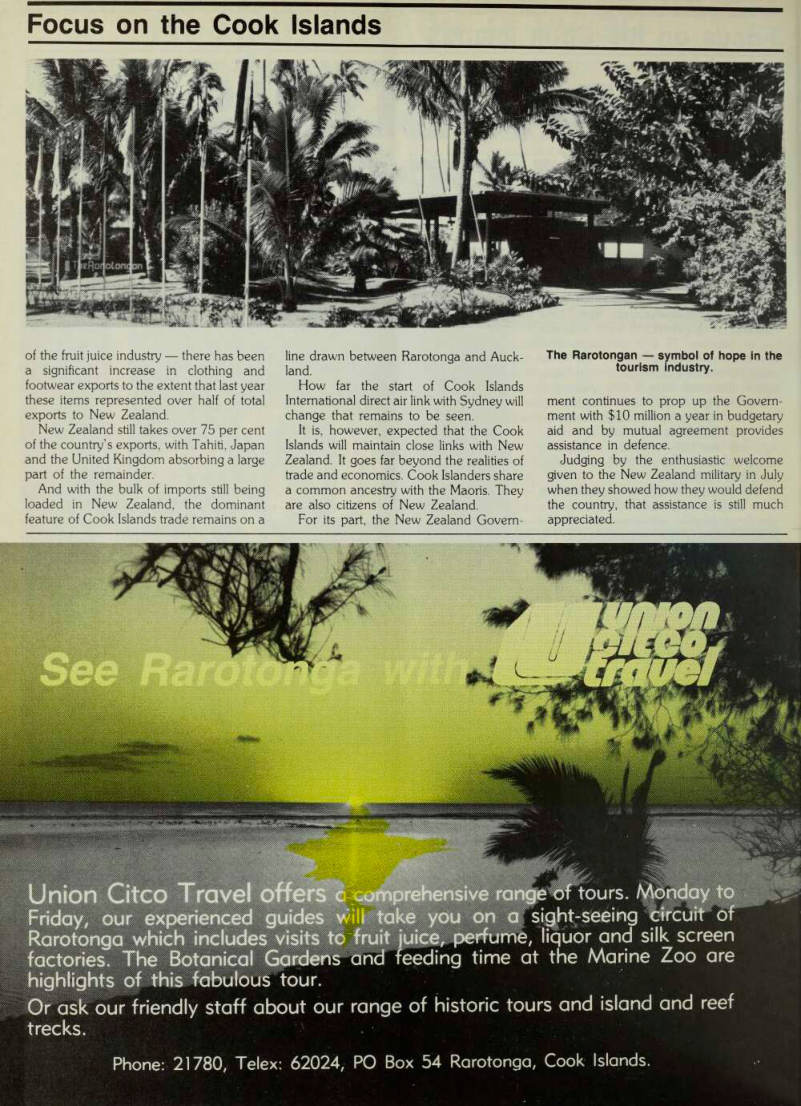
The Rarotongan symbol of hope In the tourism industry.