corporate big fish
pp. 46-47 · Read in the full issue
Tax shelter attracts corporate big fish
At first sight, there’s not much to the town of Avarua the admi nistrative and business centre of the Cook Islands.
A two-kilometre stretch of buildings many single storey and wooden on the north shore of Rarotonga, the town buzzes with motorbikes during the day, but after working hours is quiet.
But behind the small-town facade is a surprising degree of sophistication and business activity.
In 1981 the Government passed legislation to permit the setting up of off-shore banking facilities and a year later enacted another law allowing legal structures to be establish ed for overseas companies wishing to avoid taxes.
In August this year there were 520 companies registered in the Cook Islands taking advantage of the country’s tax haven status.
The bulk of these are repre sented by the Cook Islands Trust Corp., and a smaller proportion by the South Pacific Trust.
Cook Islands Trust Managing Director, Trevor Clarke, told PIM that the trust was aiming at high standards and had been quite successful in doing so.
The aim, he said, was for the Cook Islands to become the Bermuda of the South Pacific.
While Vanuatu had chased the numbers in a short time, the development of tax haven busi ness in the Cooks had been more cautious.
“We would like to develop cautiously but strongly with a view to making it a successful tax haven in the long term,” he said.
“It’s developed along the path we all hoped it would.
We’ve been attracting major
corporations and multi-na tionals and providing services for them as part of their overall transactions.”
The trust provides the legal structures and management for large offshore financial transac tions with the aim of minimising taxes.
New Zealand Corporate raid er Ron Brierley is a major shareholder in the Trust through Brierley Investments Limited.
Brierley’s share-trading acti vities in the major leagues in Australia and New Zealand have made him front page news.
The benefits to the Cook Islands were that the Govern ment received direct payments for registration fees, licences for insurance, taxes from the legal company, and a boost to tourism.
For companies using the Cooks the advantages were that the Government had a policy of developing “quality” haven status, the islands’ geog raphic position (its proximity to Australia and New Zealand and reasonable time difference when dealing with Asia), good
communications, professional
service, and a stable Govern ment.
Clarke, a former Advocate General of the Cooks, said the islands had political difficulties in the past, but these had been overcome.
“If you step back ... on a broad base . . . you’ll see that it’s a pretty stable place.”
One of the spin-offs of the country’s developing tax-haven status, was increased sophistication in general domestic business activity.
An example of this was the way in which local businessmen had developed contacts and were going overseas for fin ance.
The president of the Cham ber of Commerce, Hugh Hen ry, told PIM that his chamber enjoyed a productive relation ship with government.
He said some countries in the South Pacific did not acknow ledge the value of their cham bers of commerce, but this was not the case in the Cook Is lands.
A country with a strong gov ernment and strong commercial sector had no boundaries, he said.
Local traders’ ability to sur vive in a climate of remoteness,
infrequent shipping and high pilferage through the lack of containerised cargo was evi dence of this commercial strength, he said.
The contribution of New Zea land in establishing social and economic foundations for deve lopment had to be acknow ledged.
With an average per capita income of NZ$5OOO and take home pay of $lOO a week (the basic hourly wage rate is $1.65), Cook Islanders enjoyed a relatively high standard of living.
“I think we are doing very
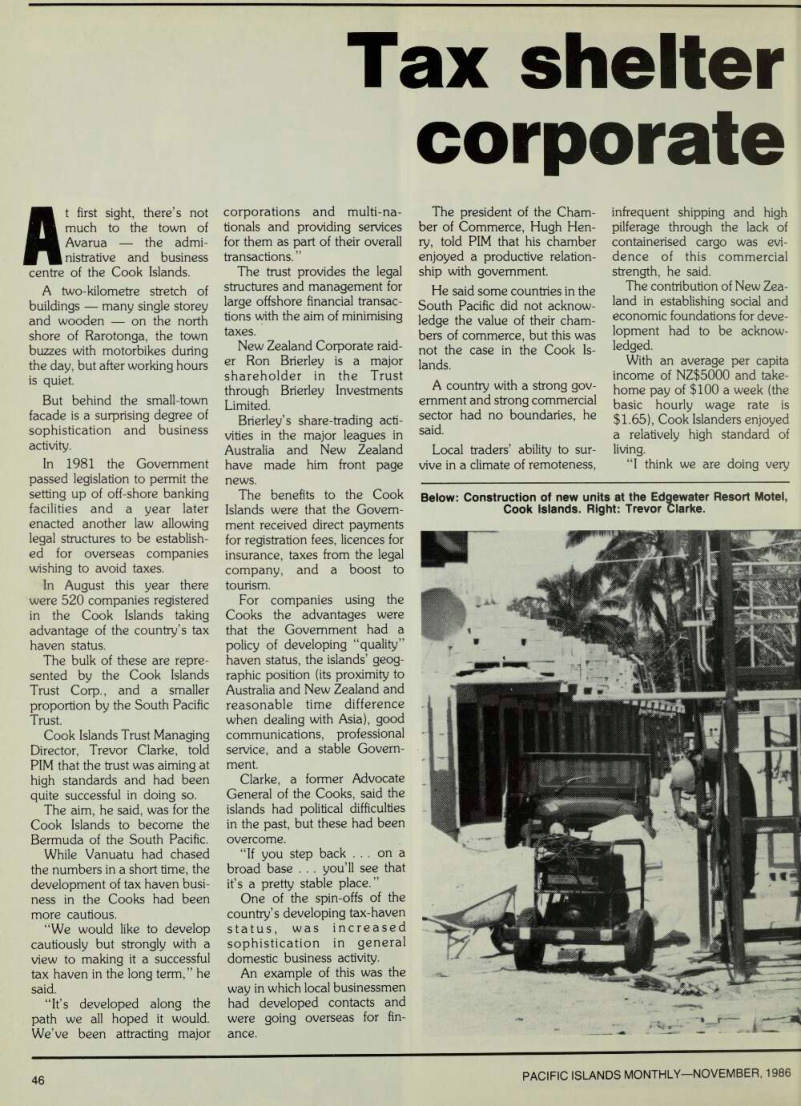
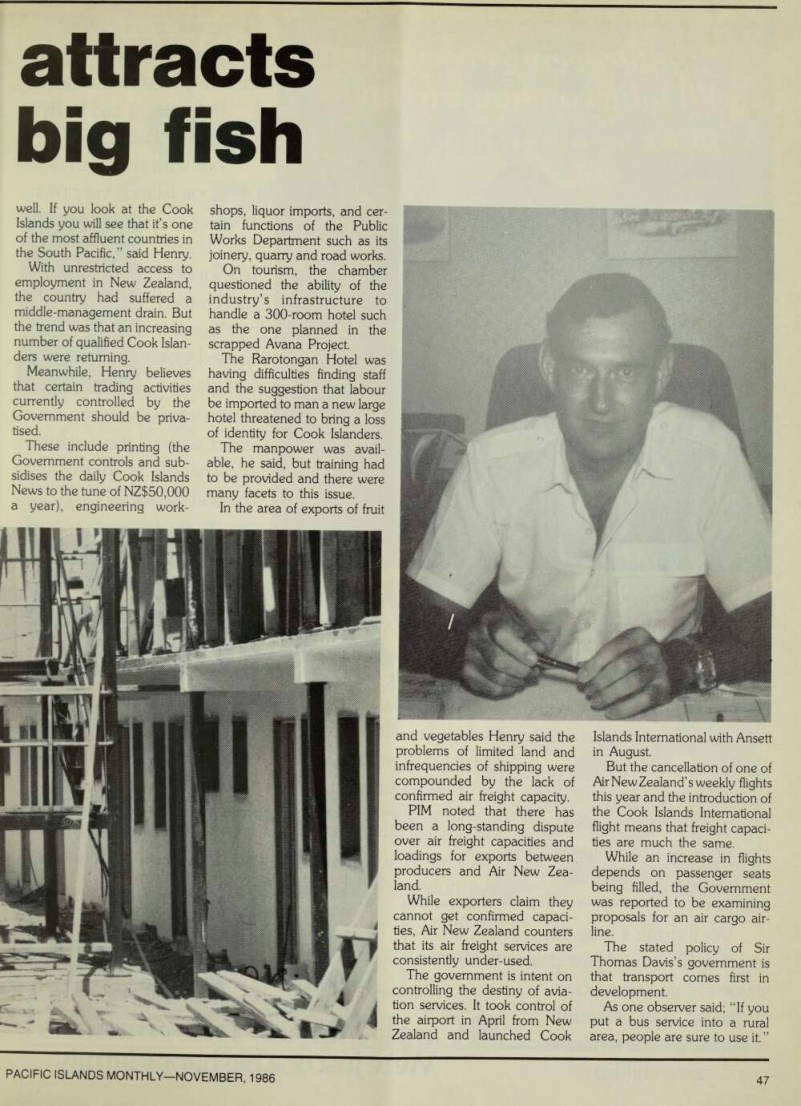
Below: Construction of new units at the Edgewater Resort Motel, Cook Islands. Right: Trevor Clarke.
well. If you look at the Cook Islands you will see that it’s one of the most affluent countries in the South Pacific,” said Henry, With unrestricted access to employment in New Zealand, the country had suffered a middle-management drain. But the trend was that an increasing number of qualified Cook Islanders were returning.
Meanwhile, Henry believes that certain trading activities currently controlled by the Government should be privati se d- These include printing (the Government controls and subsidises the daily Cook Islands News to the tune of NZ$5O,OOO a year), engineering work-
shops, liquor imports, and cer tain functions of the Public Works Department such as its joinery, quarry and road works.
On tourism, the chamber questioned the ability of the industry’s infrastructure to handle a 300-room hotel such as the one planned in the scrapped Avana Project, The Rarotongan Hotel was having difficulties finding staff and the suggestion that labour be imported to man a new large hotel threatened to bring a loss of identity for Cook Islanders.
The manpower was avail able, he said, but training had to be provided and there were many facets to this issue, In the area of exports of fruit
and vegetables Henry said the problems of limited land and infrequencies of shipping were compounded by the lack of confirmed air freight capacity.
PIM noted that there has been a long-standing dispute over air freight capacities and loadings for exports between producers and Air New Zealand.
While exporters claim they cannot get confirmed capacities, Air New Zealand counters that its air freight services are consistently under-used.
The government is intent on controlling the destiny of aviation services. It took control of the airport in April from New Zealand and launched Cook
Islands International with Ansett in August, But the cancellation of one of Air New Zealand’s weekly flights this year and the introduction of the Cook Islands International flight means that freight capaci ties are much the same, While an increase in flights depends on passenger seats being filled, the Government was reported to be examining proposals for an air cargo air line.
The stated policy of Sir Thomas Davis’s government is that transport comes first in development, As one observer said; “If you put a bus service into a rural area, people are sure to use it. ”