garment makers
pp. 32-33 · Read in the full issue
Australian ruling diverts s2m contract
Unkind cut for garment makers
When a high-level delegation from Suva was in Canberra recently the question of Fiji garment exports to Australia was high on the list of matters to discuss.
During that same week Farah Manufacturing of Australia redirected a $2 million garment making contract from Fiji to China.
For as the Fiji industry grows more efficient it becomes, ironically, harder for it to comply with what has become known as the 50 per cent rule. (Under the SPARTECA agreement garment imports to Australia from Forum is land countries must contain at least 50 per cent local or Australian content.
See PIM, July p3B).
And what was two years ago a major breakthrough for the Fiji in dustry the relocation of much of Farah’s cut make and trim (CMT) activity from Hongkong to Suva is suddenly under threat.
Farah moved to Fiji because it was close to its Australian markets and because the industry could provide the required quality. The company bought fabrics from around the world and shipped them to Fiji to be made into garments for the Australian market.
So far so good. But as Fiji’s CMT industry increased its efficiency and gradually reduced unit cost it became harder to meet the 50 per cent rule.
The problem has been compounded by the dive of the Aussie dollar and the high cost of Australian fabrics.
Farah Manufacturing’s Australian managing director David Einfield told PIM; “We can’t afford to manufacture in Fiji and pay Australian duty. If we have to pay duty on our garments, the obvious answer is to have the manu facturing done in China or Sri Lanka or wherever. Fiji costs cannot com pete with these.
“In fact we have just redirected a $2 million contract initially bound for Fiji to China because, with the fabrics the client wanted, we couldn’t be sure we could meet that 50 per cent rule. I don’t see how that benefits Australia. ”
Einfield and Farah were in strumental in promoting the recent growth of the Fiji garment industry through technical advice and a com mitment to Fiji CMT services.
“In our first year in Fiji which was an experimental year we did over a million dollars worth of exports,”
Einfield said. “But the more we streamline production over there and the more efficient the manufacturers there become, the cost of their pro duction becomes lower making it harder for them to show that half the value of the finished article is in Fijian costs. ”
Over thr past three months, Einfield has bombarded the Australian and
Fijian authorities with letters and telex messages pleading for a change in the rules.
He told FIM: “The Australians just won’t listen. And I’m not getting much backing from Fiji either. If the govern ment would only act at senior level, I think the will exists to sort this out.”
The will does not exist in the Australian customs service, however, who, if anything, have increased their adherence to the small print of the SPARTECA rules.
But why should Australia allow Farah to relocate its manufacturing offshore at the expense, perhaps, of the Australian workforce? “We’re not moving our production offshore. We are shifting production from Hon gkong, Taiwan and Korea to Fiji. And this is in the interests of Australia who should be more understanding of this.
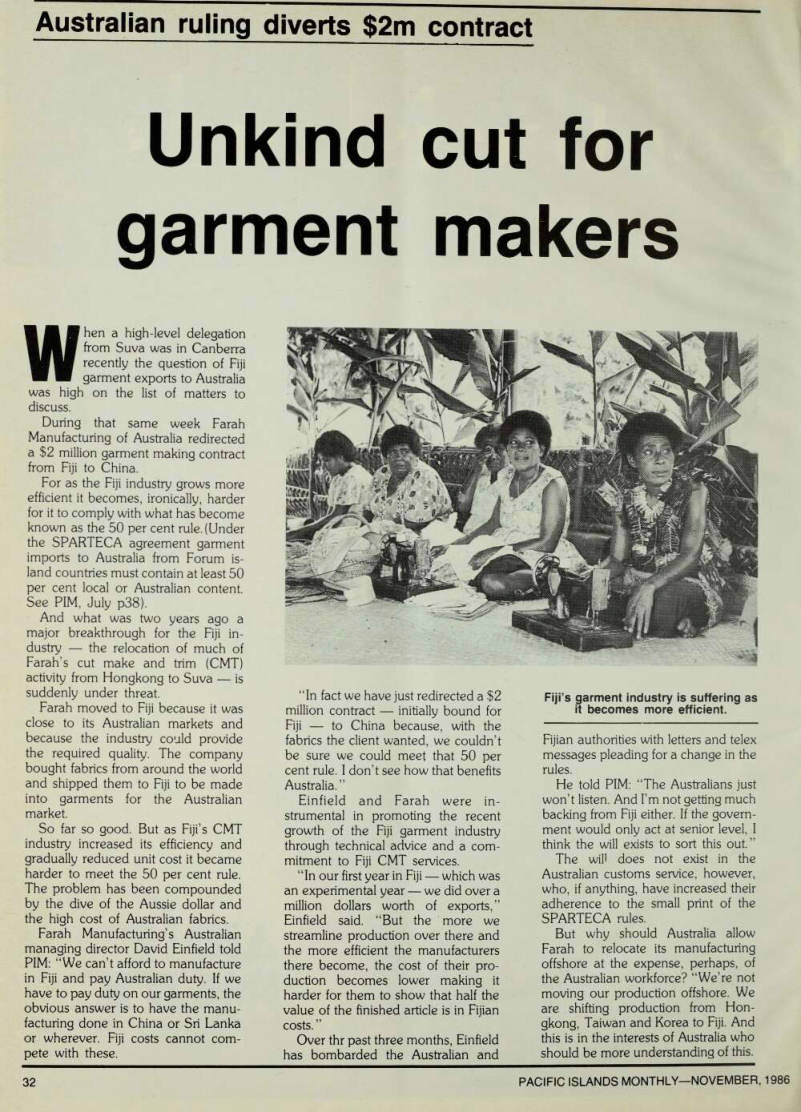
Fiji’s garment industry is suffering as it becomes more efficient.
But I can’t get this through to them.
They don’t want to change. It’s too hard.”
Without the 50 per cent stipulation, he said, the potential of the Fiji industry was in excess of As 6 million per year. With the import restriction, it would struggle to beat $2 million.
“At present,” said Einfield “Fiji manufacturers take on people for summer work. With lighter, cheaper fabrics we can just make the 50 per cent stipulation. When the demand changes to winter clothes, the Fijian factories have to lay off machinists.
That doesn’t inspire confidence in either the workers or the factory owners.
“If we could get rid of that rule, I’d be able to give my Fiji suppliers year-round work and keep their plants fully occupied.”
And if the Australian government is negative, he sees the Fiji government as soft-pedalling on the issue. “I expected help from Dr Maraj (foreign secretary) and Mr Stinson (Fiji’s deve jopement minister),” said Einfield, “but so far there’s been nothing of substance. Looking back at the Suva
Forum meeting, I see that the apparel industry wasn’t even discussed. I only hope they will increase the pressure.
“Otherwise, we could see this enor mously vital industry disappear.”
Last year Farah imported more than half of the 150,000 units sent from Fiji to Australia. It is responsible for the employment of 120 machinists in Fiji and, in February this year, Einfield wrote to the Australian minis ter responsible for customs, Senator John Button pointing out that this traffic was in danger of being halted by the 50 per cent rule.
He received a negative reply from the minister assisting the Senator.
Subsequent requests to meet Senator Button were refused and an in creasingly chilly correspondence has been going on ever since.
“The other thing,” he said, “is that the Americans are starting to discover that Fiji is now in a position to provide quality garments and is becoming more efficient because of all the effort that Australian people have put into it and I believe that over the next 12 to 18 months the Americans could come in and take over the whole production facility. It would then be lost to Australia forever.”
So why should Fiji care where the business comes from? “I’m not saying they should. But I think they’ll make more money out of Australia than America because the Americans are a lot more competitive and will.squeeze them a lot harder than we do.”
Was he in danger of “crying wolf” by saying that the very existence of the Fiji CMT industry was in danger?
“Not at all. There is no way that Fiji can compete with the other manufac turing countries on price. They will never get that efficient or achieve the economies of scale that the bigger countries can. We cannot afford to manufacture in Fiji and pay duty on our goods coming into Australia.”
Einfield still hopes to persuade Australia that the only restraint should be a provision that the garment is completely made in Fiji. This would satisfy the original aim of the 50 per cent rule which was to prevent the islands being used as entrepots with minimal benefit to their economies.
“If I could only get together with Senator Button, his advisers and the people from Fiji, we could probably solve this thing fairly quickly,” he said.
“But so far, nobody wants to even try.”
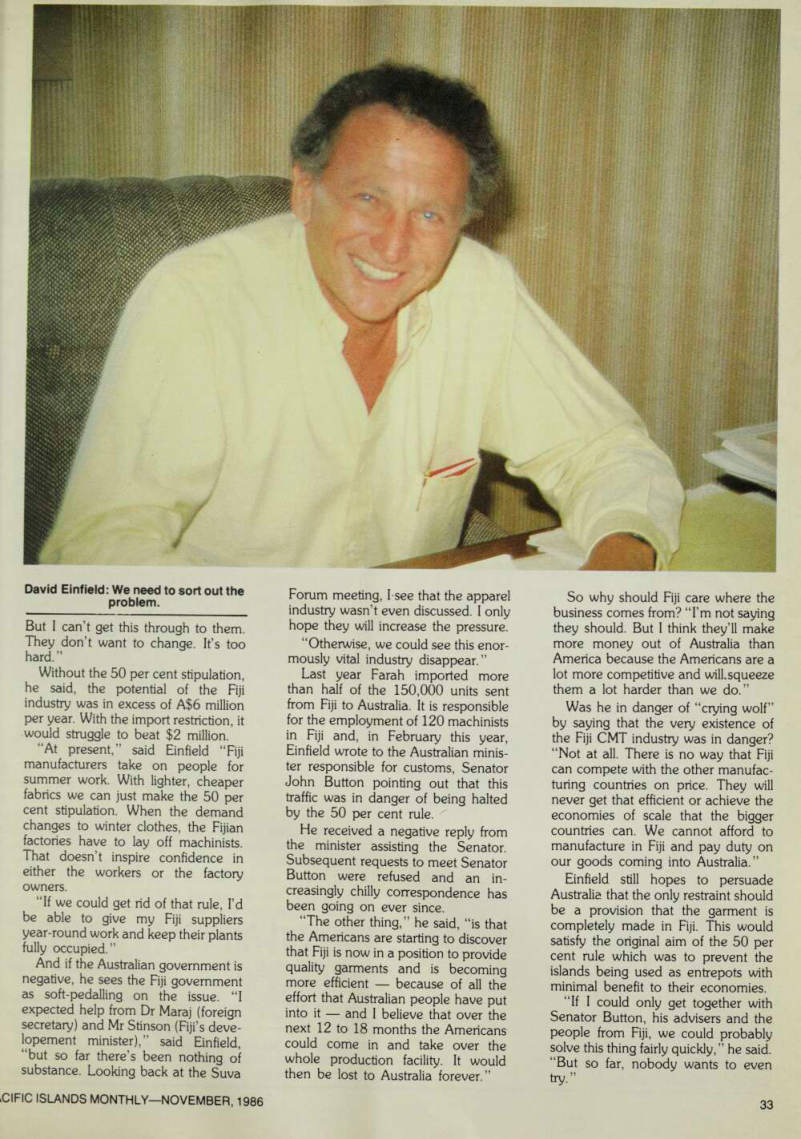
David Einfield: We need to sort out the problem.