major export earner
pp. 34-38 · Read in the full issue



Complacency threat to major export earner
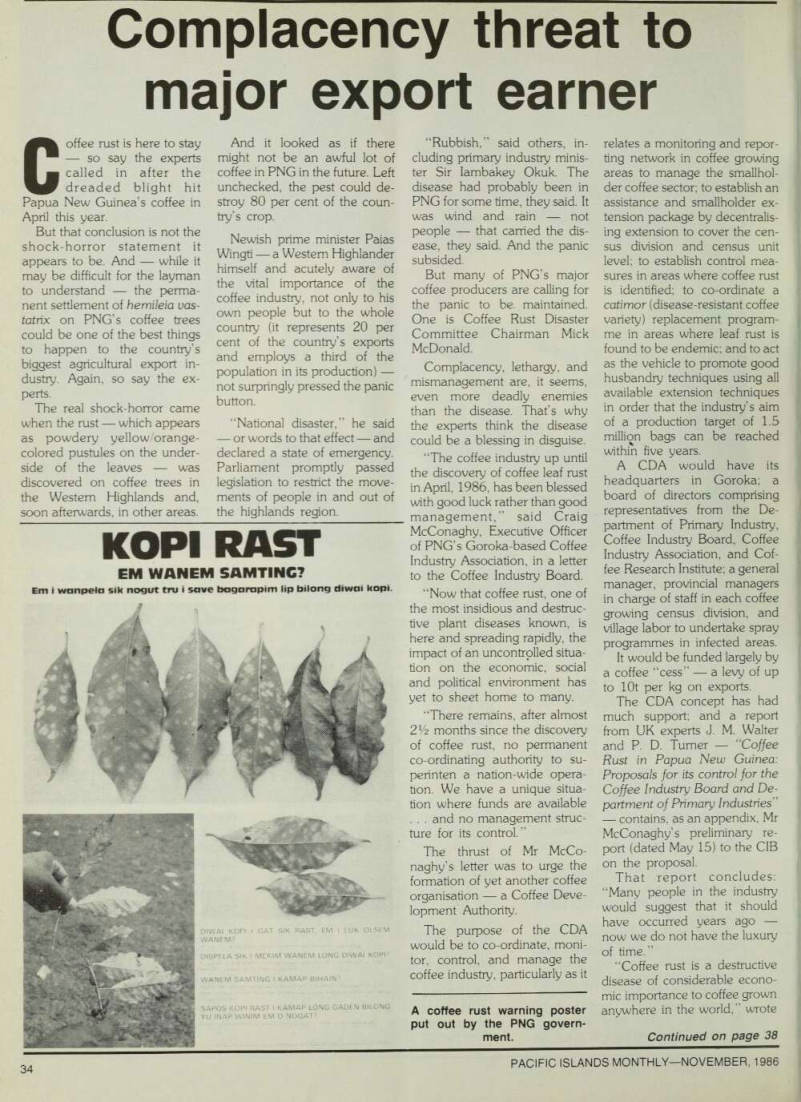
Coffee rust is here to stay so say the experts called in after the dreaded blight hit Papua New Guinea’s coffee in April this year.
But that conclusion is not the shock-horror statement it appears to be. And while it may be difficult for the layman to understand the perma nent settlement of hemileia uas tatrix on PNG’s coffee trees could be one of the best things to happen to the country’s biggest agricultural export in dustry. Again, so say the ex perts.
The real shock-horror came when the rust which appears as powdery yellow/orange colored pustules on the under side of the leaves was discovered on coffee trees in the Western Highlands and, soon afterwards, in other areas.
And it looked as if there might not be an awful lot of coffee in PNG in the future. Left unchecked, the pest could de stroy 80 per cent of the coun try’s crop.
Newish prime minister Paias Wingti a Western Highlander himself and acutely aware of the vital importance of the coffee industry, not only to his own people but to the whole country (it represents 20 per cent of the country’s exports and employs a third of the population in its production) not surpringly pressed the panic button.
“National disaster,” he said or words to that effect and declared a state of emergency.
Parliament promptly passed legislation to restrict the move ments of people in and out of the highlands region.
“Rubbish,” said others, in cluding primary industry minis ter Sir lambakey Okuk. The disease had probably been in PNG for some time, they said. It was wind and rain not people that carried the dis ease, they said. And the panic subsided.
But many of PNG’s major coffee producers are calling for the panic to be. maintained.
One is Coffee Rust Disaster Committee Chairman Mick McDonald.
Complacency, lethargy, and mismanagement are, it seems, even more deadly enemies than the disease. That’s why the experts think the disease could be a blessing in disguise.
“The coffee industry up until the discovery of coffee leaf rust in April, 1986, has been blessed with good luck rather than good management,” said Craig McConaghy, Executive Officer of PNG’s Goroka-based Coffee Industry Association, in a letter to the Coffee Industry Board.
“Now that coffee rust, one of the most insidious and destruc tive plant diseases known, is here and spreading rapidly, the impact of an uncontrolled situa tion on the economic, social and political environment has yet to sheet home to many.
“There remains, after almost 2Vfe months since the discovery of coffee rust, no permanent co-ordinating authority to su perinten a nation-wide opera tion. We have a unique situa tion where funds are available . . . and no management struc ture for its control.”
The thrust of Mr McCo naghy’s letter was to urge the formation of yet another coffee organisation a Coffee Deve lopment Authority.
The purpose of the CDA would be to co-ordinate, moni tor, control, and manage the coffee industry, particularly as it
relates a monitoring and repor ting network in coffee growing areas to manage the smallhol der coffee sector; to establish an assistance and smallholder ex tension package by decentralis ing extension to cover the cen sus division and census unit level; to establish control mea sures in areas where coffee rust is identified; to co-ordinate a catimor (disease-resistant coffee variety) replacement program me in areas where leaf rust is found to be endemic; and to act as the vehicle to promote good husbandry techniques using all available extension techniques in order that the industry’s aim of a production target of 1.5 million bags can be reached within five years.
A CDA would have its headquarters in Goroka; a board of directors comprising representatives from the De partment of Primary Industry, Coffee Industry Board, Coffee Industry Association, and Cof fee Research Institute; a general manager, provincial managers in charge of staff in each coffee growing census division, and village labor to undertake spray programmes in infected areas.
It would be funded largely by a coffee “cess” a levy of up to lOt per kg on exports.
The CDA concept has had much support: and a report from UK experts J. M. Walter and P. D. Turner “Coffee Rust in Papua New Guinea: Proposals for its control for the Coffee Industry Board and De partment of Primary Industries’’ contains, as an appendix, Mr McConaghy’s preliminary re port (dated May 15) to the CIB on the proposal.
That report concludes: “Many people in the industry would suggest that it should have occurred years ago now we do not have the luxury of time.”
“Coffee rust is a destructive disease of considerable econo mic importance to coffee grown anywhere in the world,” wrote
Continued on page 38
A coffee rust warning poster put out by the PNG govern ment.
Continued from page 34
, . KT i plant pathologist B. N. Muthap pa m volume 4 of the CRI publication PNG Coffee, in Ocotber 1985 - only months bef ° re Tf discovered m e G ighlands.
“Coffee rust has now been recorded in most of the coffee growing countries. Small out breaks of this disease have occurred on three occasions in Papua New Guinea. In each case, in 1892, 1903 and 1965, the disease was in an isolated area and it was successfully eradicated.
“Coffee in Papua New
Guinea is at present believed to be fr ee fr° m this devastating djsease if there is anothe = outbreak in futu quick action have to be taken to eradi . cate the disease on site - Walter and Turner, though, say that eradication, on a practi cal basis, is not only impossible, but unnecessary. On the other hand, they say that the advent of coffee rust makes it essential that the long-planned re habilitation programme begins at once, And economist Paul Bod man, in the July 1986 CIB Coffee Report, predicts that, within five years, there could be
a 50 per cent drop in smallhol der production in some areas if no effective extension is put in place.
Another factor supporting immediate action is the fear expressed at a May meeting of all sections of the Kainantu (E.
H. Province) community that, if rust is not identified in its early stages, coffee growers might be afraid to report an outbreak if it means that not only their own coffee but that of neighbours would be de stroyed, leading to possible re prisals and compensation claims.
The disease first observed in 1861 and believed to have originated in Ethiopia was recorded in Sri Lanka in 1868 and thereafter spread from country to country: India, Sumatra, Java, Fiji, the Philip pines, Tonkin, Borneo, Malaysia, PNG (the 1892, 1903 and 1965 outbreaks already mentioned), Samoa, Vanuatu, New Caledonia, Eastern China, Hainan, Natal, Mauritius, Re union, Madagascar, Tanzania, Kenya, Transvaal, Zimbabwe, Congo, Mozambique, Zanzibar, Cameroons, Ivory Coast, Dahomey, Sudan, Togoland, Brazil, Paraguay, Argentina, Nicaragua, Bolivia, Peru, El Salvador, Honduras, Guatema la, Mexico, Equador and Col ombia.
The disease has caused va rious degrees of damage to these countries’ economies, but none has been so severely affected as Sri Lanka where within five years of the discov ery of the disease coffee rust had spread throughout every plantation. They were soon abandoned. Could this happen in Papua New Guinea?
It has already been made clear to quote DPI economist Paul Barker that “coffee rust is a disease with which PNG will have to live.”
A levy is already being col lected on coffee exports in order to establish an effective disease control service.
The disease control program me which includes both control (on affected crops) and prophylactic (on disease-free crops) spraying is currently being administered by the DPI.
Coffee rehabilitation is being undertaken by smallholders on the advice of the DPI and sometimes by plantations or management agencies.
Coffee research is being undertaken by the DPI and the CRI. Quarantine is the re sponsibility of the DPI. Funding is provided by that levy and by the national and provincial gov ernments.
The disease will have no effect on the export earnings of July/September this year estimated at K 55 million, more than double the K 25.43 million for October/December 1985.
And total exports this year could exceed the 1983/84 fi gure of 952,000 bags.
Bui the CIB expects a drop in smallholder output next year the degree of that drop depen ding on the effectiveness of the control/extension service. With in five years, the situation unless controlled could bring about a 50 per cent drop in smallholder production. It took eight years to happen in Sri Lanka.
But possibly Sri Lankan plantations weren’t already suffering from years of neglect.
That’s what the Walter/Tumer report says is wrong with PNG’s coffee smallholdings.
“. . . 70 per cent or so of production is derived from plantings of over 200,000 small growers. Upkeep standards in these plantings . . . are often poor, creating conditions under which any attempted control would be very difficult or im possible ...”
The Walter/Turner report says: “It is also worth noting at the outset that the appearance of coffee rust (in other coun tries) has not been followed by a disastrous collapse of the coffee industry in the country concerned, except for the his torical Ceylon experience.
Given routine control mea sures, the pathogen can be controlled quite easily within acceptable limits.
“In fact, by necessitating the introduction of good agronomic standards as a factor in disease control, yields have actually increased. A similar phe nomenon could be expected in
Png.”
Jane Belfield