Chan gets tough
p. 29 · Read in the full issue
on ‘inconsistent’ aid decision
Papua New Guinea has sounded a warning that recent cuts in Australian aid may seriously undermine stability in the re gion. In a wide ranging and sometimes acid speech de livered to the highly respected Australia Papua New Guinea Business Co-Operation Com mittee in Brisbane soon after the Australian aid cuts were announced, Deputy Prime Minister Sir Julius Chan warned that the relationship between the two countries was seriously endangered.
“A stable and economically secure Papua New Guinea is vital to the security of the entire Pacific region including Aus tralia. It is not in Australia’s interest to ignore regional security needs”, noted Chan in a prepared speech he empha sised contained “a few sharp jabs”.
In a later interview with PIM Chan, who also holds the fin ance portfolio, noted that his country “can’t be tough with Australia on aid ... beggars can’t be chosers. All we want to do is arrive at an amicable arrange ment so that we can plan (ahead)”.
This goes to the heart of the growing tension between Can berra and Port Moresby. The Papua New Guineans, while emphasising they understand the reasons for Australian aid cutbacks, say that the way it was done leads to apprehension.
“There is no breakdown in communication between PNG and Hayden (but) there could be a breakdown of dialogue between him and PNG,” noted Chan wryly.
“We have been told that there will not be cuts for the remainder of Australia’s current financial year“ Chan told his Brisbane audience. “To be slightly crude about it all big deal The whole idea of a five year aid agreement was that we in Papua New Guinea would know what we would be get ting, and would be able to plan accordingly.”
Chan claimed that the most consistent years for the bilateral relationship were under the Fraser government despite the support for independence under Labor Prime Minister Gough Whitlam.
“Our aid relationships were consistent and to the real bene
fit of Papua New Guinea. To put it bluntly, those relation ships have now lost their con sistency. ”
As a result of recent events, says Chan, “it would be foolish to hide the reality that relations between our two countries are simply not as strong and not as mutually beneficial as they used to be.”
Having rammed home the point Chan has also been in itiating debate on the budget impact of the huge oil and gold finds in Papua New Guinea.
Oil, he admits, may oversha dow all else in its effects.
“In the short term it will probably mean a lot of imports and therefore an upset for foreign reserves, but over time, subject to prices being constant and the project profitable, it will mean Papua New Guinea mov ing towards self reliance at a much faster rate.”
Asked whether this would mean that Australian aid would barely matter in five years Chan replied tactfully; “We don’t want to put it in that vein. As we develop those things we will need to borrow a lot of money and it would be nicer not to borrow that much. Our rating will depend on our debt servic ing capacity so in the short term we could find ourselves ex posed. ” This is one more reason, says Chan, for con sistency in the aid program
from Australia.
Reinhardt.
Denis
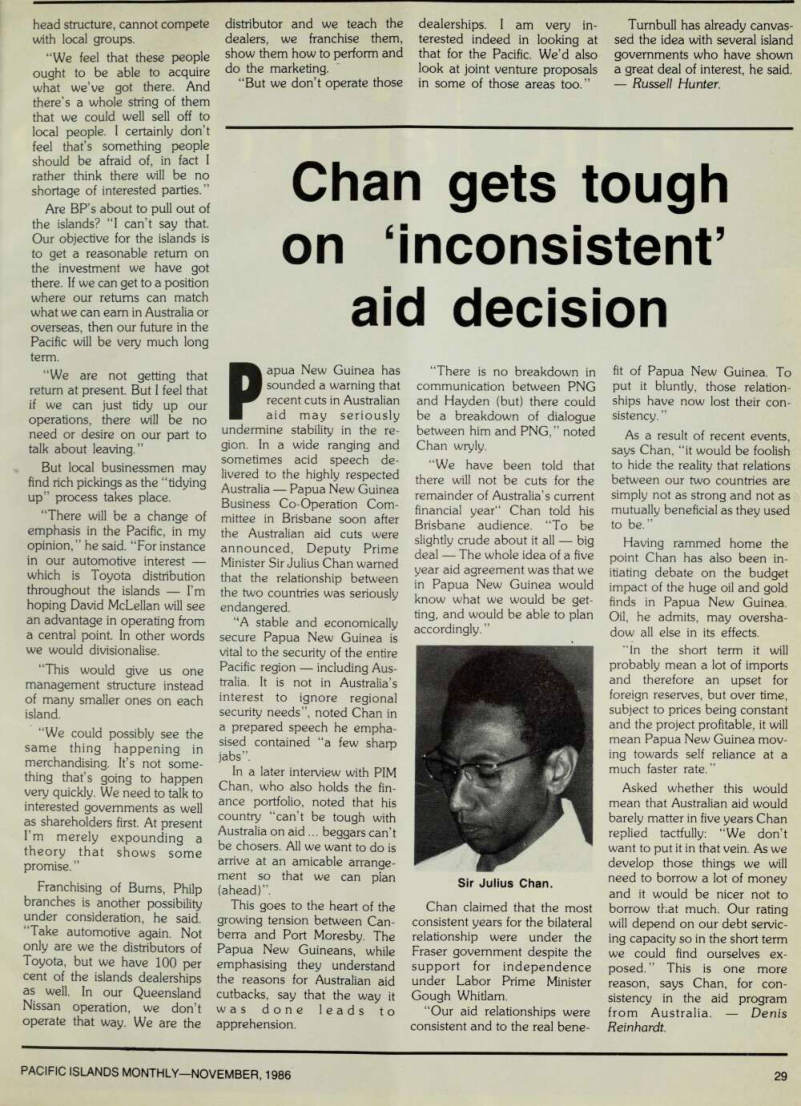
Sir Julius Chan.