Three seamen were below
p. 20 · Read in the full issue
when the ship rolled over.
Akapusi Lako was in the galley looking for some food and Jovilesi Matanisiga and Jonetarie Gu were on the steps leading down from the bridge to the lower deck. Lake managed to escape but the other two were *°^ ed - After a few minutes sitting on the side of the superstructure during which time the rest of the crew had just managed to escape through the window, I was engulfed by a torrent of water. At first 1 thought it was a huge wave breaking over the ship and I clung on to the rail to
prevent my being swept away.
However, it soon dawned on me I was going down with the ship so I let go and surfaced in raging seas in pitch darkness with no sign of the ship or her crew. I made out a small light and began to swim towards it calling out to make contact with an . y u° t J 6r s l V rviv ° rs - , . t .
I had swallowed quite a lot of water and was finding it difficult to keep my head above the breaking waves. Luckily the master was not far away and he called back and told me to swim towards the light. I made to wards the light which turned out to be a lifebuoy light held
up by one of the crew. When I reached it I found most of the survivors together clinging to various pieces of flotsam. With great relief I joined them, taking hold of a piece of deck grating, The confused breaking seas and torTentia] rain driven before , one made conditions difficult for survivors in the water but we attempted to make towards the shore which was illuminated by ii q htninq y The wind and sea gradually abated as dawn approached the first light found the exhausted survivors in a group
clinging to various bits of float ing wreckage. The second en gineer, Annais Wong, was hav ing great difficulty staying afloat until the others took off his overalls which were weighed down by the spanners and tools he had put in his pockets in case we needed to use the workboat.
The officer cadet Timoci was on a gas bottle, lan on a bundle of timber, the engineer cadet on the spare wheel from the prime minister’s Land Rover and others with hatch boards and gratings. I remarked to William Tigarea, with whom I was shar ing a deck grating, it looked just like a scene from a film. He replied, “No. Much worse. Film bullshit. This real.”
As we drew close to the shore at about 0600 punts appeared from the village of Maloku and rescued us. The Fijian crew showed their usual courtesy in refusing to be the first to be hauled out of the sea, deferring this privilege to the older and more exhausted men.
The villagers of Maloku showed us great hospitality, greeting us with dry clothes and a breakfast of lemon tea and doughnuts. We stayed as their guests for four days, sitting out a second cyclone, Nigel, in the safety of their homes on Satur day night until we were picked up by the government vessel Cagidonu on Monday morning.
When we were assembled ashore our fears were con firmed two of our shipmates had been lost. The five village punts searched the area of the wreck all day to no avail. No one will ever know why these two did not take their chance to escape when the ship rolled.
In daylight we could see the wreck lying upright in about 60 feet of water, the upper parts of the masts showing above the surface. She had bumped across the reef and fallen on her side into a deep narrow gulley off the west point of Moala, near the village of Nuku.
Though the ship was lost with the lives of two of her crew I fear if we had not been able to get to Moala under sail the chances of anyone surviving on the open sea in that cyclone would have been very slim indeed.
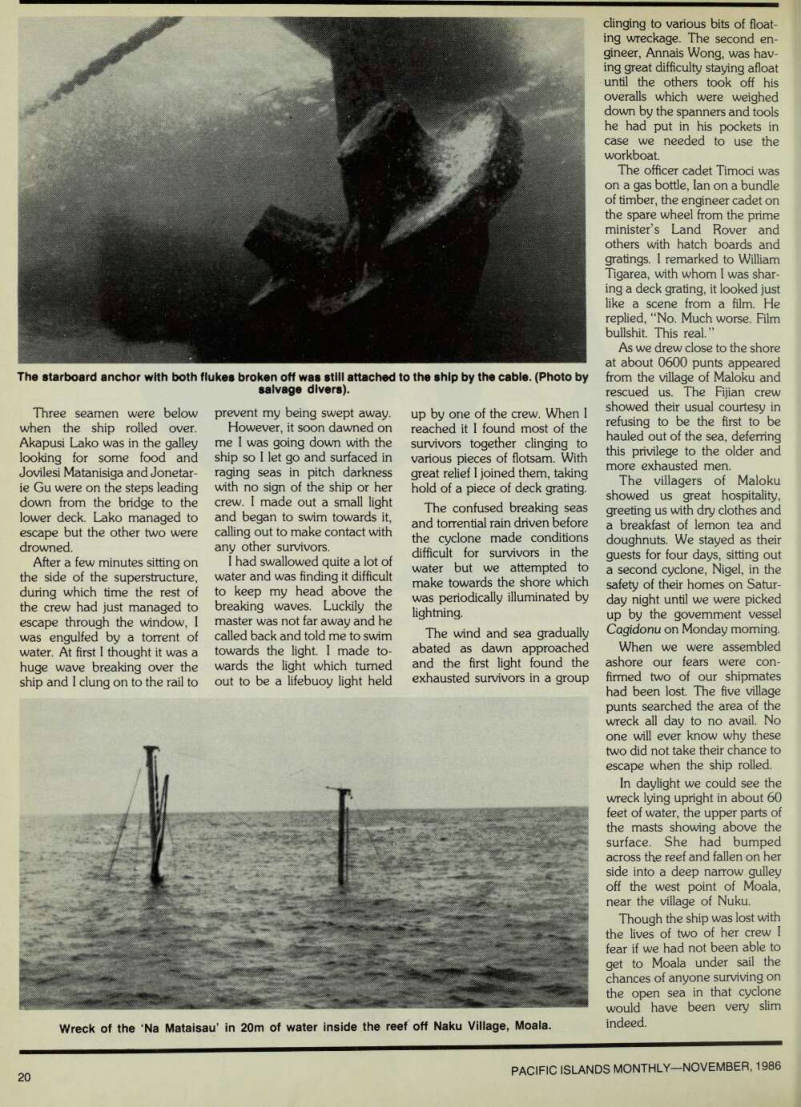
The starboard anchor with both flukes broken off was still attached to the ship by the cable. (Photo by salvage divers).
Wreck of the Na Mataisau’ in 20m of water inside the reef off Naku Village, Moala.