challenge
pp. 21-24 · Read in the full issue

The workers’ challenge
The Fiji Labour Party, born only just over a year ago, is already seen by the ruling Alliance Party as a major threat in next year’s general elec tions.
The Labour Party came into being partly as a result of dissatisfaction among trade unions over the government-imposed wage freeze. Unionists felt that the opposi tion National Federation Party (NFP) was too busy settling its own internal squabbles to effectively oppose the government. The feeling was that the government had too free a hand to implement whichever policy it chose.
When it was launched last July, the Labour Party’s founders were nothing less than forthright: the party’s aim, they declared, was to bring down the govern ment, setting 1997 as their target date.
At that stage, the ten-year build up was seen as necessary and there were no plans to even contest next year’s elections.
Events, however, have overtaken the party’s planners and Labour candidates are now gearing up for an attempt to unseat the 16-year Alliance government.
Soon after the party’s formation, the opposition NFP found itself with another leadership crisis which eventually saw the party fragmented with several members resigning. For a while they sat in Parlia ment as independents before three de cided to sit for the Labour Party.
This, ironically, presented the new party with a problem. At its inception, Labour declared that no defectors would be accepted, especially from the NFP. The strategy was to present a clear clean image and not to appear as an NFP with a different name. But the NFP deserters were accepted. Why the change?
Bavadra: “I agree that from the begin ning we said that we were not going to accept anyone from the other parties. But being a political party we must be sensitive and responsive to changing political situa tions.
“And that’s what has happened. We saw people wanting to join us and we also saw them coming with supporters. So after careful deliberation we decided that we
Fiji’s general election campaign is already well underway, although polling is not officially due until September next year.
Strong suspicions that Prime Minister Ratu Mara may call a snap election in May or even earlier have fuelled the campaign engines, however. And one reason for an early poll could be the birth and, it appears, rapid growth of the Fiji Labour Party.
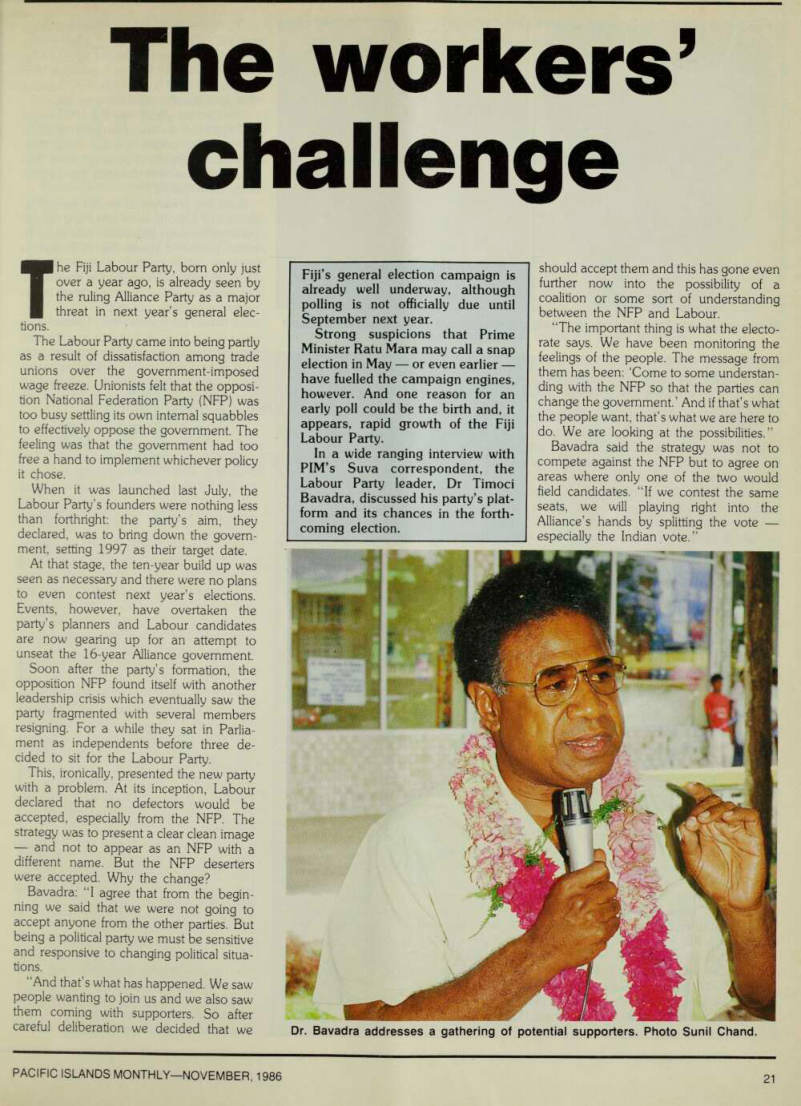
In a wide ranging interview with PlM’s Suva correspondent, the Labour Party leader, Dr Timoci Bavadra, discussed his party’s plat form and its chances in the forth coming election.
should accept them and this has gone even further now into the possibility of a coalition or some sort of understanding between the NFP and Labour.
“The important thing is what the electo rate says. We have been monitoring the feelings of the people. The message from them has been: ‘Come to some understan ding with the NFP so that the parties can change the government.’ And if that’s what the people want, that’s what we are here to do. We are looking at the possibilities.”
Bavadra said the strategy was not to compete against the NFP but to agree on areas where only one of the two would field candidates. “If we contest the same seats, we will playing right into the Alliance’s hands by splitting the vote especially the Indian vote.”
Dr. Bavadra addresses a gathering of potential supporters. Photo Sunil Chand.
The lesson of the Ba election has been learned. What had been a blue-ribbon NFP seat went to the Alliance by a narrow margin of 241, wiping out a previous NFP majority of over 5,000. The NFP-Labour vote split literally gave the seat away.
The Labour leader said the 1997 target had been set on the assumption that the two existing parties would retain their traditional support. However, there has been a power shift towards the Labour Party from the NFP.
Bavadra, however, is candid enough to admit that Labour alone can hope only to become the main opposition next year. To attain power, it needs the NFP and its coalition partner, the Western United Front. But Labour’s support in the munici pal elections was a clear indication of the party’s popularity, he said.
In Suva, he pointed out, Labour won eight of the 20 seats just four months after the party was formed. The independents won five council seats, the Alliance seven.
Apart from control in Suva, Labour won five seats in Labasa, three in Ba and one each in Nadi and Sautoka.
“Labour enjoys enough Indian sup port,” said Bavadra, “and a sizeable Fijian support in both urban and rural areas. And if reports of the silent campaign mounted by the Fijian nationalist parties are accu rate, then I see a Labour-NFP partnership winning 27 to 30 seats in the 52 seat parliament. ”
The Labour leader, not unnaturally, claims the Alliance’s chances of retaining power are very slim. “Because in 16 years of rule they have blundered so much that people are losing confidence in their ability to govern effectively and efficiently. Their ministerial line-up has remained virtually the same since 1970.
“Sixteen years ago the people had high hopes. They had a vision of the Alliance turning Fiji into a happy multiracial coun try, but the bulk of the population has been disappointed. There is greater migration now than in the early years of independ ence, unemployment is high, crime is increasing, mismanagement of govern ment money is seen in every department.
There is a strong feeling of disillusionment and disenchantment with the present gov ernment.
“The other main reason is that the two main parties, the Alliance and the NFP, have in these 16 years failed to unite the two main ethnic groups. They have basically remained racial parties.
“The Labour Party, bom out of frustra tion, has as its base the trade union movement, which is multiracial. Because of this multiracial approach, we have greater hope.”
Bavadra said time was up for the community leaders. The country, he said, now needs national leaders. “We entered
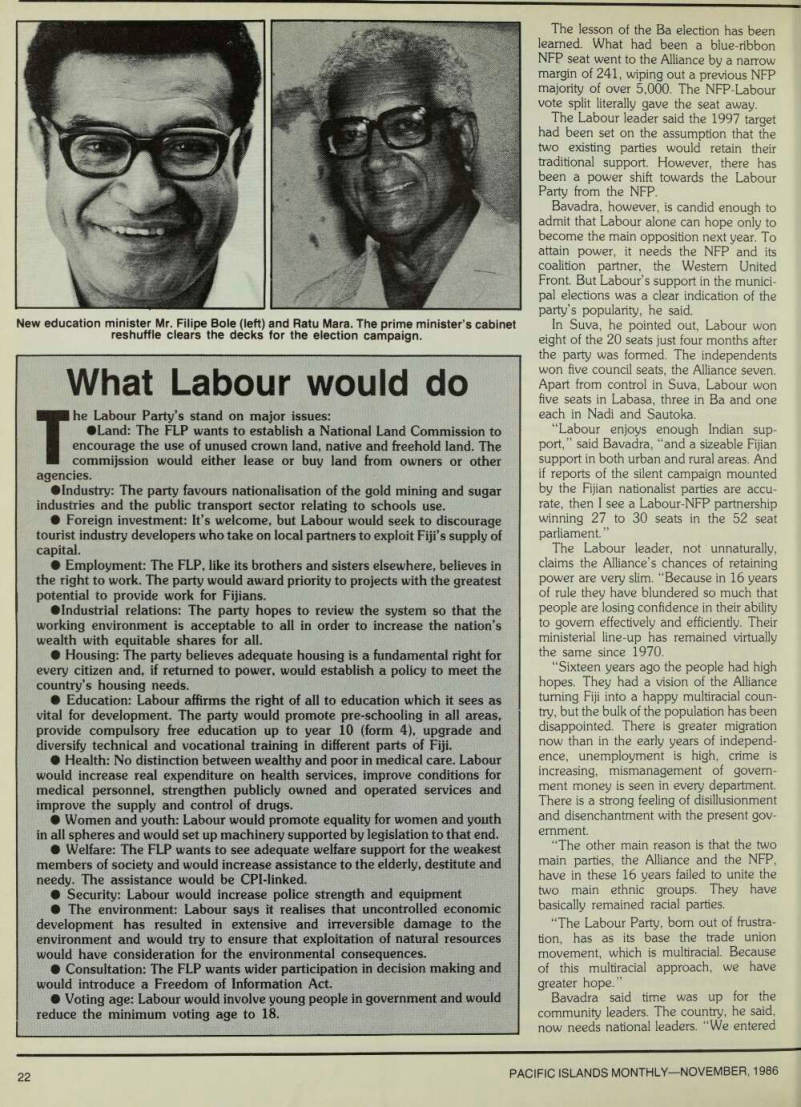
New education minister Mr. Filipe Bole (left) and Ratu Mara. The prime minister’s cabinet reshuffle clears the decks for the election campaign.
independence in 1970 with leaders like Ratu Mara, Ratu Edward, Ratu Penaia, Mr AD. Patel, Mr F.M. Koya and Mr C.A.B.J.
Singh. But if you look at their back grounds, they were community leaders brought up under the colonial administra tion. After independence they were thrust together and told, ‘You are now national leaders. Look after your country.’ It was virtually a new experience for them to work together as national leaders.”
He said that, since independence, a new generation of leaders had developed, most of whom he claimed were now firmly in the Fiji Labour Party. He said their outlook was both multiracial and national. “Frankly the chances of changing Fiji into a truly multiracial country are greater with the new breed of leaders than we have had with those who led us to independence. ”
Bavadra is critical of the prime minister
and Alliance Party president, Ratu Mara over his remarks at political gatherings, claiming the prime minister was appealing to a particular community the Fijians rather than to the nation.
He said it was not fair to play on the sensitivity of race and that national interest should come before community matters. In particular, the Labour leader cited the PM’s address in late September to a mini-convention of the Fijian Association where he called on the Fijians to remain united in order to retain the nation’s leadership.
He told the meeting that, despite being outnumbered by Indians, Fijians had politi cal leadership. If Fijians became divided, then this leadership would slip away from them.
Both the NFP leader, Mr Harish Sharma and Bavadra criticised him for raising the race issue. The Labour leader said Ratu Mara appeared to have abandoned his appeal for racial harmony and tolerance.
He claimed the prime minister’s remarks were provocative and later lodged a formal complaint with the Director of Public Prosecutions asking him to investigate whether the remarks contravened the law.
Bavadra said it was an offence under the Public Order Act to make a statement which was likely to incite racial dislike or hatred of any race or community.
Fiji’s Sunday Sun in a contemporary editorial also appealed for race to be kept out of the campaign; “In the past elections, Ratu Sir Kamisese Mara has called for parties not to indulge in politics of fear and not to fight the election on racial lines. But now the prime minister himself has begun a racially oriented campaign. His call for Fijians to unite to retain political leadership is unwarranted. If every individual race begins campaigning on those lines, this country will be in real trouble.
“For the sake of the International Year
of Peace, political leaders, especially the prime minister, would do well to keep race out of it.”
Bavadra claimed the prime minister’s speech was an indication that the Alliance Party was worried. “In the beginning when the Labour Party was formed, he de scribed it as ‘balolo’ (a sea delicacy that rises once a year and then disappears) but we have proved him wrong.”
For the first time, he said, many Fijians had learned the difference between traditional (chiefly) and political leadership.
“I have been able to explain to them their democratic right to chose the party and the man they want as far as politics is concerned, while at the same time retain ing their loyalty to their traditional chiefs. ”
But in the face of such strong attacks the Alliance Party has been far from idle. It has been preparing financially for the election through fund raising dinners and other activities. It already has $35,000 in de posits and needs about $200,000 to fund its campaign, whereas Labour estimates it will need over $300,000.
Political pundits in Fiji still put the Alliance Party ahead, seeing the NFP- Labour marriage of convenience as doubt ful in electoral terms.
Also, no other party has yet come up with a charismatic leader of the stature both physical and political of Ratu Mara.
Fiji Labour Party leader, Dr. Timoci Bavadra (left) consults with party and trade union official Mahendra Chaudhry during a rally at Ba. Photo: Sunil Chand.