Night of
pp. 17-18 · Read in the full issue
the cyclone
In late 1984 the 274-ton Government vessel Na Mataisau was converted to auxiliary sail on an experi mental fuel-saving study funded by the Asian Deve lopment Bank.
The project was supervised by a British firm of marine consultants, Mac Alister Elliott and Partners Ltd. In January, 1985 I arrived from England to complete the study by spending three months on the ship train ing the crew and collecting performance data.
After spending a few days making some modifications to the rig and getting to know the officers and crew the ship was ready for sea on January 16.
We were bound for the Lau Group with the prime minister Ratu Sir Kamisese Mara and a party of government officials as passengers, calling at Kambara, Lakemba, Thithia and Vanua Mbalavu.
On the morning of our de parture the weather forecast warned that cyclone Eric was 500 miles WNW of Nadi and moving towards the Fiji Group.
The cyclone’s position and pre dicted course were plotted on the chart and the master, Cap tain Roderick Maharak, noted suitable cyclone anchorages in the Lau Group but there was no suggestion of cancelling the voyage.
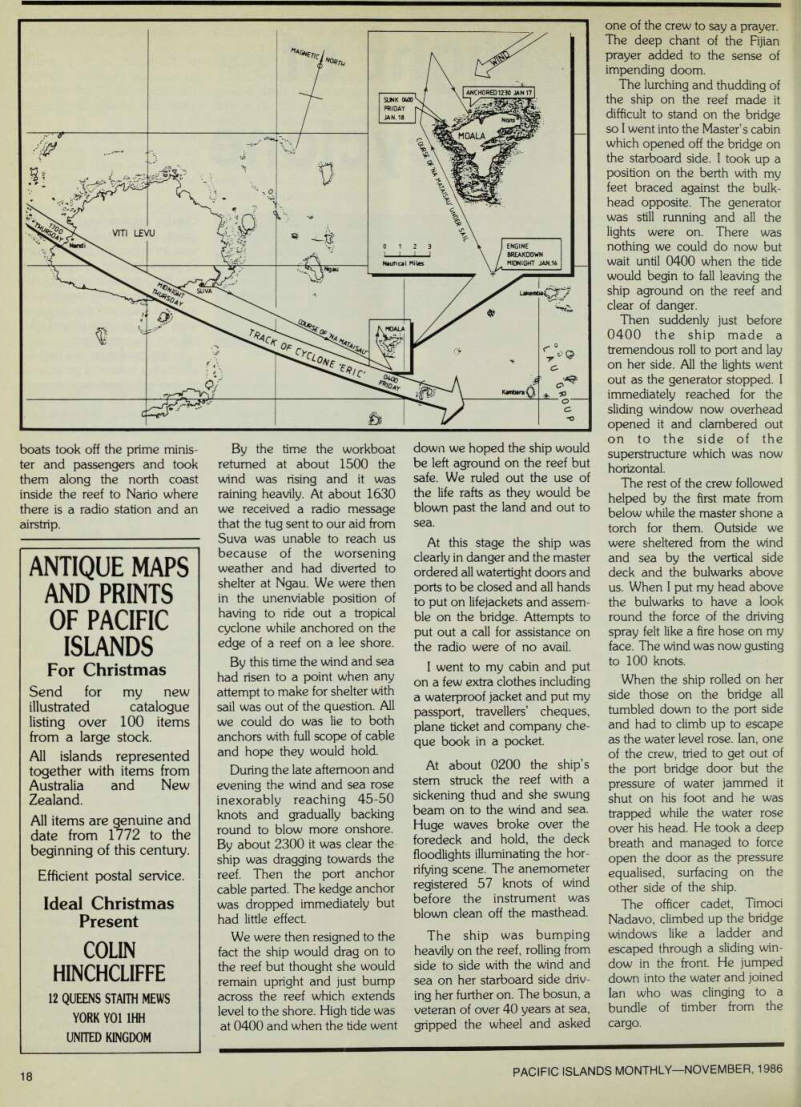
We left Suva at 1400 in a light south-easterly breeze via the Nukulau passage and set a course to pass south of the island of Moala on our way to Kambara.
Just after midnight, when we were about six miles south of Moala, the single main engine broke down. An exhaust valve had fallen inside a cylinder, causing extensive damage which could not be repaired.
By this time cyclone Eric was
The tragic loss of the Fiji government vessel Na Mataisau during cyclone Eric in 1984 with the loss of two lives could have been a worse disaster. The Prime Minister and his party were taken off the doomed vessel hours before the storm struck. CHRIS TEMPLE, who nearly became a victim in the tragedy, recalls that fearsome night.
clearly approaching the Fiji group and a cyclone warning wsa in force for the Western Division. As soon as it was clear the the engine could not be repaired the master requested a tug and a second ship to come from Suva to assist us and take off our 15 passengers.
In the meantime we had an alternative means of propulsion in the sails and two courses were open to us. We could either make our way under sail towards Suva and risk meeting the cyclone before we reached safety or make for Moala to land the prime minister and his party and hopefully reach the shelter of the main settlement at Naroi on the NE point of the island before the cyclone struck.
The latter course was de cided upon as offering the better prospect of safety for the ship, passengers and crew.
The ship sailed towards Moala making about five knots with the wind on the beam and by early morning we were off the west point of the island.
From here the course along the north coast to Naroi was much closer to the wind and progress was slow. To add to our difficul ties the wind changed direction forcing us to tack to windward to reach our objective.
The cyclone was now re ported to be 50 miles WNW off Nandi. By late morning it was clear we would not reach the safety of Naroi before the weather deteriorated and it was decided to anchor off the reef on the north coast of the island to land the prime minister and passengers. At 12.30 we came to anchor off the reef opposite the village of Maloku. The weather was still fine but the cyclone was fast approaching.
The workboat was launched and together with local fishing
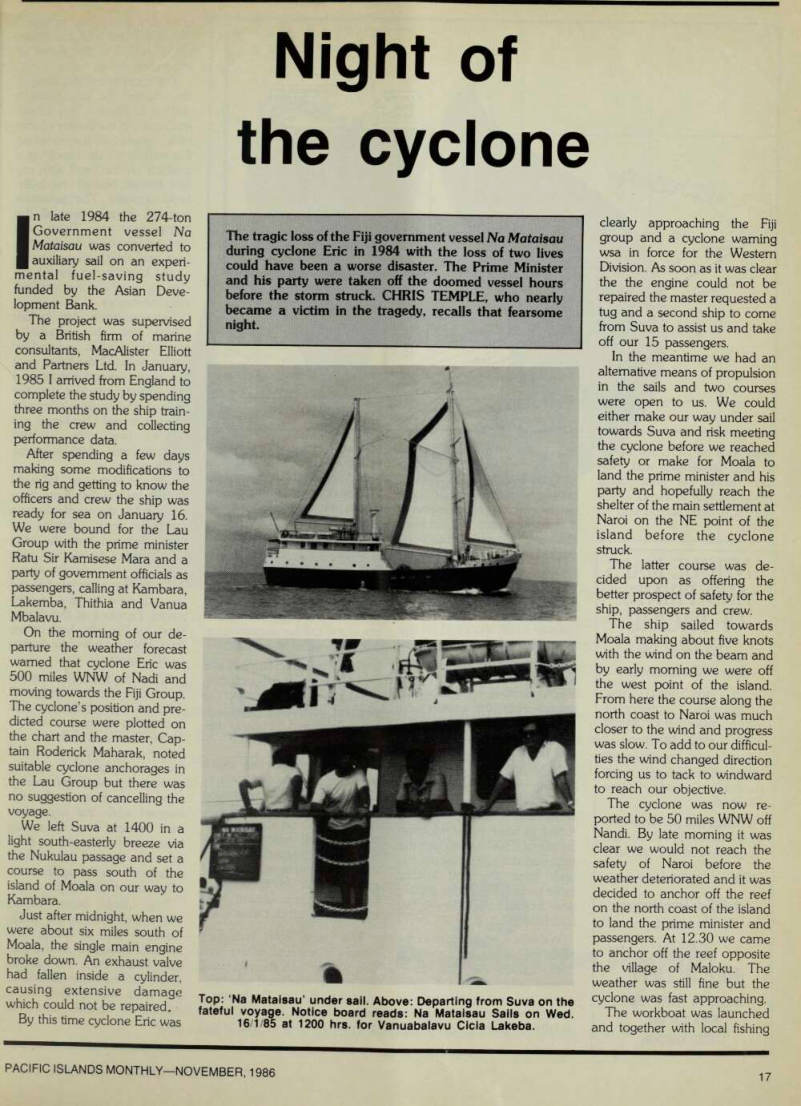
Top: Na Mataisau’ under sail. Above: Departing from Suva on the fateful voyage. Notice board reads: Na Mataisau Sails on Wed. 16/1/85 at 1200 hrs. for Vanuabalavu Cicia Lakeba.
boats took off the prime minister and passengers and took them along the north coast inside the reef to Nario where there is a radio station and an airstrip.
By the time the workboat returned at about 1500 the wind was rising and it was raining heavily. At about 1630 we received a radio message that the tug sent to our aid from Suva was unable to reach us because of the worsening weather and had diverted to shelter at Ngau. We were then in the unenviable position of having to ride out a tropical cyclone while anchored on the edge of a reef on a lee shore.
By this time the wind and sea had risen to a point when any attempt to make for shelter with sail was out of the question. All we could do was lie to both anchors with full scope of cable and hope they would hold.
During the late afternoon and evening the wind and sea rose inexorably reaching 45-50 knots and gradually backing round to blow more onshore.
By about 2300 it was clear the ship was dragging towards the reef. Then the port anchor cable parted. The kedge anchor was dropped immediately but had little effect.
We were then resigned to the fact the ship would drag on to the reef but thought she would remain upright and just bump across the reef which extends level to the shore. High tide was at 0400 and when the tide went
down we hoped the ship would be left aground on the reef but safe. We ruled out the use of the life rafts as they would be blown past the land and out to sea.
At this stage the ship was clearly in danger and the master ordered all watertight doors and ports to be closed and all hands to put on lifejackets and assem ble on the bridge. Attempts to put out a call for assistance on the radio were of no avail.
I went to my cabin and put on a few extra clothes including a waterproof jacket and put my passport, travellers’ cheques, plane ticket and company che que book in a pocket.
At about 0200 the ship’s stem struck the reef with a sickening thud and she swung beam on to the wind and sea.
Huge waves broke over the foredeck and hold, the deck floodlights illuminating the hor rifying scene. The anemometer registered 57 knots of wind before the instrument was blown clean off the masthead.
The ship was bumping heavily on the reef, rolling from side to side with the wind and sea on her starboard side driv ing her further on. The bosun, a veteran of over 40 years at sea, gripped the wheel and asked
one of the crew to say a prayer.
The deep chant of the Fijian prayer added to the sense of impending doom.
The lurching and thudding of the ship on the reef made it difficult to stand on the bridge so I went into the Master’s cabin which opened off the bridge on the starboard side. I took up a position on the berth with my feet braced against the bulk head opposite. The generator was still running and all the lights were on. There was nothing we could do now but wait until 0400 when the tide would begin to fall leaving the ship aground on the reef and clear of danger.
Then suddenly just before 0400 the ship made a tremendous roll to port and lay on her side. All the lights went out as the generator stopped. I immediately reached for the sliding window now overhead opened it and clambered out on to the side of the superstructure which was now horizontal.
The rest of the crew followed helped by the first mate from below while the master shone a torch for them. Outside we were sheltered from the wind and sea by the vertical side deck and the bulwarks above us. When I put my head above the bulwarks to have a look round the force of the driving spray felt like a fire hose on my face. The wind was now gusting to 100 knots.
When the ship rolled on her side those on the bridge all tumbled down to the port side and had to climb up to escape as the water level rose. lan, one of the crew, tried to get out of the port bridge door but the pressure of water jammed it shut on his foot and he was trapped while the water rose over his head. He took a deep breath and managed to force open the door as the pressure equalised, surfacing on the other side of the ship.
The officer cadet, Timoci Nadavo, climbed up the bridge windows like a ladder and escaped through a sliding win dow in the front. He jumped down into the water and joined lan who was clinging to a bundle of timber from the cargo.