Leaders talk of ‘revolution’
p. 12 · Read in the full issue
Row over missile range lease
Where now for the Re public of the Marshall Islands (RMI)? One year on from the eruption of protest when the land lease agreement for Kwajalein Missile Range (KMR) expired on September 30, 1985 the row rumbles on.
Landowners of the Kwajelein Atoll Corporation (KAC) led a series of demonstrations, sit-ins and blockades in a campaign of civil disobedience aimed at hal ting the work of the KMR.
Now one of the protest lead ers, Senator Ataji Bales has warned that the protest is far from over and could culminate “in revolution.”
Bales (who is also KAC chair man), Ebeye mayor, Alvin Jacklick and KAC treasurer, Julian Riklon also assert, how ever, that their campaign is against “American apartheid” as well as for nuclear disarma ment and independence.
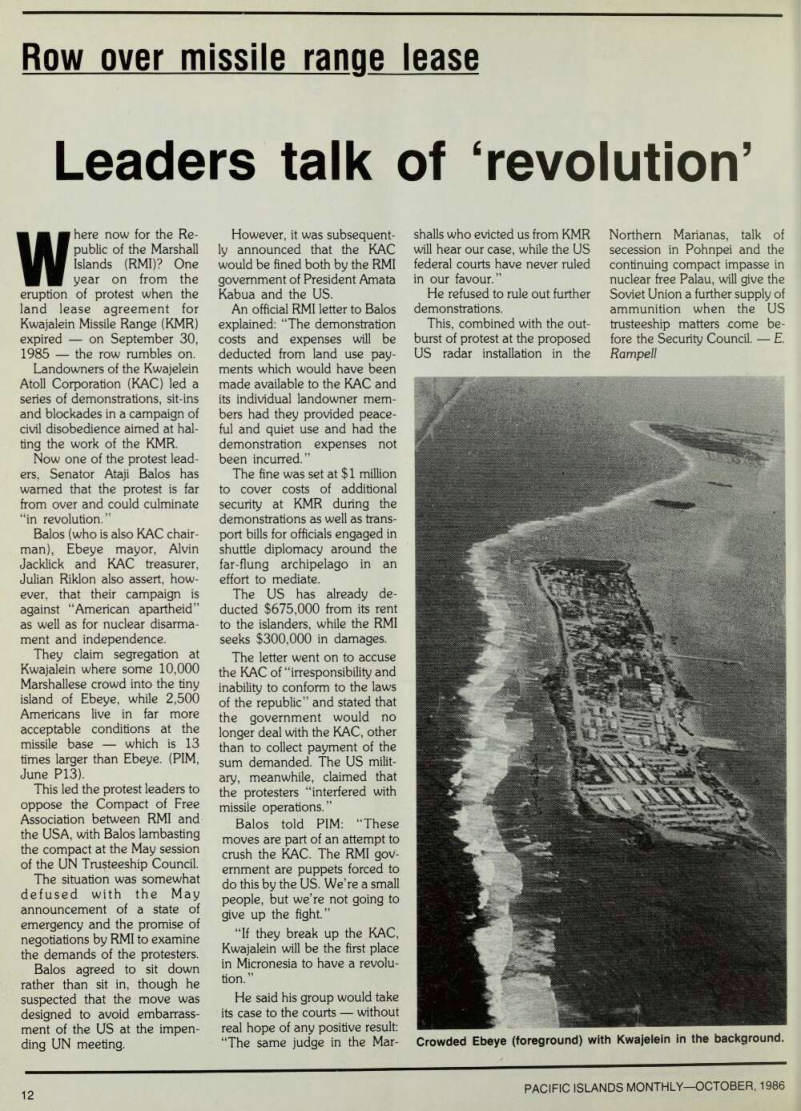
They claim segregation at Kwajalein where some 10,000 Marshallese crowd into the tiny island of Ebeye, while 2,500 Americans live in far more acceptable conditions at the missile base which is 13 times larger than Ebeye. (PIM, June Pl 3).
This led the protest leaders to oppose the Compact of Free Association between RMI and the USA, with Balos lambasting the compact at the May session of the UN Trusteeship Council.
The situation was somewhat defused with the May announcement of a state of emergency and the promise of negotiations by RMI to examine the demands of the protesters.
Balos agreed to sit down rather than sit in, though he suspected that the move was designed to avoid embarrass ment of the US at the impen ding UN meeting.
However, it was subsequent ly announced that the KAC would be fined both by the RMI government of President Amata Kabua and the US.
An official RMI letter to Bales explained: “The demonstration costs and expenses will be deducted from land use pay ments which would have been made available to the KAC and its individual landowner mem bers had they provided peace ful and quiet use and had the demonstration expenses not been incurred.”
The fine was set at $1 million to cover costs of additional security at KMR during the demonstrations as well as trans port bills for officials engaged in shuttle diplomacy around the far-flung archipelago in an effort to mediate.
The US has already de ducted $675,000 from its rent to the islanders, while the RMI seeks $300,000 in damages.
The letter went on to accuse the KAC of “irresponsibility and inability to conform to the laws of the republic” and stated that the government would no longer deal with the KAC, other than to collect payment of the sum demanded. The US milit ary, meanwhile, claimed that the protesters “interfered with missile operations.”
Bales told PIM: “These moves are part of an attempt to crush the KAC. The RMI gov ernment are puppets forced to do this by the US. We’re a small people, but we’re not going to give up the fight.”
“If they break up the KAC, Kwajalein will be the first place in Micronesia to have a revolu tion.”
He said his group would take its case to the courts without real hope of any positive result: “The same judge in the Mar
shalls who evicted us from KMR will hear our case, while the US federal courts have never ruled in our favour.”
He refused to rule out further demonstrations.
This, combined with the out burst of protest at the proposed US radar installation in the
Northern Marianas, talk of secession in Pohnpei and the continuing compact impasse in nuclear free Palau, will give the Soviet Union a further supply of ammunition when the US trusteeship matters come be
fore the Security Council.
E.
Rampell
Crowded Ebeye (foreground) with Kwajelein in the background.