home to his island
p. 11 · Read in the full issue
A soldier goes home to his island
Guam Congressman Ben Blaz, who has emerged as the principal US political leader suppor ting nuclear non-proliferation in the South Pacific, says he does so because he is a son of the islands.
“We are all island people,” he said recently on a visit to San Francisco. “We feed off the resources of the sea. Those resources are migratory.
“We eat tuna, for instance.
The resources are so fragile.
You can’t see radioactivity. And there is the possibility of some thing going violently wrong.
You could have an enormous tidal wave and island people could wake up some morning and their homes would be gone. And they would be gone. ”
These are not the customary sentiments of a customary American politician. Congress man Blaz, however, does not fit anyone’s customary descrip tion.
Ben Blaz is a Chamorro, a native Guamanian bom on the island on February 14, 1928.
As an adolescent, he experi enced the hardships of the Japanese occupation. That time of hunger and privation was not without its rewards, he says. “I was with my father and with my grandfather 24 hours a day. I was given the wisdom they had accumulated over the years.
We suffered for every ounce of sup beans and com.
“One day, my father said to me, ‘I think you are going to be OK; you have discovered the sweetness of the saltiness of sweat’.”
Inspired by the “sweetness of the saltiness of sweat,” young Blaz won a scholarship to Notre Dame University at South Bend, Indiana. Upon gradua tion in 1951, he entered the United States Marine Corps.
Promotions and decorations came regularly.
He had been liberated on
Guam Congressman Ben Blaz, a Republican, has suddenly emerged as the most prominent American politician supporting the New Zealand position on atomic weapons and atomic-powered warships. Because he is a retired US Marine Corps brigadier general and a member of the Armed Services Committee of the US House of Representatives, his views carry special weight. RALPH CRAIB interviewed him in San Francisco.
Guam by the Ninth Regiment of the Marines; he later assumed command of that regi ment in Japan after being promoted to full colonel.
“When I took command of the Ninth Marines, ” he says, “it was a supreme moment. I only wished that the guys in the village on Guam could have seen me.”
Congressman Blaz ended his military career in 1980 with the rank of brigadier-general after 29 years of active duty. He served as military representa tive of the US Joint Chiefs of Staff in talks with the Soviet Union in Helsinki and holds a whole galaxy of medals for combat service and meritorious achievement.
On return to civilian life, he taught at the University of Guam, trying to inspire his young Chamorro students with the unlimited possibilities he believes the future holds for them. His own “incredible odyssey” is a model, he says.
“When I look back on my career in the Marine Corps for all of those years, I realise that the place that means absolutely the most to me, in the twilight of my years, is that little island of Guam,” the member of Con gress says.
“The people who mean most to me are my people, the island people of Guam. The farther away I travel, the more I want to be back with the people of Guam.”
The travels, his experience negotiating with the Soviet Un ion and travelling within it, have all made the congressman
acutely aware of the dangers of nuclear proliferation. He has visited Tahiti and finds that the French “are being arbitrary” and not “giving any thought to New Zealand and Australia.”
He muses about the fact that the Enola Gay left Tinian, part of the same island chain as Guam, to deliver the first ato mic bomb in Japan and talks about the continuing effort to clean up Bikini at both econo mic and human cost. And he thinks about the Chernobyl accident and the possibility of accidents elsewhere, particu larly somewhere in the Pacific.
“I find this problem very difficult,” he says. “Maybe we (mankind) need a few little areas where there’s a haven from nuclear worries. I think that the focus may be changing.
People are saying, ‘hey, this lake is getting choppy. We better take another look.’ I don’t think that the United States ever realised what a precious gem this ocean is, what gems these islands are.”
The congressman defines himself, as do many American military men, as a “peacekeep er.” His career in the Marine Corps was largely that of being prepared to use force so that its use would never be neces sary. His public pronounce ments, however, stress the strategic value of Guam and of its Air Force and Navy bases.
He placed particular emphasis upon Guam’s military import ance during the long period of instability in the Philippines be fore the Marcos regime col lapsed.
Some time ago, because of public criticism of some former military men receiving both pension and a salary in a new job, legislation was enacted prohibiting former active duty officers from receiving pensions while in Congress. Congress man Blaz is the only member of Congress so penalised.
He receives an annual salary of $75,000 as a member of the House of Representatives but has had to give up his Marine Corps pension of $45,000 per annum. This, not surprisingly, disturbs him. “I think soldiers should have the same rights as shoemakers, doctors and lawyers,” he says.
One of Congressman Blaz’s highest priorities is his pursuit of Commonwealth status in Guam’s relationship with the United States. The proposal, first put forth seriously in 1980, would give Guam greater autonomy while preserving its ties to the United States.
Some Washington observers feel that Blaz’s many abilities and strong force of personality gives Commonwealth status a better chance of attainment than has existed in the past.
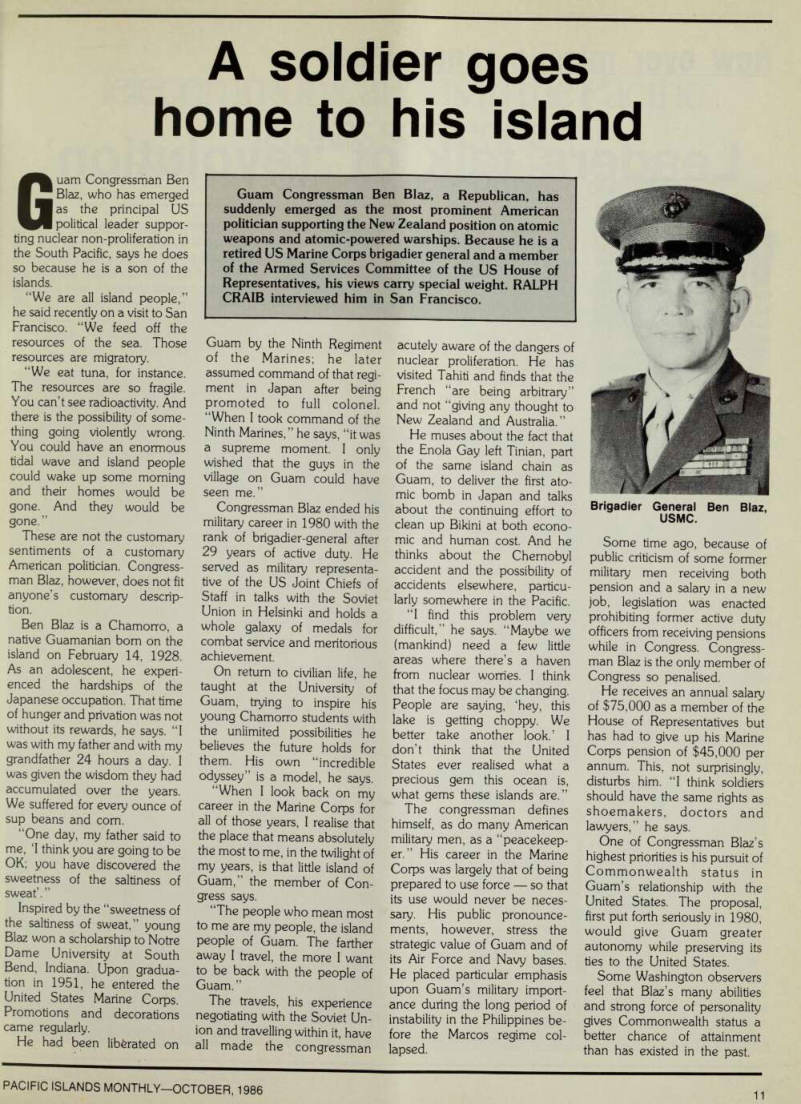
Brigadier General Ben Blaz,