Judges join the legal trade
pp. 14-16 · Read in the full issue


legal trade
One of the most intriguing items in the South Paci fic import-export trade is that of judicial talent.
Britain, New Zealand and the United States are among the exporters: American Samoa, the Cooks, the Solomons and Tuvalu among the importers; while Fiji plays both roles, simultaneously importing and exporting judges.
Perhaps the most remarkable aspect of these arrangements, to American eyes, is the role played from a distance by Lon don’s Law Lords. They serve as the highest court of appeal for Fiji, Tuvalu and other island jurisdictions, as they do for all of New Zealand’s legal contests and for some cases arising in the Queensland courts. (Austra lia’s own High Court serves as the highest tribunal for most Australian legal matters).
The Law Lords, more formally the Judicial Committee of Her Majesty’s Privy Council, are selected from the member ship of the House of Lords.
They have the last word on the interpretation of the United Kingdom’s statutes, and have preserved this role for many of the nations that used to be part of the British Empire.
Although the number of Pacific-based cases reaching the Privy Council is modest, the Law Lords’ role can be a powerful one.
A few years ago, for exam ple, they over-ruled the Gov ernment of New Zealand on an immigration case, holding that a New Zealand statute should be interpreted in such a way as to make most of Western Samoa’s population legal residents of New Zealand. (PIM, Jan., ’B5).
The Prime Ministers of the two countries had a hurried summit meeting and subse quently New Zealand’s Parlia ment moved quickly (and unanimously) to limit the effect of the Law Lords’ ruling, and, in the process, provided instant
citizenship to a number of Sa moans resident in New Zealand who had previously been re garded as illegal aliens.
The setting for the Law Lords in session is an informal one according to Ratu Josua Brown Toganivalu, who visited their chambers while serving as Fiji’s High Commissioner in London.
“I thought I was going to see a truly impressive, formal opera tion,” he told me once, “but it was just a bunch of men, sitting around a table in a small room, talking with each other and interrupting each other.”
While the Law Lords extend their influence to the Pacific without ever leaving Westmins ter, there is a small body of men (no women seem to be in
volved) who work full or part time in the islands’ judicial trade. Fiji’s court system, for example, is largely staffed by such persons.
The highest of Fiji’s courts is the Fiji Court of Appeal, which has five working members, three New Zealanders and two Fiji citizens. All are appointed by Fiji’s Governor-General to serve in these part-time posi tions.
The Court meets three times a year, in March, June and October, for sessions of four to six weeks, depending on the workload. The presiding officer of the Court, who does not, in fact, sit on cases, is Sir Timoci Tuivaga, a Fijian who also serves as Chief of Fiji’s
Supreme Court (the nation’s principal trial court) from which decisions can be appealed to the Court of Appeal.
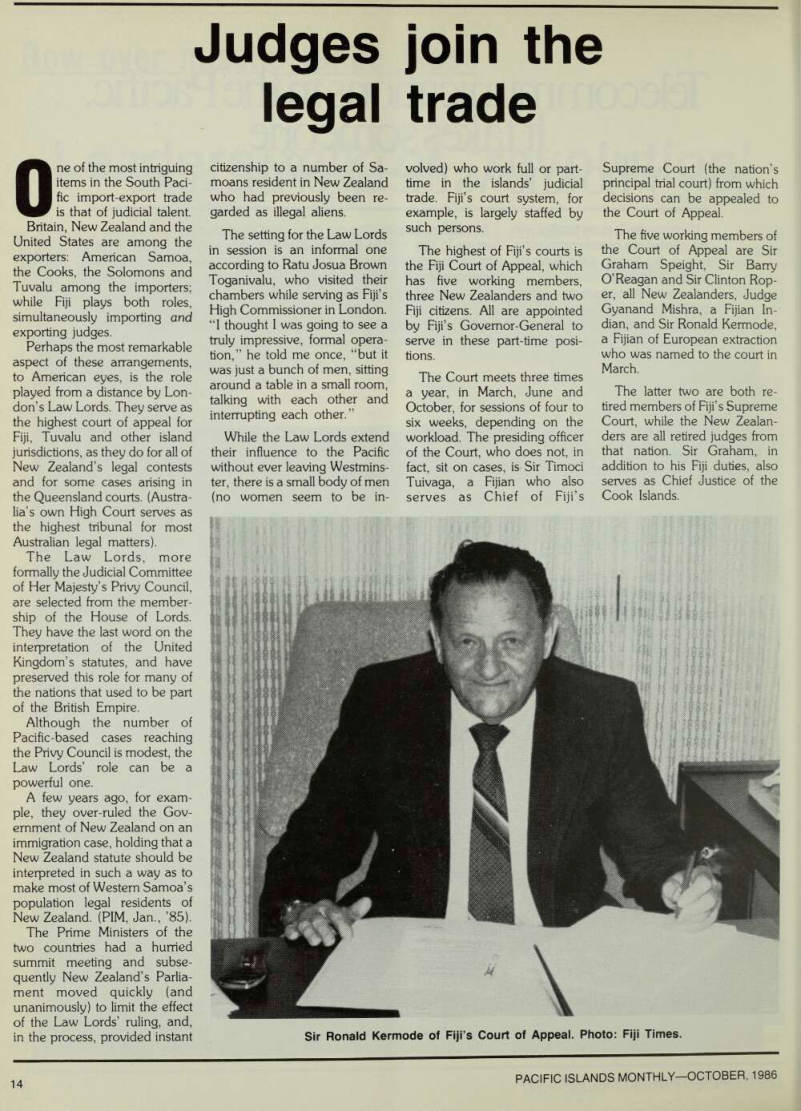
The five working members of the Court of Appeal are Sir Graham Speight, Sir Barry O’Reagan and Sir Clinton Rop er, all New Zealanders, Judge Gyanand Mishra, a Fijian In dian, and Sir Ronald Kermode, a Fijian of European extraction who was named to the court in March.
The latter two are both re tired members of Fiji’s Supreme Court, while the New Zealan ders are all retired judges from that nation. Sir Graham, in addition to his Fiji duties, also serves as Chief Justice of the Cook Islands.
Sir Ronald kermode of Fiji’s Court of Appeal. Photo: Fiji Times.
These judges work in groups of three, usually two New Zealanders and one Fijian citizen. The formalities of court are strictly observed, with wigs and gowns required of the judges and of the lawyers appearing before them. The only sartorial sign of the islands to be seen in their modest courtrooms is the uniform worn by the member of the Fiji Royal Police in attendance.
The judges, probably with their wigs and gowns in mind, have secured airconditioning for their rooms, though Fiji’s Parliament, which meets in a small building a few yards from the courtrooms, does not in dulge in that luxury. Fiji’s Sen ate and House of Representa tives, incidentally, take turns using a single room for their deliberations, an economy measure.
Fiji’s Supreme Court is also dominated by imported talent.
There are seven judges, four of them expatriates. The quartet includes a British lawyer, a New Zealander, and two Irishmen who spent a number of years in judicial positions in British Afri ca. The three Fiji citizens, prob ably not accidentally, are repre sentatives of Fiji’s three ethnic groups.
Fiji, however, is both an exporter and an importer of judicial talent, with the exports going to Tuvalu. That nation,
with only some 8000 inhabi tants, has enlisted Fijian judges to help run its complex, six layer judicial system.
Tuvalu’s court system starts at the grass roots with Island Magistrate courts; the magis trates are not lawyers, but are older men respected by their communities.
A decision in these courts can be appealed to the national Magistrates’ Court, and from there to a Senior Magistrate’s Court. From there the appeal goes, sequentially, to Tuvalu’s High Court, to the Court of Appeal in Fiji, and from there to the Law Lords.
To some extent the upper reaches of this structure appear only on paper. While Fiji’s Chief Magistrate, makes about two trips a year to Tuvalu (at Tuvalu expense) to preside over the Senior Magistrate’s Court, the High Court is with out a Chief Justice.
Sir Timoci had held the post but resigned because of the pressure of other business. This is in keepng with his comments to the press, in April, that Fiji’s Supreme Court was overbur dened (a condition that relates to the fact that any Fijian citizen can take any matter directly to that court, short-circuiting the system of magistrate’s courts).
According to Feve Tipu, Tuvalu’s High Commissioner to Fiji (and to Papua New
Guinea), the Government of New Zealand has been asked to find a new Chief Justice for Tuvalu. He also told me that few cases have been heard by the Fiji Court of Appeal and none, to his knowledge, had ever gone as far as the Law Lords.
Now Fiji has become an “exporter” to Solomon Islands with departure of chief magis trate Gordon Ward, the new chief justice in Honiara.
Similarly, Fiji is not the only island nation exporting judicial talent. Papua New Guinea re cently entered negotiations with Vanuatu to provide some judges.
While the appointment of expatriate judges and the use of the Privy Council are voluntary actions taken by the island governments, the situation in American Samoa is different, reflecting its colonial position, as well as the political partner ship that often plays a role in the selection of American judges.
The recent selection of Grov er Rees as Chief Justice of American Samoa reminded me of my own experiences with exporting judges to the South Pacific.
That occured some 19 years ago when I was serving in a mid-level political position on the outskirts of Lyndon John son’s White House. I was director of the Cabinet Com mittee on Mexican American Affairs, then newly-created but now a long-since abandoned arm of the U.S. Government.
One of my visitors was, as many of them were, a good Democrat, a Texan, a lawyer and a Mexican American. He wanted a job.
“But you have a job, a good one,” I said “you are an Associ ate Justice of the Supreme Court of an American Samoa. ”
He agreed, but said that he had been there for close to five years and he wanted to get back to the mainland. “My kids are losing touch with America I want them to attend Amer ican high schools. Besides, the Chief Justice is impossible.”
The Chief was also from the mainland, an Anglo (i.e. non- Mexican) political appointee.
He and my Mexican American friend were, at the time, two of the very few lawyers in the territory (I think no Samoans had completed law school at that time). There were Sa moans on the Supreme Court (as it was then known) but they were non-lawyers, older men steeped in the traditions of the islands, who gave advice but had no votes on the Court.
I made a few phone calls and eventually the U.S. Post Office Department, then a thoroughly political agency, found a posi tion for him, full-time and in Washington, in a quasi-judical role roughly analogous to a post as a federal magistrate.
At this point we were able to pull off a minor coup for the Mexican American Democrats.
We knew that the Associate Judgeship of the Samoan Supreme Court was vacant and no one else, at least in Washington, had that informa tion.
Without a thought for the residents of American Samoa (I blush to say in retrospect), but with a real concern for what was then another colonial population (the Mexican Amer icans) we found another good Texas Democrat, a lawyer and a Mexican American, who was seeking a job.
We told him about the opportunity, he liked the idea, and our contacts in the Office of the Secretary of Interior arranged for his appointment. I never heard from him again, and have no clue as to how he fared in the islands.
While the U.S. continues to send mainland political appoin tees to the Samoan High Court, it does not do so for the other island territories (Puerto Rico, Guam and the Virgin Islands).
Those jurisdictions select their own territorial judges.
Federal district court judges in those three territories are appointed, as federal judges are on the mainland, by the White House. (There is no federal district court judge for American Samoa). The one federal dis trict court judge in a Pacific Territory is a native of Guam, Cristobal C. Duenas; he has been the Federal district court judge for Guam since Decem ber, 1969 David S. North.
Former Fiji chief magistrate and now Solomon Islands Chief Justice, Mr Gordon Ward. Photo: FIJI Times.