shipping efficiency
pp. 27-28 · Read in the full issue

trade winds
Sail power hoists shipping efficiency
FIJI, like all Pacific Island nations, depends on in ter-island shipping sus tain its economic, politi cal and social life. The small inter-island passenger-cargo vessels, generally built in times of cheap fuel, are not efficient to run.
Shipping consumes a large proportion of the fuel and fore ign exchange budgets. All fuel has to be imported and one sixth is used for shipping.
In the ten years between 1970 and 1980, fuel costs rose fourteen times, consumption by 70 per cent and the total import
Despite the tragic loss of a vessel and two lives during a cyclone, an experiment in inter-island shipping using sail as well as diesel power is proving to be a success. Sail power has helped reduce fuel bills and has made voyages less unpleasant for passengers.
bill rose nearly twenty-five times.
At the request of the Fiji Government, the Asian Deve lopment Bank funded a study to assess the value of fitting auxiliary sail to existing vessels to save fuel. Mac Alister Elliott and Partners Ltd., a British firm of international marine and fisheries consultants, were re
cruited to carry out this study on the Fiji Government Fleet of inter-island vessels.
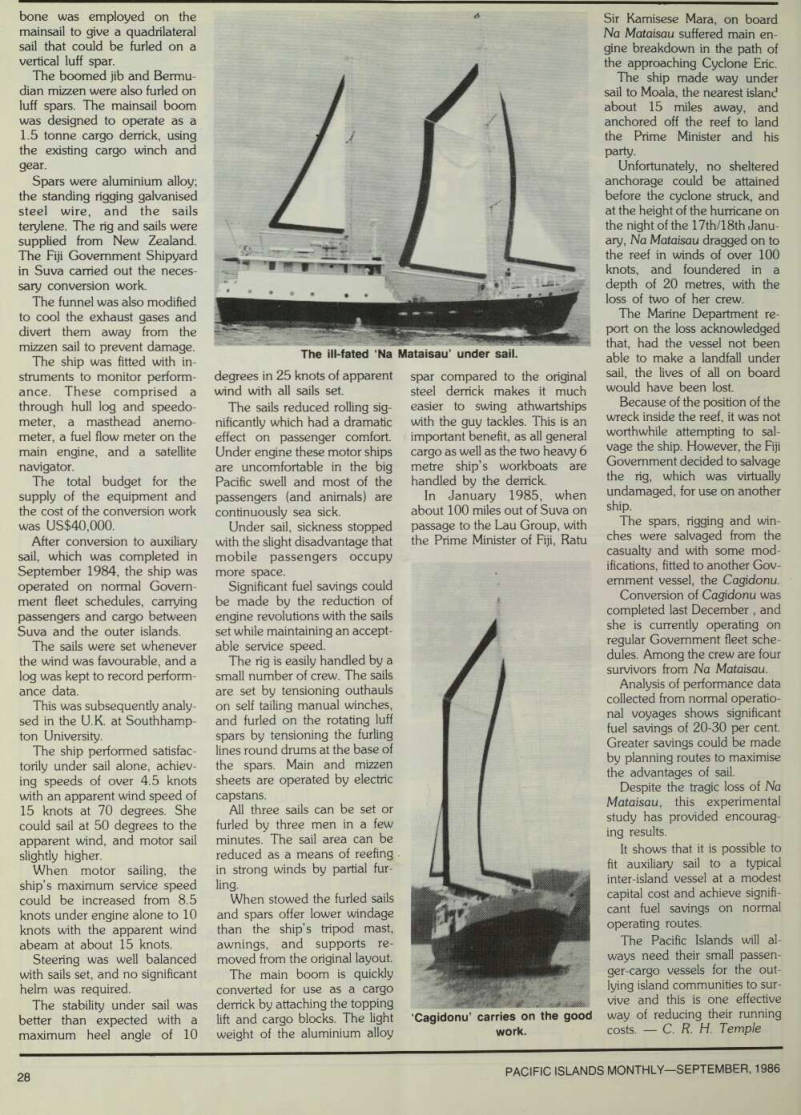
The project selected a typical inter-island motor ship from the Fiji Government fleet for conversion to auxiliary sail. She was the Na Mataisau, a 27 metre LOA, 274 GRT steel passenger cargo vessel, powered by a single GM V 6-71
diesel engine.
An appropriate rig was de signed to satisfy the require ments of simplicity, reliability and ease of handling within a modest budget.
A soft sail ketch rig was chosen, with manually oper ated roller furling on all sails.
The sail area of 201 sq. metres was designed to give a heel angle of 10 degrees in about 20 knots of apparent wind, when reefing would begin.
The layout of the ship lent itself to a two masted configura tion with the mainsail over the cargo hold. A standing wish
bone was employed on the mainsail to give a quadrilateral sail that could be furled on a vertical luff spar.
The boomed jib and Bermu dian mizzen were also furled on luff spars. The mainsail boom was designed to operate as a 1.5 tonne cargo derrick, using the existing cargo winch and gear.
Spars were aluminium alloy; the standing rigging galvanised steel wire, and the sails terylene. The rig and sails were supplied from New Zealand.
The Fiji Government Shipyard in Suva carried out the neces sary conversion work.
The funnel was also modified to cool the exhaust gases and divert them away from the mizzen sail to prevent damage.
The ship was fitted with in struments to monitor perform ance. These comprised a through hull log and speedo meter, a masthead anemo meter, a fuel flow meter on the main engine, and a satellite navigator.
The total budget for the supply of the equipment and the cost of the conversion work was US$4O,OOO.
After conversion to auxiliary sail, which was completed in September 1984, the ship was operated on normal Govern ment fleet schedules, carrying passengers and cargo between Suva and the outer islands.
The sails were set whenever the wind was favourable, and a log was kept to record perform ance data.
This was subsequently analy sed in the U.K. at Southhamp ton University.
The ship performed satisfac torily under sail alone, achiev ing speeds of over 4.5 knots with an apparent wind speed of 15 knots at 70 degrees. She could sail at 50 degrees to the apparent wind, and motor sail slightly higher.
When motor sailing, the ship’s maximum service speed could be increased from 8.5 knots under engine alone to 10 knots with the apparent wind abeam at about 15 knots.
Steering was well balanced with sails set, and no significant helm was required.
The stability under sail was better than expected with a maximum heel angle of 10
degrees in 25 knots of apparent wind with all sails set.
The sails reduced rolling sig nificantly which had a dramatic effect on passenger comfort.
Under engine these motor ships are uncomfortable in the big Pacific swell and most of the passengers (and animals) are continuously sea sick.
Under sail, sickness stopped with the slight disadvantage that mobile passengers occupy more space.
Significant fuel savings could be made by the reduction of engine revolutions with the sails set while maintaining an accept able service speed.
The rig is easily handled by a small number of crew. The sails are set by tensioning outhauls on self tailing manual winches, and furled on the rotating luff spars by tensioning the furling lines round drums at the base of the spars. Main and mizzen sheets are operated by electric capstans.
All three sails can be set or furled by three men in a few minutes. The sail area can be reduced as a means of reefing in strong winds by partial fur ling.
When stowed the furled sails and spars offer lower windage than the ship’s tripod mast, awnings, and supports re moved from the original layout.
The main boom is quickly converted for use as a cargo derrick by attaching the topping lift and cargo blocks. The light weight of the aluminium alloy
spar compared to the original steel derrick makes it much easier to swing athwartships with the guy tackles. This is an important benefit, as all general cargo as well as the two heavy 6 metre ship’s workboats are handled by the derrick.
In January 1985, when about 100 miles out of Suva on passage to the Lau Group, with the Prime Minister of Fiji, Ratu
Sir Kamisese Mara, on board Na Mataisau suffered main en gine breakdown in the path of the approaching Cyclone Eric.
The ship made way under sail to Moala, the nearest island about 15 miles away, and anchored off the reef to land the Prime Minister and his party.
Unfortunately, no sheltered anchorage could be attained before the cyclone struck, and at the height of the hurricane on the night of the 17th/18th Janu ary, Na Mataisau dragged on to the reef in winds of over 100 knots, and foundered in a depth of 20 metres, with the loss of two of her crew.
The Marine Department re port on the loss acknowledged that, had the vessel not been able to make a landfall under sail, the lives of all on board would have been lost.
Because of the position of the wreck inside the reef, it was not worthwhile attempting to sal vage the ship. However, the Fiji Government decided to salvage the rig, which was virtually undamaged, for use on another ship.
The spars, rigging and win ches were salvaged from the casualty and with some mod ifications, fitted to another Gov ernment vessel, the Cagidonu.
Conversion of Cagidonu was completed last December, and she is currently operating on regular Government fleet sche dules. Among the crew are four survivors from Na Mataisau.
Analysis of performance data collected from normal operatio nal voyages shows significant fuel savings of 20-30 per cent.
Greater savings could be made by planning routes to maximise the advantages of sail.
Despite the tragic loss of Na Mataisau, this experimental study has provided encourag ing results.
It shows that it is possible to fit auxiliary sail to a typical inter-island vessel at a modest capital cost and achieve signifi cant fuel savings on normal operating routes.
The Pacific Islands will al ways need their small passen ger-cargo vessels for the out lying island communities to sur vive and this is one effective way of reducing their running
costs.
C. R. H. Temple
The ill-fated Na Mataisau’ under sail.
‘Cagidonu’ carries on the good work.