Pennies More
pp. 24-25 · Read in the full issue
For A Few
Every morning when the lucky ones set out to go work, a less fortunate man takes a bus to Port Moresby’s Boroko shopping centre to begin his clay’s toil.
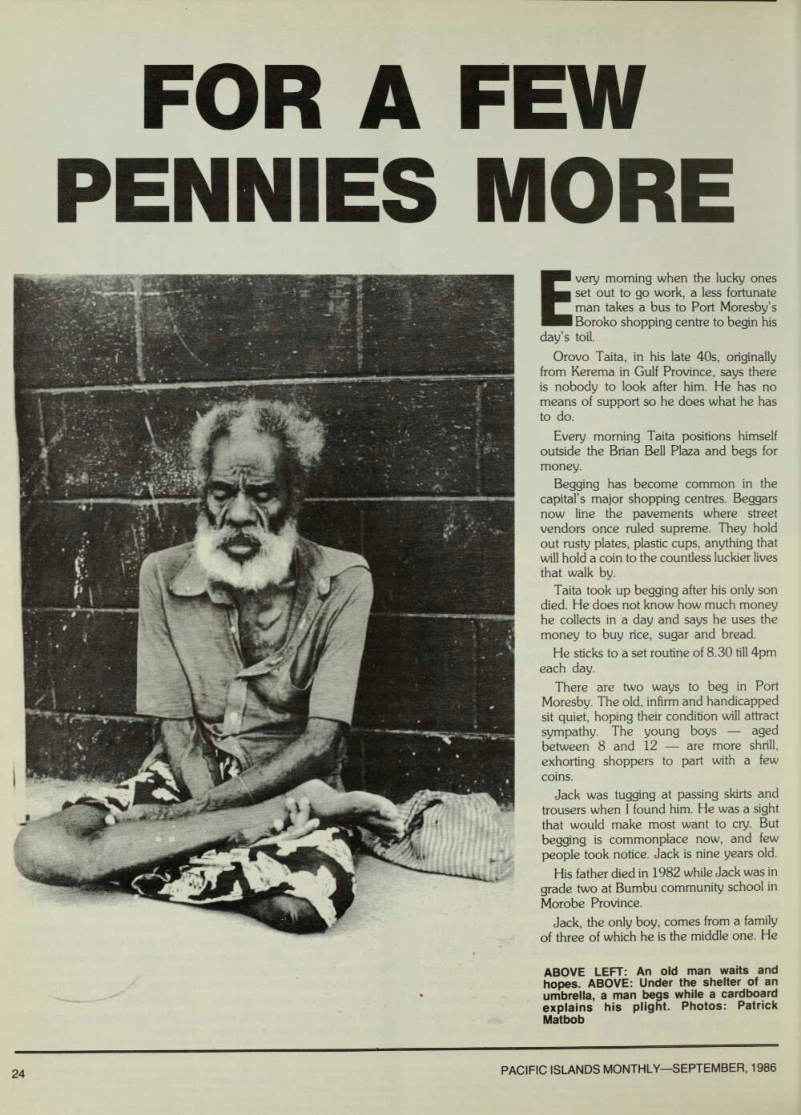
Orovo Taita, in his late 40s, originally from Kerema in Gulf Province, says there is nobody to look after him. He has no means of support so he does what he has to do.
Every morning Taita positions himself outside the Brian Bell Plaza and begs for money.
Begging has become common in the capital’s major shopping centres. Beggars now line the pavements where street vendors once ruled supreme. They hold out rusty plates, plastic cups, anything that will hold a coin to the countless luckier lives that walk by.
Taita took up begging after his only son died. He does not know how much money he collects in a day and says he uses the money to buy rice, sugar and bread.
He sticks to a set routine of 8.30 till 4pm each day.
There are two ways to beg in Port Moresby. The old, infirm and handicapped sit quiet, hoping their condition will attract sympathy. The young boys aged between 8 and 12 are more shrill, exhorting shoppers to part with a few coins.
Jack was tugging at passing skirts and trousers when I found him. He was a sight that would make most want to cry. But begging is commonplace now, and few people took notice. Jack is nine years old.
His father died in 1982 while Jack was in grade two at Bumbu community school in Morobe Province.
Jack, the only boy, comes from a family of three of which he is the middle one. He
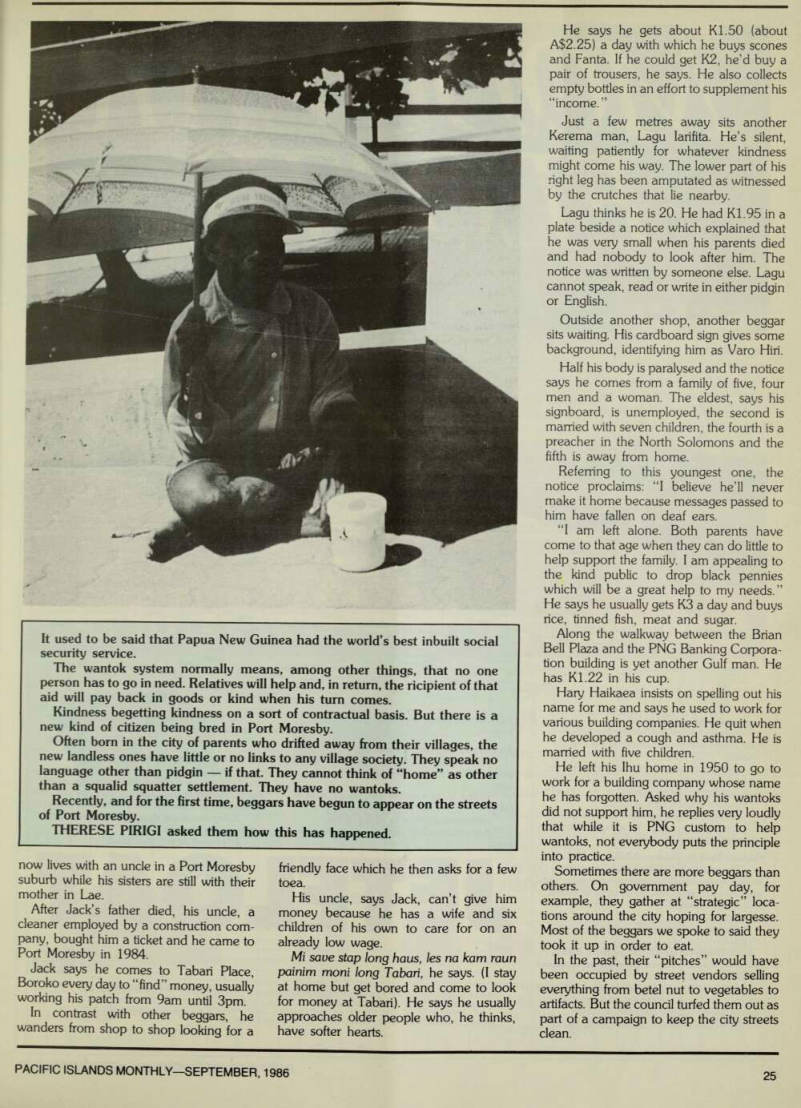
ABOVE LEFT: An old man waits and hopes. ABOVE: Under the shelter of an umbrella, a man begs while a cardboard explains his plight. Photos: Patrick Matbob
It used to be said that Papua New Guinea had the world’s best inbuilt social security service.
The wantok system normally means, among other things, that no one person has to go in need. Relatives will help and, in return, the ricipient of that aid will pay back in goods or kind when his turn comes.
Kindness begetting kindness on a sort of contractual basis. But there is a new kind of citizen being bred in Port Moresby.
Often born in the city of parents who drifted away from their villages, the new landless ones have little or no links to any village society. They speak no language other than pidgin if that. They cannot think of “home” as other than a squalid squatter settlement. They have no wantoks.
Recently, and for the first time, beggars have begun to appear on the streets of Port Moresby.
THERESE PIRIGI asked them how this has happened.
now lives with an uncle in a Port Moresby suburb while his sisters are still with their mother in Lae.
After Jack s father died, his uncle, a cleaner employed by a construction company, bought him a ticket and he came to Port Moresby in 1984.
Jack says he comes to Tabari Place, Boroko every day to “find” money, usually working his patch from 9am until 3pm.
In contrast with other beggars, he wanders from shop to shop looking for a
friendly face which he then asks for a few toea.
His uncle, says Jack, can’t give him money because he has a wife and six children of his own to care for on an already low wage.
Mi save stop long haus, les na kam raun painim moni long Tabari, he says. (I stay at home but get bored and come to look for money at Tabari). He says he usually approaches older people who, he thinks, have softer hearts.
He says he gets about K 1.50 (about A 52.25) a day with which he buys scones and Fanta. If he could get K 2, he’d buy a pair of trousers, he says. He also collects empty bottles in an effort to supplement his “income. ”
Just a few metres away sits another Kerema man, Lagu larifita. He’s silent, waiting patiently for whatever kindness might come his way. The lower part of his right leg has been amputated as witnessed by the crutches that lie nearby.
Lagu thinks he is 20. He had K 1.95 in a plate beside a notice which explained that he was very small when his parents died and had nobody to look after him. The notice was written by someone else. Lagu cannot speak, read or write in either pidgin or English.
Outside another shop, another beggar sits waiting. His cardboard sign gives some background, identifying him as Varo Hiri.
Half his body is paralysed and the notice says he comes from a family of five, four men and a woman. The eldest, says his signboard, is unemployed, the second is married with seven children, the fourth is a preacher in the North Solomons and the fifth is away from home.
Referring to this youngest one, the notice proclaims: “I believe he’ll never make it home because messages passed to him have fallen on deaf ears.
“I am left alone. Both parents have come to that age when they can do little to help support the family. I am appealing to the kind public to drop black pennies which will be a great help to my needs.”
He says he usually gets K 3 a day and buys rice, tinned fish, meat and sugar.
Along the walkway between the Brian Bell Plaza and the PNG Banking Corpora tion building is yet another Gulf man. He has K 1.22 in his cup.
Hary Haikaea insists on spelling out his name for me and says he used to work for various building companies. He quit when he developed a cough and asthma. He is married with five children.
He left his Ihu home in 1950 to go to work for a building company whose name he has forgotten. Asked why his wantoks did not support him, he replies very loudly that while it is PNG custom to help wantoks, not everybody puts the principle into practice.
Sometimes there are more beggars than others. On government pay day, for example, they gather at “strategic” loca tions around the city hoping for largesse.
Most of the beggars we spoke to said they took it up in order to eat.
In the past, their “pitches” would have been occupied by street vendors selling everything from betel nut to vegetables to artifacts. But the council turfed them out as part of a campaign to keep the city streets clean.