A new force in the land
p. 23 · Read in the full issue
French Polynesia enjoys a high standard of living, essentially due to the political and military pre sence of the parent country.
But this conventional wisdom is about to be challenged by an up and coming local politician who sees “the main problem” as “the unfair distribution of wealth which profits only a small minority, while thousands of Polynesians live in near misery in slums on the outskirts of Papeete.”
This is not the statement of a rabid left wing radical. It is the considered view of a self-made businessman turned politician.
Enrique Braun-Ortega, elected this year to the Territo rial Assembly, hopes to forge an opposition alliance capable of toppling Flosse at the next election.
He pulls no punches. “I am glad that a Polynesian was named Under Secretary of State in charge of South Pacific affairs. However, I regret that it had to be Gaston Flosse as I fear that his self serving attitude and his irresponsible megalo mania will tarnish further the image of France and Tahiti in this part of the world,” said the man known as “Quito”.
Braun-Ortega and Flosse have crossed swords in the past but in the world of business rather than politics.
The Papeete-born new politi cian, who went to school in Hawaii and spent four years in the US Navy at the height of the Vietnam war, returned to Tahiti at the end of 1974 to join the family company Enterprise J.A.
Cowan et Fils which was founded in 1924 by his grandparents.
Elected chairman the follow ing year a position he still holds he set about diversify ing the business through a New Zealand shipping link which became the CTM-Tahiti Line whose freight and passenger services have steadily increased over the years.
In 1985, the company’s MV Bounty 3 transported 82,430 tons of freight from New Zea land to Tahiti, representing 27
The most successful and best known French Polynesian politician of recent years is Gaston Flosse, winner in both the territorial and national elections this year. Now, however, a rival of similar training and background is beginning to emerge, report * MARIE-THERESE and
Bengt Danielsson.
per cent of the total tonnage unloaded in the port of Pape ete. The vessel, he said, is manned by an all-Tahitian crew with the exception of the chief engineer.
However, Braun-Ortega ac cuses Flosse of attempting to stifle this initiative as well as another.
“As early as 1982,” he said, “we took a 10 per cent interest in Tahiti Conquest airline, a local charter company.
“In August, 1984, at the request of the local govern ment, we participated in the creation of Tahiti Airlines, whose prime objective was the reorganisation of inter-island air services in French Polynesia as a stepping stone to an in ternational air transport pro ject.”
However, he said, at the same time Flosse was negotiat ing with the French airline UTA and the Tahiti Airlines project died.
“I finally decided last year to enter politics,” he said. “It was because I disagreed very strongly with Gaston Flosse’s political system which operates against the economic and social interests of the territory and its people. ”
The opposition to Flosse in this year’s campaign was at an immediate disadvantage, how ever.
“The vastness of French Polynesia and the cost of trans port restrained the movements of the opposition parties be cause they lacked the financial resources to travel everywhere,” Braun-Ortega said.
On the other hand, he said, Flosse and his allies were able to make use of official means to tour all the islands carrying their political message as well as gifts.
“Gaston Flosse’s victory was above all achieved with the
help of the enormous financial resources he used to influence the voters of the distant Mar quesas, Tuamotu-Gambier and Austral islands,” he told PIM.
“He owes his majority to the millions of Pacific francs the government poured into the remote islands.”
This, he said, explains why Flosse’s Gaullist RPR-affiliated party, Tahoeraa obtained up to 71 per cent of the votes in the Marquesas, while winning only 36 per cent on the islands of Tahiti and Moorea.
Disunity among the opposi tion parties, however, also con tributed to Flosse’s sweeping overall victory.
The goal of the Alliance had been to gather all moderate opposition parties under one banner “promoting the general welfare of the people.”
This alliance was concluded by the presidents of Arnuitahir aa, Here Ai’a and Maohinui.
However, the president of Here Ai’a, Jean Juventin, later pulled out of the alliance, “thus demoralising those voters who wanted a change, ” according to Braun-Ortega, who said he still did not know the reason for the sudden change of heart.
“The election results show,” he said, “that an alliance includ ing Here Ai’a would have obtained the majority in the Territorial Assembly and Jean Juventin would have been re elected to the National Assembly. ”
He said his other concern was the eventual termination of the French government’s assist ance and “the vital importance of planning substitute economic activities to provide employ ment for the 2,500 young Polynesians entering professio nal life each year.”
“But before even talking about economic policies, we must give back to each Polyne-
sian his freedom and his dignity.
“Then, in opposition to Flos se’s government ... we wish to give the elected officials, espe cially in the distant islands, more responsibility in the de cisions that affect the future of their islands and people.”
To do that, Braun-Ortega proposes to create six geographical regions with large ly decentralised powers.
“The major economic deve lopment we can hope for is an economy based on tourism,” he said. “But we want to tailor our tourist industry to our size and to take into consideration the geograpahic, cultural and social realities of our territory.
He said he strongly opposed Flosse’s “gigantic” tourist plans.
According to Braun-Ortega, there are early signs of social unrest in the territory which, along with economic un certainties, made change desir able “very soon”.
“We have brought these problems to the attention of the government of France through the Minister for Overseas Terri tories in Paris and the High Commissioner in Tahiti.”
The import of Korean ce ment, he claimed, was a typical example of political interference against the best interests of the Polynesian companies.
“Fortunately, and thanks in part to the determination of the employees and seamen of CTM-Tahiti Line, we have managed to save our business and our jobs.
“But how long can we resist this man?”
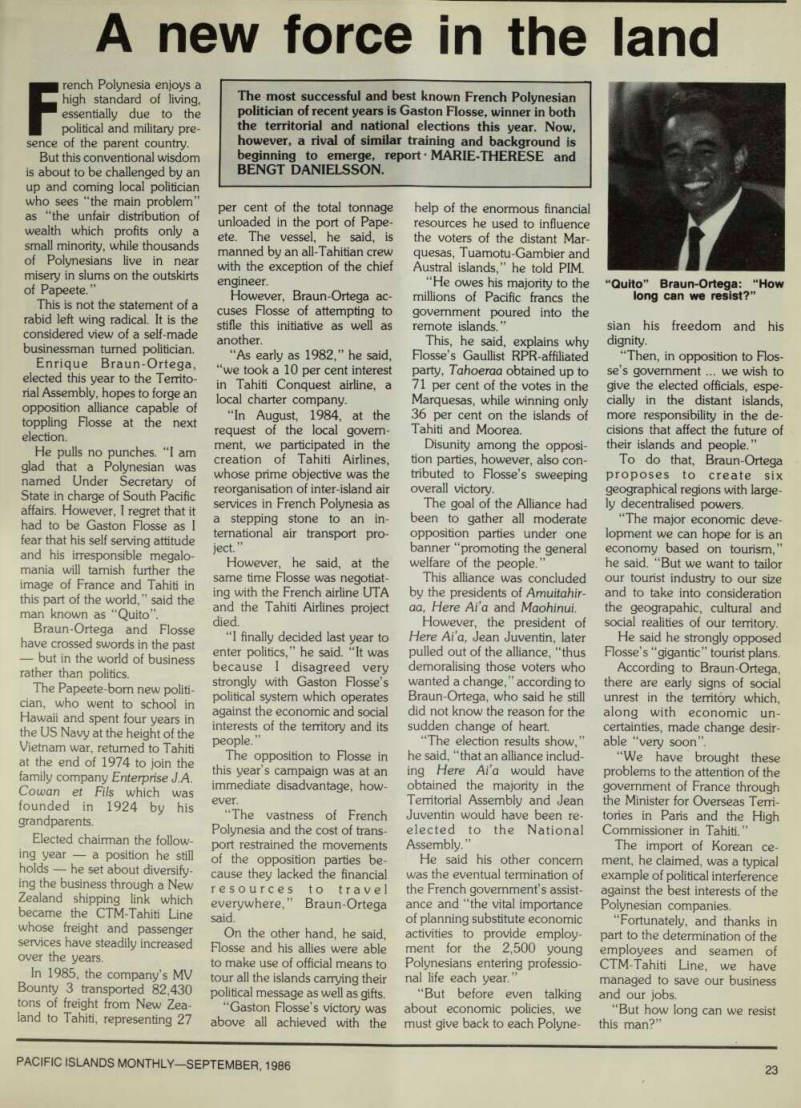
“Quito” Braun-Ortega: “How long can we resist?”