An island way of death
pp. 43-45 · Read in the full issue
In 1805, Will Mariner, the “Boy King” of Tonga, noted Samoan burial customs: “At Hampa (the Naviga tor’s Island) it is the custom to keep the death above ground for a considerable length of time. As the body during this period is apt to become very inflated, it is the duty of a relation to prevent this happen ing to a great extent, by the practice of a most disgusting operation, viz. making a hole in some part of the abdomen, and, the mouth being applied, sucking out the putrescent fluids, and spitting them into a dish. And this is done out of love and affection for the de ceased, without any apparent signs of disgust.”
Mariner’s host, the chief Finau, in an apparent desire to insult the Tongan gods for the death of his daughter, departed from the traditional Tongan methods of burial.
He invented some new cus toms, prohibited lamentations and substituted several “Ha moan” practices: he had his daughter “laid out on a fine and beautiful Hamoa mat”; he re quired mourners to “dress themselves in new tapas (this is the Hamoa custom);” and the daughter, Saw-aw-mai Lalangi (So’na’emalelagi, a Samoan name, which Mariner translates as “descended from the sky”), was deposited in the model of a canoe, about three and a half
YEARS ago, before the Samoans were told that the soul rose to the heavens upon the death of the body, they believed that the soul began a westward journey. When the death rattle sounded, the soul escaped from the mouth and sought Pulotu, to the west of Savai’i.
Like the English expression, the soul had “gone west”, to the afterworld. From as far away as Atua-Koro in the Cooks, they would leap off the stone called Reinga vaerua (“leaping place of souls”), and on Penrhyn they spoke of souls “going to Savaiki”.
In Manu’a, there were three leaping places, one each for the islands of Ofu and Olosega and one on the island of Ta’u. There was a leaping stone on the western end of Upolu and another on Manono. The final leaping place was at Falealupo, the westernmost point of Savai’i. (It was called fatu osofai (“jumping stone”).
There were two openings there: one was a pool on land (the Lualoto ali’i, the “hole for chiefs”) the other was out to sea (the Luatoto a tufanua, the “hole for commoners”).
These were the entrances (the Fafa) to Pulotu, guarded by a demigod called Lepsia, “The Watcher”, or “The Keeper”.
The god of the underworld was Saveasiuleo (“Savea of the echo”), a merman. Strong currents swept the souls to Pulotu, deep in the ocean, along a river, to the bottom of the Lua’o (“Abyss”).
Life there was similar to life on the islands, though easier. It never rained and all was provided through leisure rather than labor. Beautiful women, “whose breasts never hang down”, waited upon the souls (Wilkes, 1839).
A village there was called Nonpa (“Bound”) which was not so pleasant: souls were unable to speak there, only gesture. One legend says that in Nonpa souls wandered, dragging their entrails.
Such was Pulotu, known as Bulotu to the Tongans, the place “where the sun plunged into the sea”.
feet long, made for the express purpose, and nicely polished by one of Finow’s carpenters (this is the Hamoa custom).”
After a 19-day wake, the body became bloated, and the “Hamoan” operation was per formed.
The missionary George Tur ner tells the following story in his book Samoa, published in 1884: “Now and then the face was oiled with a mixture of scented oil and turmeric, and passing strangers were freely admitted to see the remains of the departed.
“Until about twenty years ago there were four bodies laid out in this way in a house belonging to the family to which we refer, viz. a chief, his wife and two sons.
“They were laid on a plat form raised on a double canoe.
They must have been embalmed upwards of thirty years, and although much ex posed, they were in a remark able state of preservation. They assigned no particular reason for this embalming, further than that it was the expression of their affection to keep the bodies of the departed still with them as if they were alive.
“None were allowed to dress them but a particular family of old ladies, who all died off; and as there was a superstitious fear on the part of some and an
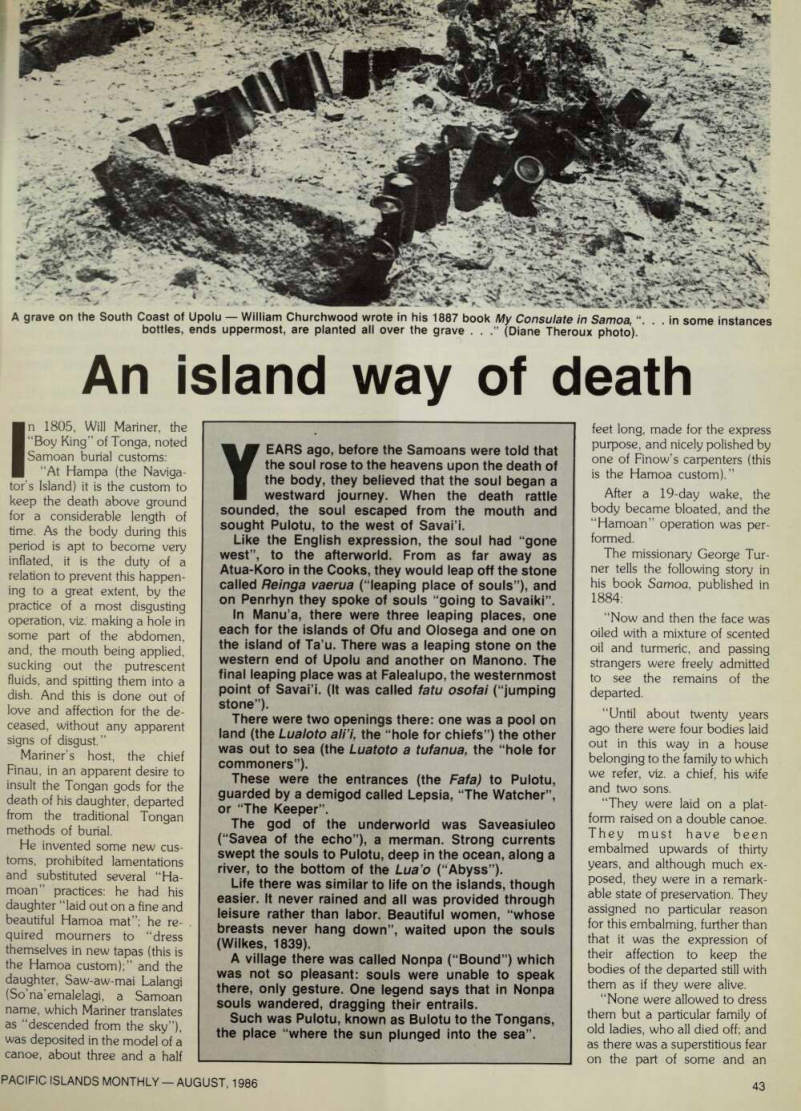
A grave on the South Coast of Upolu-William Churchwood wrote in his 1887 book My Consulate in Samoa , .. in some instances bottles, ends uppermost, are planted all over the grave . . (Diane Theroux photo).
unwillingness on the part of others, to handle them, it was resolved at last to lay them underground.”
The missionary J. B. Stair saw these “mummies” at the Mata’afa family burial place at Aliepata, Upolu, in 1841. He says in his book Old Samoa that this “rude kind of embal ming” was called O le fa’a- Atua-lalaina, which he trans lated as “made into a sun-dried god”.
Peter Buck tells of a similar custom in the Cooks: two kings “had been placed in the cave after being sun-dried on wooden biers ...”
Turner also speaks of embal ming, which was practised, he writes, only by women: “The viscera being removed and buried they day after day, anointed the body with a mix ture of oil and aromatic juices. ”
He then mentions the treatment observed by Mariner, but with a difference: “To let the fluids escape, they continued to puncture the body all over with fine needles”.
This is not necessarily a con tradiction: customs varied from one part of Samoa to another, just as legends and worship varied.
Turner records that the sto mach cavity was filled with tapa and that the hair of the head, removed prior to the embal ming, was glued carefully on to the scalp by a resin from the bush.
He adds: “The body was buried without a coffin (i.e. wrapped in tapa or mats except in the case of chiefs, when a log of wood was hollowed out for the purpose.”
This is essentially a descrip tion of a Samoan pappao a canoe. Stair says the body was “wrapped in folds of native cloth or enclosed in a crude coffin or box, sometimes formed from an old canoe, but more generally hollowed out
from the trunk of a tree.”
This continual mention of boats and canoes suggests sea burials, probably already a fad ing custom by the time of the missionaries. But Stair said that “putting (the body) into a canoe and sending it adrift on the ocean” did happen some times.
Margaret Mead adds (in her Social Organisation of Manua, 1930): “Canoe burial at sea of toula aitu (priests or spirit mediums) is vaguely remem bered, together with the tradi tion of sending a live child with the corpse.”
However, she adds: “No in formant has ever seen this done.” Sea burials did occur in Mangareva and Niue, and evi dence suggests it was also the case in Samoa.
The everyday word for cof fin, then as now, translates as “dead box” ( pusa oti). The polite or chiefly language word is vo'a, the generic term for “boat”.
There were no burial grounds in old Samoa as there were in Hawaii, for instance.
Turner wrote; “The grave was often dug close by the house. They made it about four feet deep, and after spreading it with mats, like a comfortable bed, called an epa. there they placed the body with the head to the rising of the sun and the feet to the west.”
Death was obviously associ ated with the setting sun. Stair records the following: “Then pointing to the west, she ex claimed ‘Misery there.’ To the east, ‘Prosperity there.’ Into the grave, ‘Misery there; but leave happiness with us’.”
Archaeologists, finding bones by house posts, assumed they were the bones of sacrificed slaves, buried alive as post holders. This led writers like Michener to envision the grin ning faces of slaves staring up at
the plunging posts. Nothing could be further from the truth.
Mead says; “Occasionally a favorite child was buried in the house. (The ground covered with coral being the Samoan floor.) The frequent slight shif ting of house sites upon a small piece of land, often brought graves under the centre post.
This seems to be the source of human bones found under house posts, as there is no record of human sacrifices con nected with house building.”
She does, add, however, an interesting note on one Manu’a village custom: “Fitiuta infor mants insisted upon sitting bu rial, with palms pressed to gether between flexed knees.”
Meagre items were included in the grave, not to assist the wanderer to Fulota, “but it was supposed that if (the items) were left and handled by others further disease and death would be the consequence.” (Turner.) Clothing, a shell cup, a bam boo pillow among other things may have been included, along with the grave-digging sticks. . . if it had been a noted warrior, his grave might be surrounded by spears, or his club laid loosely at the top.” (Turner.) Stair says: “I once saw a musket thus placed upon the grave of a warrior at Matautu, on Savaii, which had fallen to pieces from long exposure to the atmosphere.” He added: “A few trinkets and playthings may often be seen lovingly placed upon the grave of some beloved child . . .”
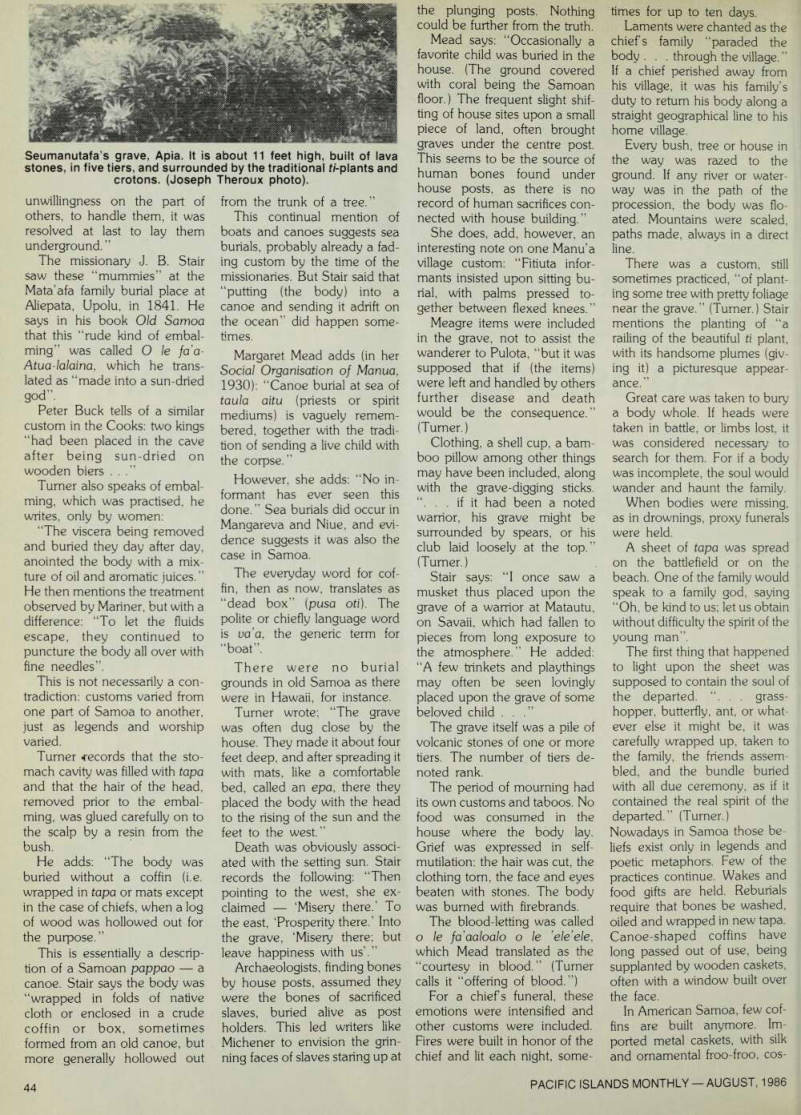
The grave itself was a pile of volcanic stones of one or more tiers. The number of tiers de noted rank.
The period of mourning had its own customs and taboos. No food was consumed in the house where the body lay.
Grief was expressed in self mutilation: the hair was cut, the clothing torn, the face and eyes beaten with stones. The body was burned with firebrands.
The blood-letting was called o le fa’aaloalo o le ’ele’ele, which Mead translated as the “courtesy in blood.” (Turner calls it “offering of blood.”) For a chief’s funeral, these emotions were intensified and other customs were included.
Fires were built in honor of the chief and lit each night, some
times for up to ten days.
Laments were chanted as the chief’s family “paraded the body . . . through the village. ”
If a chief perished away from his village, it was his family’s duty to return his body along a straight geographical line to his home village.
Every bush, tree or house in the way was razed to the ground. If any river or water way was in the path of the procession, the body was flo ated. Mountains were scaled, paths made, always in a direct line.
There was a custom, still sometimes practiced, “of plant ing some tree with pretty foliage near the grave.” (Turner.) Stair mentions the planting of “a railing of the beautiful ti plant, with its handsome plumes (giv ing it) a picturesque appear ance.”
Great care was taken to bury a body whole. If heads were taken in battle, or limbs lost, it was considered necessary to search for them. For if a body was incomplete, the soul would wander and haunt the family.
When bodies were missing, as in drownings, proxy funerals were held.
A sheet of tapa was spread on the battlefield or on the beach. One of the family would speak to a family god, saying “Oh, be kind to us; let us obtain without difficulty the spirit of the young man”.
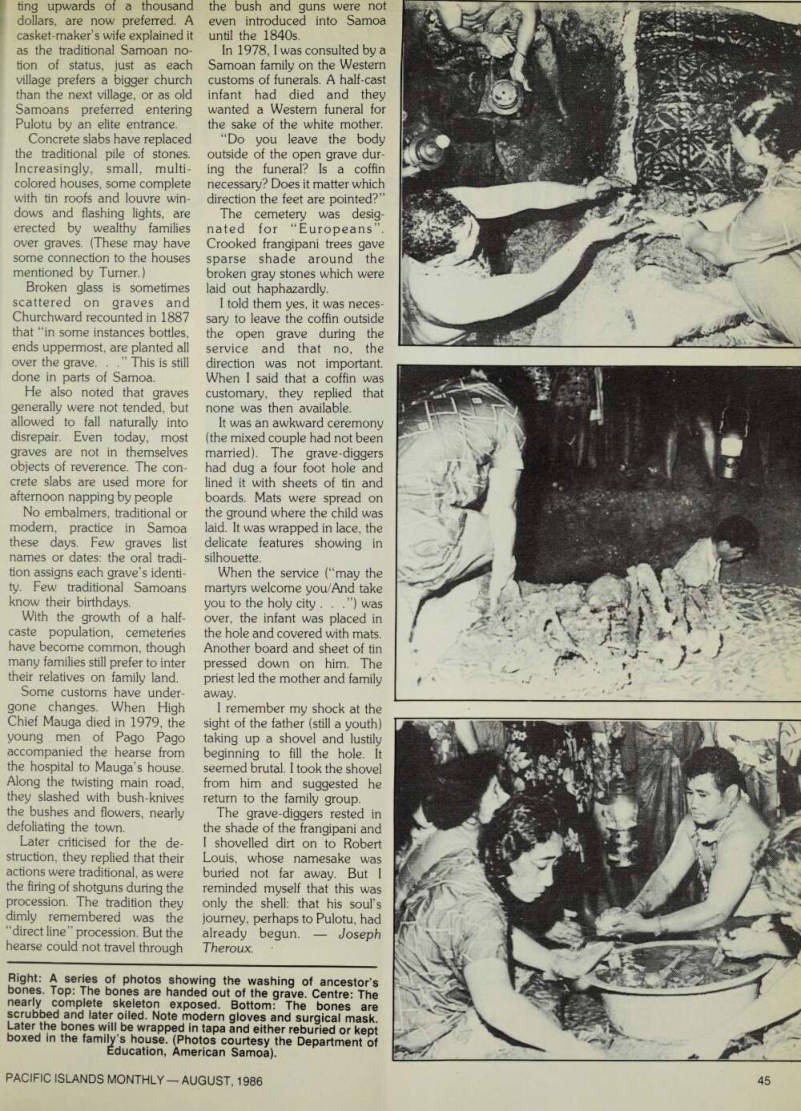
The first thing that happened to light upon the sheet was supposed to contain the soul of the departed. “. . . grass hopper, butterfly, ant, or what ever else it might be, it was carefully wrapped up, taken to the family, the friends assem bled, and the bundle buried with all due ceremony, as if it contained the real spirit of the departed.” (Turner.) Nowadays in Samoa those be liefs exist only in legends and poetic metaphors. Few of the practices continue. Wakes and food gifts are held. Reburials require that bones be washed, oiled and wrapped in new tapa.
Canoe-shaped coffins have long passed out of use, being supplanted by wooden caskets, often with a window built over the face.
In American Samoa, few cof fins are built anymore. Im ported metal caskets, with silk and ornamental froo-froo, cos
Seumanutafa’s grave, Apia. It is about 11 feet high, built of lava stones, in five tiers, and surrounded by the traditional ti-plants and crotons. (Joseph Theroux photo).
ting upwards of a thousand dollars, are now preferred. A casket-maker’s wife explained it as the traditional Samoan no tion of status, just as each village prefers a bigger church than the next village, or as old Samoans preferred entering Pulotu by an elite entrance.
Concrete slabs have replaced the traditional pile of stones.
Increasingly, small, multi colored houses, some complete with tin roofs and louvre win dows and flashing lights, are erected by wealthy families over graves. (These may have some connection to the houses mentioned by Turner.) Broken glass is sometimes scattered on graves and Churchward recounted in 1887 that “in some instances bottles, ends uppermost, are planted all over the grave. . . ” This is still done in parts of Samoa.
He also noted that graves generally were not tended, but allowed to fall naturally into disrepair. Even today, mpst graves are not in themselves objects of reverence. The con crete slabs are used more for afternoon napping by people No embalmers, traditional or modem, practice in Samoa these days. Few graves list names or dates: the oral tradi tion assigns each grave’s identi ty. Few traditional Samoans know their birthdays.
With the growth of a half caste population, cemeteries have become common, though many families still prefer to inter their relatives on family land.
Some customs have under gone changes. When High Chief Mauga died in 1979, the young men of Pago Pago accompanied the hearse from the hospital to Mauga’s house.
Along the twisting main road, they slashed with bush-knives the bushes and flowers, nearly defoliating the town.
Later criticised for the de struction, they replied that their actions were traditional, as were the firing of shotguns during the procession. The tradition they dimly remembered was the “direct line” procession. But the hearse could not travel through
the bush and guns were not even introduced into Samoa until the 1840 s.
In 1978,1 was consulted by a Samoan family on the Western customs of funerals. A half-cast infant had died and they wanted a Western funeral for the sake of the white mother.
“Do you leave the body outside of the open grave dur ing the funeral? Is a coffin necessary? Does it matter which direction the feet are pointed?”
The cemetery was desig nated for “Europeans”.
Crooked frangipani trees gave sparse shade around the broken gray stones which were laid out haphazardly.
I told them yes, it was neces sary to leave the coffin outside the open grave during the service and that no, the direction was not important.
When I said that a coffin was customary, they replied that none was then available.
It was an awkward ceremony (the mixed couple had not been married). The grave-diggers had dug a four foot hole and lined it with sheets of tin and boards. Mats were spread on the ground where the child was laid. It was wrapped in lace, the delicate features showing in silhouette.
When the service (“may the martyrs welcome you/And take you to the holy city . . ,”)was over, the infant was placed in the hole and covered with mats.
Another board and sheet of tin pressed down on him. The priest led the mother and family away.
I remember my shock at the sight of the father (still a youth) taking up a shovel and lustily beginning to fill the hole. It seemed brutal. I took the shovel from him and suggested he return to the family group.
The grave-diggers rested in the shade of the frangipani and I shovelled dirt on to Robert Louis, whose namesake was buried not far away. But I reminded myself that this was only the shell: that his soul’s journey, perhaps to Pulotu, had already begun. Joseph Theroux.
Right: A series of photos showing the washing of ancestor’s bones. Top: The bones are handed out of the grave. Centre: The nearly complete skeleton exposed. Bottom: The bones are scrubbed and later oiled. Note modern gloves and surgical mask Later the bones will be wrapped in tapa and either reburied or kept boxed in the family’s house. (Photos courtesy the Department of Education, American Samoa).