books
pp. 46-48 · Read in the full issue

‘Melanesian movements’: Religion and cargo
Religious movements in Melanesia today (1). Edited by Wendy Flannery. Point Series No. 2. Goroka, The Melanesia Institute for Pastoral and Socio- Economic Service. Pp. xv & 204. No price indicated.
Niue The Island and its people. By S. Percy Smith and with Traditions by Pulekula.
Reprinted and published by the Institute of Pacific Studies, Suva, and the Nuie Extension Centre of the University of the South Pacific, Alofi. Pp. 141.
No price indicated.
The Language of Easter Is land. Its development and Eastern Polynesian relation ships. By Robert Langdon and Darrell Tiyon. Published by the Institute for Polynesian Studies, Laie, Hawaii. Pp. 82. No price indicated.
Europeans have been trying to find out about the South Paci fic, its origins and traditions, on the decks of pitching sailing ships and in the quiet vaults of research libraries for over two centuries.
In order to spin their tales of other people’s histories, they have relied upon eyeball ex amination of physical features, talking to the locals themselves, digging in sand and soil, even dissecting the details of con ventional language.
These three studies try in their way to understand chal lenges to Christian missions, and the development and ori gins of two small islands.
Millenarian movements or, more usually, cargo cults, are acknowledged features of Melanesian life, seen by various authors as emergent political movements, challenging colo nial authority, or mystical reli gious beliefs questioning basic European assumptions about how the world operates on both
spiritual and material planes.
Such cultic activity, in the post-independence era, con tinues to oppose the state in favour of local, even parochial (literally) superiority.
Religious Movements is a col lection of thirteen articles by 14 authors looking in sometimes great detail at such movements in Papua New Guinea and Irian Jaya. These studies were first presented at three different conferences, held in 1980 and 1982.
Most of the light contributors are missionaries, while three are academics, two more being practicing members of the Panio True Group.
The purpose of the papers is summed up by contributor Hayward: ... of formulating a
pastoral and missionary re sponse to the phenomena which we call ‘Melanesian movements’.
To move towards accom plishing this, he surveys a good deal of the relevant literature, deriving some eight common characteristics. He concludes that in order for missionaries to successfully combat the move ments, more knowledge of them must be gained and pastoral duty must include a philosophy of community deve lopment.
Another contributor (Hovey) suggests that one method of dealing with cargo cults is to re-interpret them in Christian principles.
The two Pomio Kivung
Movement contributors, the only Melanesians in the book, take a rather different line. They conclude their account of their beliefs and history by stressing that the established church and their movement should not be seen in competition, but that the two institutions “run para llel”.
Anthropologist Walter, whose article concludes the book, tends to take a theoretical line developed by David Aberle, whom he does not cite; that cultic activity derives from a feeling of deprivation and re sults from frustration.
He feels that far from show ing that cargo cult activity repre sents backwardness, it shows how sophisticated Melanesians are in socio-cultural adaptation and in perceiving their own way to political and economic deve lopment.
The most glaring error in an otherwise competetent volume is that the bibliography was omitted in the Adams article, which, at forty-one pages is the long one in the series.
The reprinting of the Smith study of Niue, from the original 1902-3 plates, has been done mainly with the aim of provid ing the present population of Niueans with an authoritative description of their past. What with most Niueans living off their tiny island, it is probably very needed.
Smith spent but four months on Niue, sent to prepare the island for annexation in 1901.
Smith was aware of his mission (not a religious one, as with most of those in the previous volume) to preserve the past for the future, and says so openly.
The author is candid about his shortcomings and critical about his attempts to find ori gins of the folk he studied,
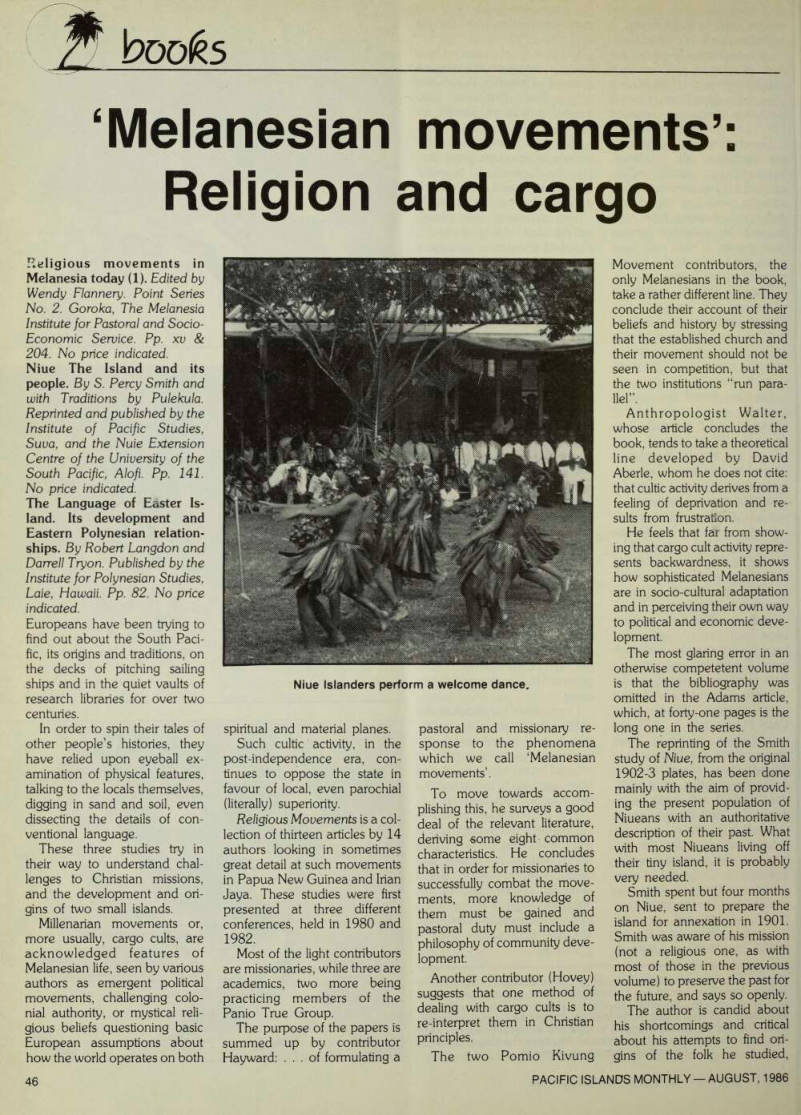
Niue Islanders perform a welcome dance.
querying diffusionist theorists popular in the day. Some, in those days, apparently, thought that kava drinking, particularly in ceremonial, might have a derivation from ancient indie soma; he ventures a specula tion of his own that kava sounds identical to the Arabic word for coffee, which he re nders as “kawah”.
In spite of this, Smith is a careful ethnographer, giving lo cal terms for major concepts, even extensive texts in the Niuean of the day. These texts, in particular, owing to his named collaborator, Pulekula, take up nearly a third of the book’s pages.
The Language of Easter Is land is quite another attempt to understand Pacific origins, de riving as it does from the commonly held two stratum theory of an earlier time.
Now, no one denies that diffusion played a major part in the settlement of Polynesia. It could hardly be otherwise. The question is diffusion from where and how this migration is deter mined.
Langdon and Tryon choose to base their case on linguistic evidence.
The four technical chapters on phonology, morphology, syntax and lexicon, will be rather hard going for anyone but the trained linguist, or avid philological amateur, with a stock of Polynesian dictionaries close to hand.
The easy understandability of the “Historical review” and “Discussion and conclusions” betray the fluid Langdon style, well known to PIM readers.
The basic argument is that
there are some difficulties with the Easter Island language in terms of how it fits into the grand scheme of oceanic lan guages, or so the authors feel.
These problems exist in the kinds of sounds the Easter Islanders make, the most prom inent being a very subtle glottal stop that a Scot would hardly hear, and in some of their vocabulary.
In both of these, it is impor tant to remember that compa rative linguistics is based on the premise that people borrow from one another’s languages, changing according to local pat tern. Such a theoretical assumption does not give much attention to local invention.
It may be just there that the Langdon-Tryon schema falls down for, among Pacific islan ders, the ones from Easter must be amongst the most inventive and innovative, in both the past and the present.
But, back to Langdon and Tryon. I will not go into the complex arguments about the Tryon section, for professional linguists, such as Roger Green, are doing that in the technical journals. At the recent confer ence on Easter Island (See PIM, November & December 1984), Green presented a detailed re futation of the Tryon scheme, noting that the case for Easter Island reclassification, and sure ly association with Raivavae, rests on but six forms.
Langdon himself, in his sum ming up, bases his linking of Raivavae with Easter Island, on a great deal of circumstantial evidence, to which he himself admits. For example, a mythical personage, Hiro, figures in
place names both on Raivavae and Easter Island. Smith, in the previously discussed study of Niue, would have rejected that as slender evidence indeed.
Readers of Langdon’s The Lost Caravel will recall why it is important for Raivavae to figure in the Easter Island story being, as it is, one of the links in his tale of the Basque conquest of the Pacific.
Nevertheless, the Langdon story is told with his usual excellent grasp of the Pacific material, owing to his position as Director of the Pacific Manu scripts Bureau, and his “flypap er” mind which can marshal seemingly overwhelming facts to support his arguments.
Written as it is in his authori tative but engaging style, the reader can take pleasure in the account, even if agreement means suspending a concern
for how facts are linked to gether.
Readers should have a look at Langdon and Tryon’s radical suggestions for reforming Paci fic linguistic classification and for proposing a quite innovative scheme for Pacific migration and settlement, and decide for themselves.
Easter Islanders who may hear of this study will be very happy to see their land moved from being the tail end of an extensive human migration, that of the “conquest of the Pacific”, as Peter Bellwood cal led it (see PIM March 1981) to being a kind of local centre for settlement and cultural diffu sion.
Potential purchasers of any or all of these volumes, whose cover prices are unlikely to be great, will have good additions
to their libraries.
Grant
McCall.
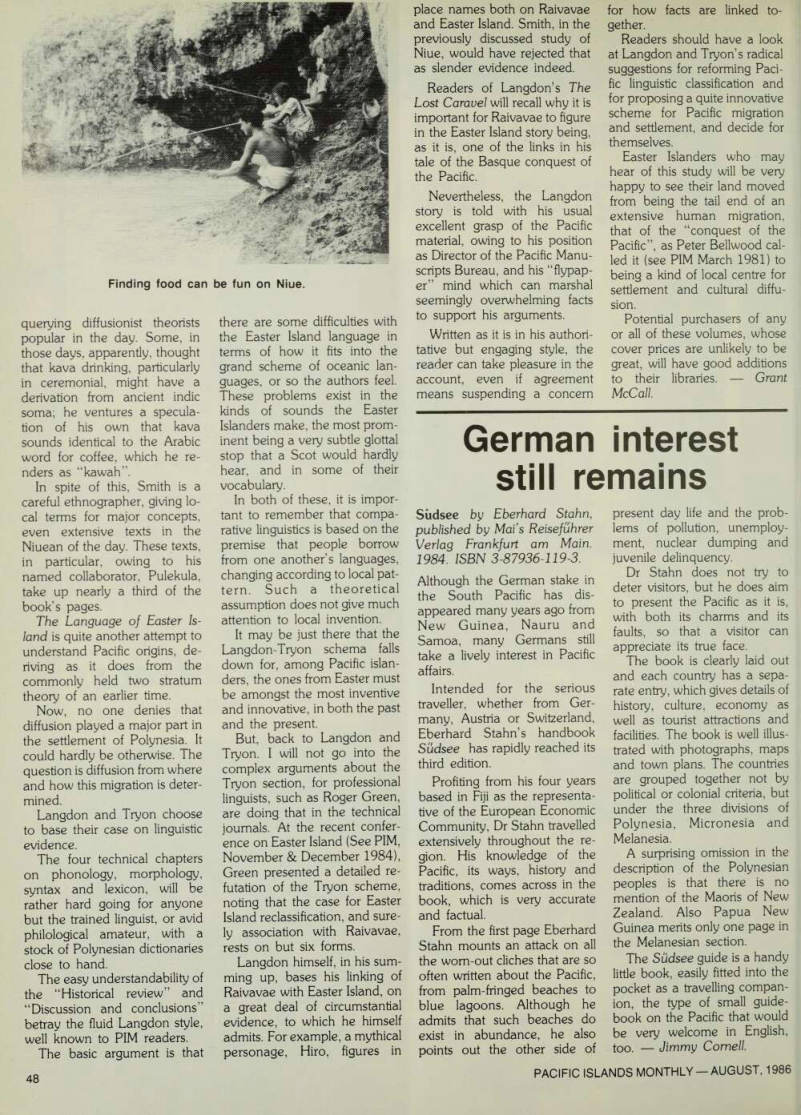
Finding food can be fun on Niue.