major breakthrough
p. 41 · Read in the full issue
Every chance of a major breakthrough
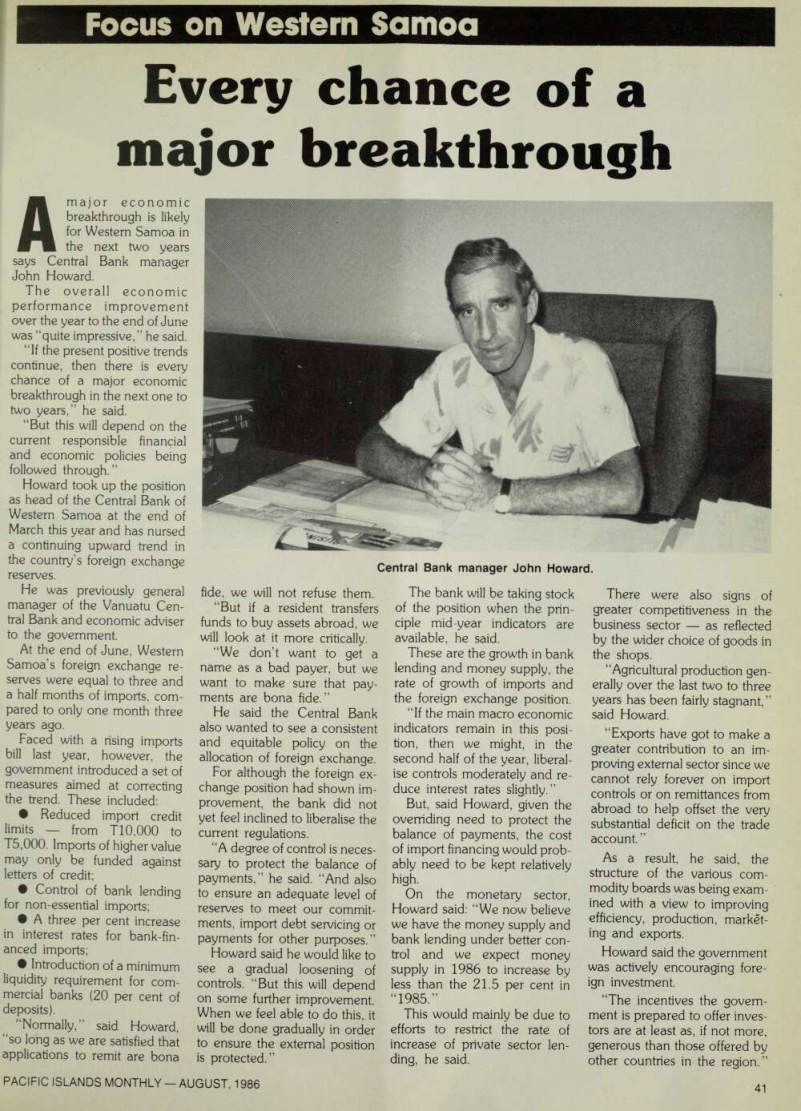
A major economic breakthrough is likely for Western Samoa in the next two years says Central Bank manager John Howard.
The overall economic performance improvement over the year to the end of June was “quite impressive,” he said.
“If the present positive trends continue, then there is every chance of a major economic breakthrough in the next one to two years,” he said.
“But this will depend on the current responsible financial and economic policies being followed through.”
Howard took up the position as head of the Central Bank of Western Samoa at the end of March this year and has nursed a continuing upward trend in the country’s foreign exchange reserves.
He was previously general manager of the Vanuatu Cen tral Bank and economic adviser to the government.
At the end of June, Western Samoa’s foreign exchange re serves were equal to three and a half months of imports, com pared to only one month three years ago.
Faced with a rising imports bill last year, however, the government introduced a set of measures aimed at correcting the trend. These included: • Reduced import credit limits from TlO,OOO to T 5,000. Imports of higher value may only be funded against letters of credit; • Control of bank lending for non-essential imports; • A three per cent increase in interest rates for bank-fin anced imports; • Introduction of a minimum liquidity requirement for com mercial banks (20 per cent of deposits).
“Normally,” said Howard, “so long as we are satisfied that applications to remit are bona
fide, we will not refuse them.
“But if a resident transfers funds to buy assets abroad, we will look at it more critically.
“We don’t want to get a name as a bad payer, but we want to make sure that pay ments are bona fide.”
He said the Central Bank also wanted to see a consistent and equitable policy on the allocation of foreign exchange.
For although the foreign ex change position had shown im provement, the bank did not yet feel inclined to liberalise the current regulations.
“A degree of control is neces sary to protect the balance of payments,” he said. “And also to ensure an adequate level of reserves to meet our commit ments, import debt servicing or payments for other purposes.”
Howard said he would like to see a gradual loosening of controls. ‘‘But this will depend on some further improvement.
When we feel able to do this, it will be done gradually in order to ensure the external position is protected.”
The bank will be taking stock of the position when the prin ciple mid-year indicators are available, he said.
These are the growth in bank lending and money supply, the rate of growth of imports and the foreign exchange position.
“If the main macro economic indicators remain in this posi tion, then we might, in the second half of the year, liberal ise controls moderately and re duce interest rates slightly.”
But, said Howard, given the overriding need to protect the balance of payments, the cost of import financing would prob ably need to be kept relatively high.
On the monetary sector, Howard said: “We now believe we have the money supply and bank lending under better con trol and we expect money supply in 1986 to increase by less than the 21.5 per cent in “1985.”
This would mainly be due to efforts to restrict the rate of increase of private sector len ding, he said.
There were also signs of greater competitiveness in the business sector as reflected by the wider choice of goods in the shops.
“Agricultural production gen erally over the last two to three years has been fairly stagnant,” said Howard.
“Exports have got to make a greater contribution to an im proving external sector since we cannot rely forever on import controls or on remittances from abroad to help offset the very substantial deficit on the trade account. ”
As a result, he said, the structure of the various com modity boards was being exam ined with a view to improving efficiency, production, market ing and exports.
Howard said the government was actively encouraging fore ign investment.
“The incentives the govern ment is prepared to offer inves tors are at least as, if not more, generous than those offered by other countries in the region.”
Central Bank manager John Howard.