Samoa In Focus
pp. 33-38 · Read in the full issue



A nation In the business of success
it’s not easy to find a private investor in Western Samoa prepared to say what he really thinks when it comes to the question of what is needed to stimulate the economy.
Businessmen are conserva tive the world over, and West ern Samoans are no exception.
Careful not be quoted on any thing controversial, they are ever mindful of the need to protect what they have worked so hard to create.
And the record shows that they have achieved consider able progress in the last five years especially in food manufacturing and primary produce exports.
These advances have not only shown that private enter
prise works well in Western Samoa, but have also led to a general re-think by the powers that-be on how to tackle the country’s economic problems.
Faced with a crippling trade deficit (currently running at US$lO million annually) largely brought about by tumbling world prices for coconut oil and cocoa, the government is re examining its attitudes to the
public and private sectors.
Its fifth Development Flan for 1985-87 spells this out clearly with the promise that: ’’Government is considering the possibility of withdrawing from certain lines of activity currently handled by public enterprises so as to provide further scope for private sector expansion.”
The problem is clearly illus trated by the govemment-own
ed Western Samoa Trusts Estates Corporation (WSTEC) which controls about 30,100 acres of prime agricultural land, or about 20 per cent of the country’s total cultivated area.
The plan was that WSTEC would be the pivot of an impro ving agricultural sector through a vigorous replanting program, rehabilitating the plantations by
Continued on page 38
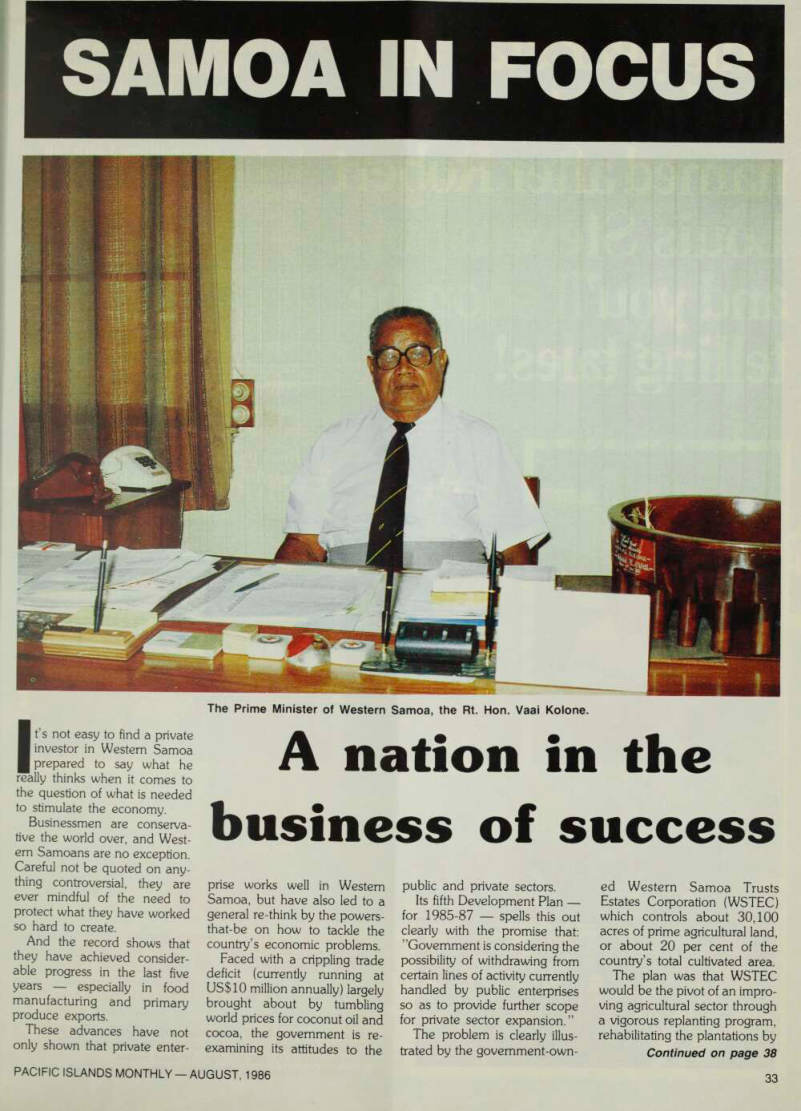
The Prime Minister of Western Samoa, the Rt. Hon. Vaai Kolone
upgrading management and by development of new areas.
But due to heavy operating losses amounting to $3.6 mil lion in 1983 and, in turn, an inability to implement replan ting programs, it was unable to meet its commitments.
Initiatives to allow the corporation to operate as a statutory body independent of government were tried, but it is understood that WSTEC’s los ses have continued to mount and the enterprise is again under review.
The government replaced board members with ’’pro fessionals with technical and entrepreneurial knowledge” and removed MPs who had previously sat on the board.
While the posiotion of WSTEC continues to be a matter of some concern for the government, it is also a subject of keen interest to the private sector, where businessmen see considerable opportunities if WSTEC’s extensive operations were to be offered.