Runway set to land
pp. 35-37 · Read in the full issue
Focus on Western Samoa
Runway set to land tourist trade
ourism is one way that has been identified to ■ expand Samoa’s foreign earnings base. ™nd the government is deter mined that the development will proceed without damage to the local culture.
Conventional wisdom in the industry has it that a landing facility must come before hotel development.
Thus, although Apia’s run way can now accommodate the big jets, there aren’t yet enough hotel rooms in Samoa to take in a full plane load.
That situation won’t last for long, however.
The firm resolve of the gov ernment to develop tourism was made plain to PIM in an interview with with the minister responsible for the industry, Le Tagaloa Pita.
“It’s going to be done in line witn the cultural values of the people,” he said.
“The basic philosophy is that Samoa is not going to regard visitors as rich men at the table with the proverbial crumbs, but to look t these people as visitors or guests of our government, villagers, country and extended families.
“We’re not harpooning the rich like whales. We will pam per him but will not exploit him,” the minister said.
Friendship, he said, was a strong feature in Samoan cul ture and Samoans would like to extend this to all visitors.
“We welcome family groups, visitors coming for conferences, curiosity travellers and are now poised to welcome each and all.”
The minister said the govern ment had established a sub committee to examine methods of welcoming visitors in the traditional Samoan way.
Heads of departments in volved in the processing of tourists were all called to the
cabinet room, he said, and were told by the committee that they were first of all ambassa dors for their country and should treat visitors in the traditional Samoan manner.
Every two years, the two
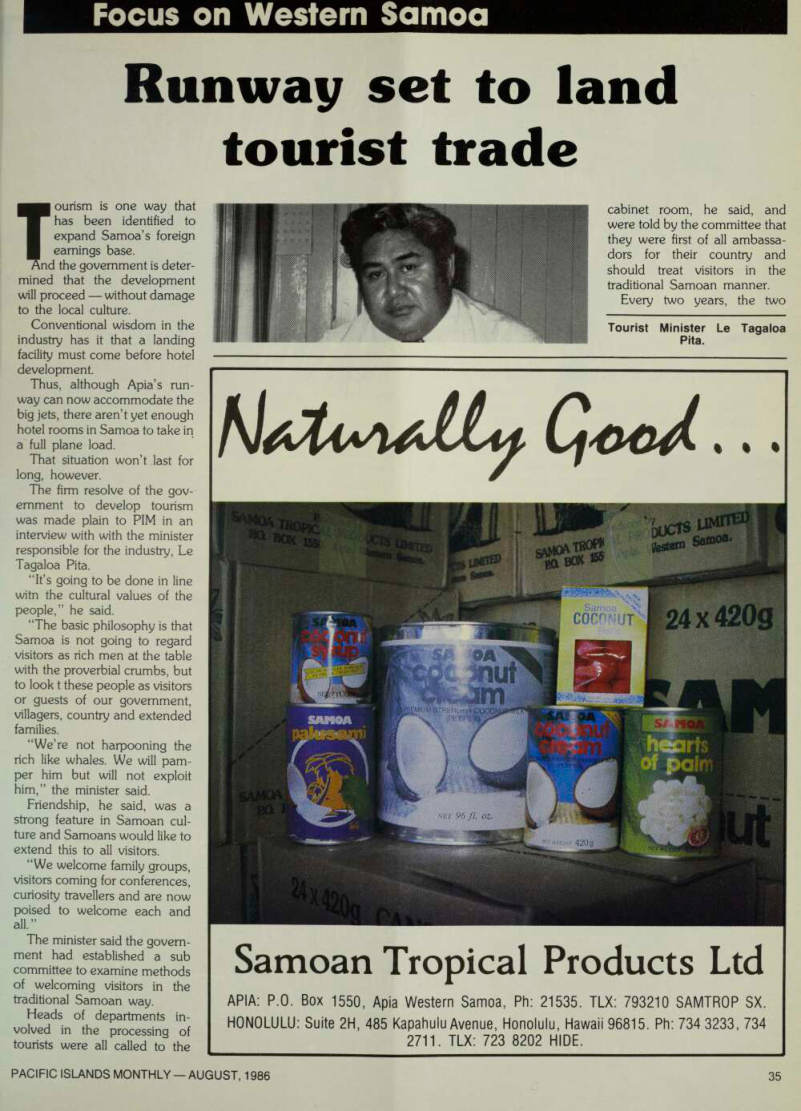
Tourist Minister Le Tagaloa Pita.
officials who are judged to have performed best in this regard, will win an overseas'trip as a prize for their efforts.
The government has also launched a village-level educa tion program to help people adapt to tourism.
Le Tagaloa said the govern ment hoped visitors would stay in villages. “We are encourag ing this and developing facili ties. Perhaps villages can put up hotels, motels and guest houses on Samoan lines.
“The whole aima is to have visitors exposed to Samoan cul tures and values,” he said.
Samoa did not want tourism to develop a “canned culture”.
Instead, the government wanted visitors absorbed into local traditions rather than the other way round.
He said the governement did, however, warmly welcome foreign investment in tourism adding that a number of deve lopments were planned.
Building of the 227-room
Royal Samoan Hotel at Apia would proceed “as soon as possible. ”
One condition for this deve lopment was the extension of the international airport run way, and this had now been done with the assistance of Japanese aid.
Asked about reports that the governors of American Samoa had applied pressure to the US State Department to prevent Hawaii Air’s plan to start a direct Honolulu-Apia DCS service, Le Tagaloa Pita said: “The isolationist thinking that promoted this is too narrow.
“It’s based on a misunder standing of the geography of the area.” The Samoans were one country, one race, he said.
“It’s a very condescending attitude,” he added.
On the question of Samoa’s current meagre T 55,000 budget for the promotion of tourism, he said it was hoped that a supplementary budget of T 150,000 would be approved.