‘Club Med’ justice
p. 32 · Read in the full issue
for French Agents
The two French secret service agents convicted for their parts in the bom bing of the Greenpeace flag ship, Rainbow Warrior, in Au ckland harbour last year won’t be serving out the remainder of their 10-year sentences in the inconvenience of an Auckland prison cell.
Alain Mafart and Dominique Prieur will, instead, spend their time in the somewhat more ambient atmosphere of the atoll of Hao in the Tuamotu archipelago in French Polynesia.
There is no prison on Hao.
There is, however, an extreme ly well appointed military base.
More like Club Med than anything in New Zealand, it boasts picturesque thatched bungalows, a club with well stocked bar and extensive wine cellar, a movie theatre and an international standard runway.
Major Mafart will have ample opportunity to sharpen his water-sports expertise on Hao where the water is consider ably warmer and clearer than that in Auckland harbour.
It is unlikely that the New Zealand government were aware of the atoll’s extensive facilities.
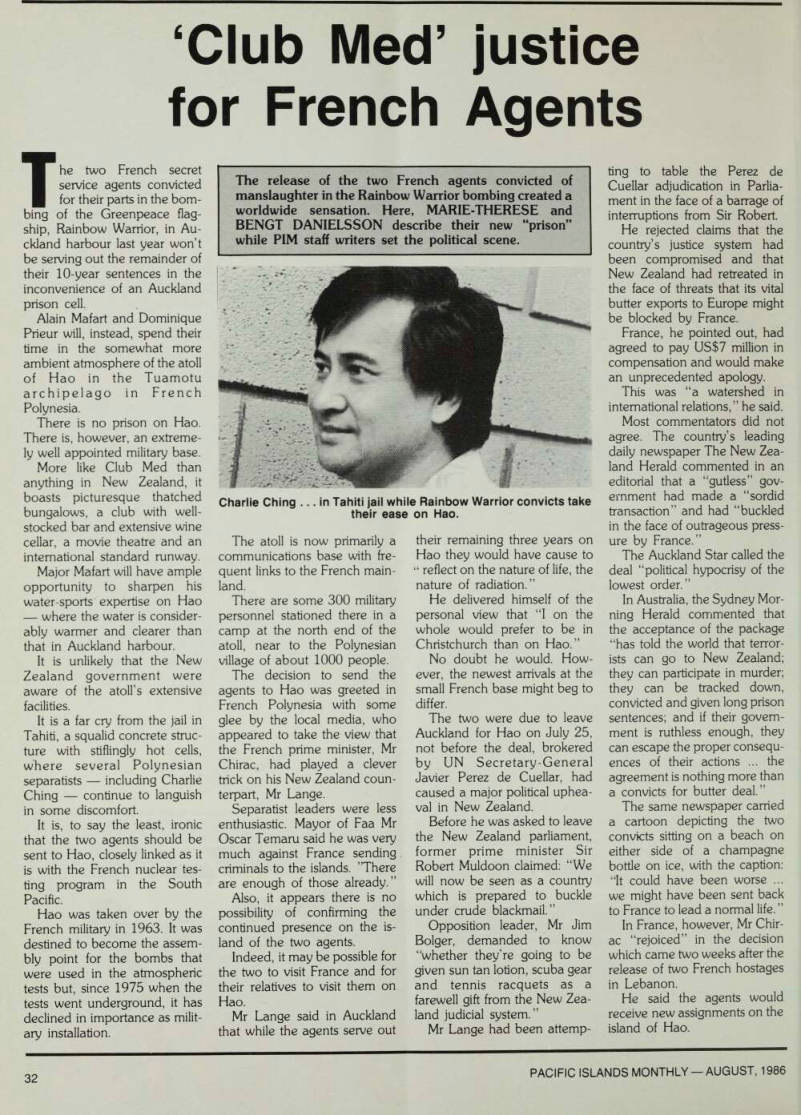
It is a far cry from the jail in Tahiti, a squalid concrete struc ture with stiflingly hot cells, where several Polynesian separatists including Charlie Ching continue to languish in some discomfort.
It is, to say the least, ironic that the two agents should be sent to Hao, closely linked as it is with the French nuclear tes ting program in the South Pacific.
Hao was taken over by the French military in 1963. It was destined to become the assem bly point for the bombs that were used in the atmospheric tests but, since 1975 when the tests went underground, it has declined in importance as milit ary installation.
The release of the two French agents convicted of manslaughter in the Rainbow Warrior bombing created a worldwide sensation. Here, MARIE-THERESE and BENGT DANIELSSON describe their new “prison” while PIM staff writers set the political scene.
The atoll is now primarily a communications base with fre quent links to the French main land.
There are some 300 military personnel stationed there in a camp at the north end of the atoll, near to the Polynesian village of about 1000 people.
The decision to send the agents to Hao was greeted in French Polynesia with some glee by the local media, who appeared to take the view that the French prime minister, Mr Chirac, had played a clever trick on his New Zealand coun terpart, Mr Lange.
Separatist leaders were less enthusiastic. Mayor of Faa Mr Oscar Temaru said he was very much against France sending criminals to the islands. ’’There are enough of those already.”
Also, it appears there is no possibility of confirming the continued presence on the is land of the two agents.
Indeed, it may be possible for the two to visit France and for their relatives to visit them on Hao.
Mr Lange said in Auckland that while the agents serve out
their remaining three years on Hao they would have cause to “ reflect on the nature of life, the nature of radiation.”
He delivered himself of the personal view that “I on the whole would prefer to be in Christchurch than on Hao.”
No doubt he would. How ever, the newest arrivals at the small French base might beg to differ.
The two were due to leave Auckland for Hao on July 25, not before the deal, brokered by UN Secretary-General Javier Perez de Cuellar, had caused a major political uphea val in New Zealand.
Before he was asked to leave the New Zealand parliament, former prime minister Sir Robert Muldoon claimed: “We will now be seen as a country which is prepared to buckle under crude blackmail.”
Opposition leader, Mr Jim Bolger, demanded to know “whether they’re going to be given sun tan lotion, scuba gear and tennis racquets as a farewell gift from the New Zea land judicial system.”
Mr Lange had been attemp
ting to table the Perez de Cuellar adjudication in Parlia ment in the face of a barrage of interruptions from Sir Robert.
He rejected claims that the country’s justice system had been compromised and that New Zealand had retreated in the face of threats that its vital butter exports to Europe might be blocked by France.
France, he pointed out, had agreed to pay US$7 million in compensation and would make an unprecedented apology.
This was “a watershed in international relations,” he said.
Most commentators did not agree. The country’s leading daily newspaper The New Zea land Herald commented in an editorial that a “gutless” gov ernment had made a “sordid transaction” and had “buckled in the face of outrageous press ure by France.”
The Auckland Star called the deal “political hypocrisy of the lowest order.”
In Australia, the Sydney Mor ning Herald commented that the acceptance of the package “has told the world that terror ists can go to New Zealand; they can participate in murder; they can be tracked down, convicted and given long prison sentences; and if their govern ment is ruthless enough, they can escape the proper consequ ences of their actions ... the agreement is nothing more than a convicts for butter deal.”
The same newspaper carried a cartoon depicting the two convicts sitting on a beach on either side of a champagne bottle on ice, with the caption: “It could have been worse ... we might have been sent back to France to lead a normal life. ”
In France, however, Mr Chir ac “rejoiced” in the decision which came two weeks after the release of two French hostages in Lebanon.
He said the agents would receive new assignments on the island of Hao.
Charlie Ching ... in Tahiti jail while Rainbow Warrior convicts take their ease on Hao.