turns world’s eyes
pp. 27-28 · Read in the full issue
Record share float turns world’s eyes on South Pacific
Placer Pacific Ltd, Austra lia’s biggest ever com pany float, is likely to focus world attention on the South Pacific as a premier gold bearing region.
A subsidiary of Placer Deve lopment Ltd., North America’s sixth largest mining house, Placer Pacific is launched on the Sydney stock exchange this month and is already oversub scribed.
When the prospectus was issued in June, investors cla moured for the paper promp ting one commentator to re mark that every , time he saw a queue at the Sydney exchange,
As investors clamour for shares in Australia’s largest ever public float, DENIS REINHARDT examines the prospects for Placer Pacific, the new mining giant with extensive regional interests.
he would stand in it in the hope that a Placer Pacific prospectus might be at the other end.
The prospectus, for the re cord, invited shareholdings from Australian and Papua New Guinean citizens, offering 128 million $1 shares.
Placer Pacific will not only include 70 per cent of one of Australia’s biggest gold mines, Kidston, but will also have the
Misima Island and Porgera “ad vanced exploration prospects” in Papua New Guinea.
Both are scheduled to begin gold production within three years.
Porgera, to the west of Mount Hagen, is in PNG’s remote Enga province and is regarded as the world’s richest post-war gold find.
The new company is likely to
quickly gain international atten tion because, as events in South Africa escalate, gold in vestors will be searching for more stable homes for their funds.
Australasia is alreadu a signi ficant gold producer and is growing.
Australia and PNG produced 92.7 tonnes or 7.6 per cent of the non-communist world out put of 1212.8 tonnes of gold last year, compared to South Africa’s 673 tonnes (55.5 per cent) and Latin America’s 162.7 tonnes (13.4 per cent).
Fiji’s output from the Emper or mine was 1.4 tonnes.
When Porgera and Misima come on stream, the South Pacific region is expected to quickly match the Latin Amer ican output.
So far, gold stocks in Austra lia and Papua New Guinea have proved difficult invest ments. In world terms, they have simply been too small to take the scale of funds that major institutions like to place in gold stocks.
Apart from Kidston, which has been listed on Australian exchanges for little more than a year, Bougainville Copper, a major gold producer, has been one of the few gold stocks with sufficient scrip to absorb foreign investment without the share register being swamped.
The formation of the new company takes Placer back to its roots. It was Placer, the brainchild of two New Zealand and Australian mining entrep reneurs, which pioneered the Bulolo alluvial goldfields in PNG in the 19205.
Asa result of the need to airlift in the large alluvial dredges (one of which now serves as home to two PNG families), Placer also became pioneers in heavyweight air transport not only in PNG but worldwide.
Placer Development will hold 78 per cent of the 600 million shares in Placer Pacific, which will absorb all the company’s regional interests with the ex ception of oil exploration.
Sixty years on from Bulolo, Placer’s best goldmine any where in the world will be along that same mountain chain at Porgera which is estimated to contain US$6.3 billion in gold and silver with further reserves open to exploration.
By 1990, Porgera is expected to be producing 820,000 ounces of gold annually from two related ore bodies, one of which contains over 1.7 million tonnes grading 1.25 ounces/ tonne a bonanza reserve by world standards.
Placer Pacific will be not only the South Pacific’s biggest pro ducer, outranaking the huge Ok Tedi and Bougainville mines in comparison to North Amer ican producers, it will be surpas sed only by the largest, the Homestake Mining Company.
Among South African pro ducers, only the Rand’s Driefontein mine will have low er production costs than the Porgera mine when it comes on stream.
One reason why the share market is so enthusiastic about the new mining house is the scale of production envisaged.
Another, however, is Placer’s record in bringing its mines on stream under budget and on time a glaring comparison to the cost overruns which almost mothballed Ok Tedi.
The most recent example of this has been the Kidston gold mine, near Townsville in Queensland.
After 16 months of opera tion, Kidston’s shareholders have received three dividends and watched the share price climb from A 51.60 to levels between As 6 and As 7.
Apart from Kidston, Placer also includes in its portfolio 30 per cent of the big Bell mine in Western Australia which will be rated third among Australian producers when it starts mining.
But Misima and Porgera remain the richest among the pros pects.
This means hard-nosed negotiations with the Papua New Guinea government.
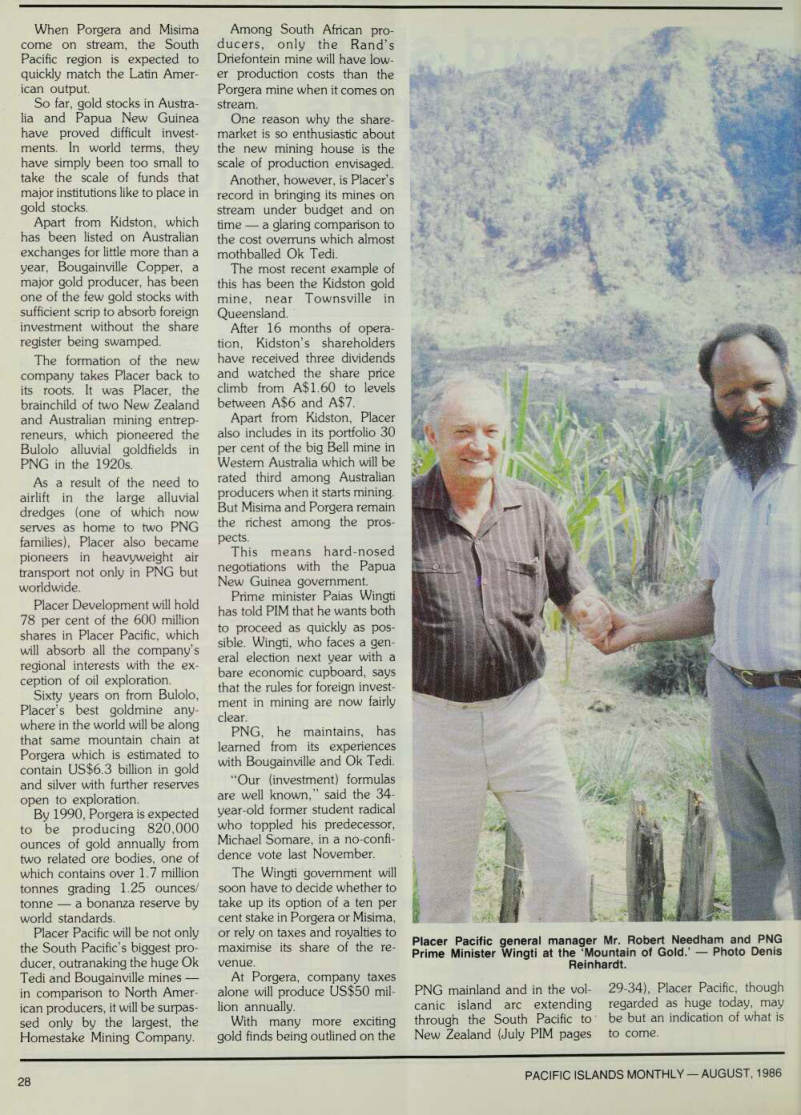
Prime minister Paias Wingti has told PIM that he wants both to proceed as quickly as pos sible. Wingti, who faces a gen eral election next year with a bare economic cupboard, says that the rules for foreign invest ment in mining are now fairly clear.
PNG, he maintains, has learned from its experiences with Bougainville and Ok Tedi.
“Our (investment) formulas are well known,” said the 34year-old former student radical who toppled his predecessor, Michael Somare, in a no-confi dence vote last November.
The Wingti government will soon have to decide whether to take up its option of a ten per cent stake in Porgera or Misima, or rely on taxes and royalties to maximise its share of the re venue.
At Porgera, company taxes alone will produce USSSO mil lion annually.
With many more exciting gold finds being outlined on the
PNG mainland and in the vol canic island arc extending through the South Pacific to' New Zealand (July PIM pages
29-34), Placer Pacific, though regarded as huge today, may be but an indication of what is to come.
Placer Pacific general manager Mr. Robert Needham and PNG Prime Minister Wingti at the ‘Mountain of Gold.’ Photo Denis Reinhardt.