budget cuts for islands
p. 24 · Read in the full issue
Deficit deal may mean budget cuts for islands
The US federal government is at war with itself over how to handle the worst budget deficit in two centuries of the country’s history.
And this means budgetary uncertainty all across the Cen tral and South Pacific in island dependencies and affiliates which receive an annual sub sidy of $187.7 million from Washington.
Some $8.2 million has already been chopped from island (excluding Hawaii) budgets early this year as part of the Pacific contribution to US fiscal solvency.
But more will be taken de pending on events, including a US Supreme Court decision expected this month.
The cuts, thus far, do not
appear to be terribly damaging.
They have meant reduced allocations for long distance telephone calls and off-island travel and some salary reduc tions.
American Samoa has intro duced a two per cent sales tax for the first time in the territory’s history. The Pago Pago Marine Railway has been transferred to private ownership and a private owner is being sought for the Rainmaker Hotel, Tutuila’s most important tourist hostelry.
Congressman Fofo I. F.
Sunia, American Samoa’s non voting member of Congress, was able to report in his regular radio broadcast from Washing ton that he had successfully won an allocation of $1.2 mil lion for classrooms and a new
school gymnasium, $1 million for a housing loan program and $600,000 for new medical equipment.
He said he had been working to ensure that American Samoa would have a capital improve ment budget of $6.5 million in the new fiscal year.
But cuts could come later even though Congressman Sunia said the powerful House of Representatives’ Committee on Interior and Insular Affairs supported his goals.
Frank Quimby, press assis tant to Guam’s non-voting Congressman Ben Blaz, said Guam had suffered no signifi cant budget cuts this year and no capital improvement pro jects had been lost.
Guam depends to an ex traordinary extent on federal funds which come in at the combined rate of some $621 million a year.
But there is no conflict be tween that figure and the lesser $187.7 to island governments as the Guam figure includes a huge military component spent on the island but not given to the Guam government.
The Guam money, in fact, breaks down into $334 million in civilian and military salaries, $ll2 million in federal govern ment purchases and $72 mil lion in various federal social programs including pensions, food stamps and welfare pay ments.
Uncertainty over some of these funds arises because the US Congress, alarmed at huge budget deficits, passed legisla tion known as the Gramm- Rudman-Hollings Act.
If this law is upheld by the Supreme Court, it will result in flat, across-the-board budget cuts in many non-social govern ment programs.
The measure has been
much-criticised in the US be cause it will remove discretion from local government authori ties.
In the worst possible cases envisioned by critics, jail guards and hospital nurses may be fired although money could be saved by trimming less essential programs.
The Gramm-Rudman-Holl ings legislation passed, how ever, because Republican President Ronald Reagan and a House of Representatives con trolled by opposition Demo crats could not agree on any other way to trim the burgeon ing federal deficit.
Gramm-Rudman-Hollings has already embroiled Guam in a costly dispute. Federal law provides that all federal taxes collected in Guam should be rebated to the territory a matter of some $3O million each year.
Guam lost $1.29 million of this money earlier this syear and wants it back.
It could lose a lot more in future if Washington applies Gramm-Rudman-Hollings to funds that it once said should be sent back to Agana.
Ralph Craib.
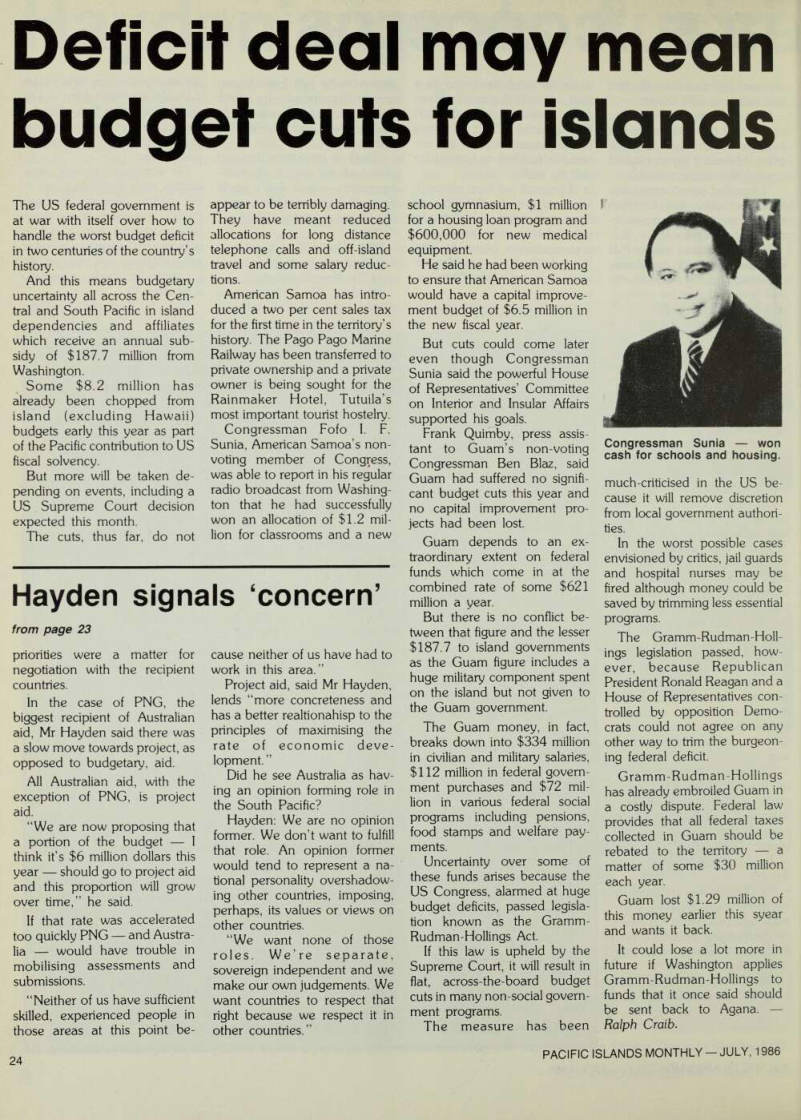
Congressman Sunia won cash for schools and housing.