Hayden signals Australia's 'concerns'
pp. 22-24 · Read in the full issue
The South Pacific Nuclear Free Zone Treaty (SPNFZ) was one of the major themes of Austra lian Foreign Minister Bill Hayden’s tour of the Pacific islands, he told PIM in an exclusive interview.
He also encountered concern over the Soviet presence.
He told PIM; “There was pretty evident concern over the potential for Russian activity in the Pacific a concern that this might lead to superpower
rivalry and the sort of com petitiveness and tensions that it might bring in its wake.
“On the other hand, coun tries also acknowledged that there is a need for a number of the island states, most of which have very narrow resource bases, to take up any legitimate commercial prospect that be comes available.
“They feel a keen need to have independent sources of commercial income. We re
spect and recognise that.
“But I suspect this is a point that we’ll hear more of as time goes by.”
There is a body of opinion in Washington that feels Austra lia’s attitude to the Russian overtures is complacent.
Hayden rejects that view.
“I don’t believe that the Americans have said that there has been any complacency on Australia’s part.
“At every contact I’ve had
with them bilaterally, they have commended the role that Aus tralia plays and acknowledged that Australia can fulfill a pro ductive role in this region much more successfully than the Americans generally can on past experience.”
Mr Hayden also discussed Vanuatu’s relationship with Libya. He was reminded in Port Vila that Vanuatu had a sovereign right to establish rela tions with any country it
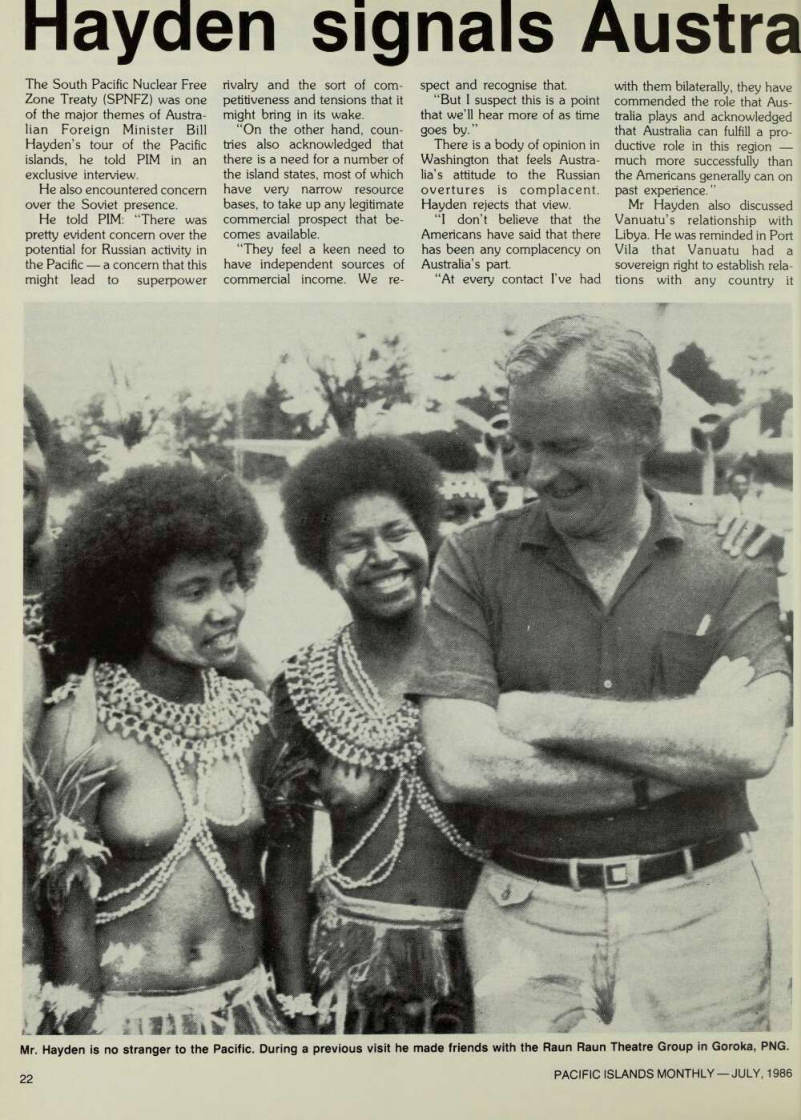
Mr. Hayden is no stranger to the Pacific. During a previous visit he made friends with the Raun Raun Theatre Group in Goroka, PNG.
chooses and that Australia also had relations with Libya.
“I acknowleged this. Our concern is that, wherever this happens in the region, it might affect Australia if it goes beyond normal diplomatic relations.
“I signalled our concerns. We have authority in our own country to exercise proper re straint and monitoring.”
He said he was aware that some members of the Kanak movement in New Caledonia had gone to Libya for training and for meetings.
“We do have some concern as to what might be the con sequences of that sort of in volvement. Beyond that I have nothing more to say.”
Mr Hayden is watching deve lopments in the Russian fishing negotiations.
While recognising the coun tries’ needs for trade, the gran ting of shore facilities would worry Australia.
“It would cause us some concern because it would give them a toe-hold on the ground.
“Past experience strongly suggests that a toe-hold encour ages them to engage in things beyond normal commercial in terests which are not always in the best interests of the host country. ”
Other issues raised included the condition of the ANZUS pact, regional environmental matters, economic deve lopment aid and the Australian patrol boat program which some countries find to expen sive.
“Some countries proposed to us that we allow short term employment for their people in Australia. They are keen to earn remittances for obvious reasons. ”
The answer, however, is a flat no.
Mr Hayden saw no room for movement on Australia’s im migration policy which is based on permanent residence with the right to take out Australian citizenship.
On ANZUS, Mr Hayden said he told the island leaders that,
while the pact itself was in a state of strain, there were differ ences between Australia and New Zealand in their responses to American desires to use harbour facilities or airports for military traffic.
“I pointed out that, although functioning under ANZUS had been suspended, we bilaterally work closely with America and separately bilaterally with New Zealand including in each case, separate military ex ercises”
Mr Hayden would not be
drawn on the new French government proposals for New Caledonia, saying he wanted to analyse these and have further discussions.
“Until we have done that and observed the trend of developments and that’s some time off we wouldn’t propose to say anything definitive,” he said.
PIM: Would it be fair to say that Australia backs independence for New Caledonia?
Hayden: We believe there should be an act of self de-
termination and we believe that it would be preferable, as I’ve always said, that New Caledo nia joins the independent na tions of the region as soon as practicable. ”
He expressed general satis faction with Australia’s aid to the region though “perhaps there’s a need to focus them (aid programs) into a tighter pattern with a view to economic self sufficiency and productivity in particular areas, especially agriculture.”
But, in the end, program
Where now for the nuclear-free South Pacific effort?
Mr Hayden was emphatic that the treaty document would be deposited with the United Nations giving it treaty status.
But it has no meaning outside the South Pacific unless the Americans and, more importantly perhaps, the French agree to sign any of the three protocols to the treaty.
All the nuclear powers have been asked by a forum delegation to accede to the protocols.
The first of these would require the US, UK and France not to manufac ture, station or test nuclear devices in the region.
The second protocol would re quire the five nuclear powers not to use, or threaten the use of nuclear weapons against parties to the treaty.
The third would require each of the five not to test nuclear armaments in the region.
Numbers one and three are non starters as far as France is con cerned, while the United States and Britain may be able to take a more relaxed view of all three.
However, that was not the attitude of the delegation from the US Con gress who visited the region early this year.
In their report to Congress, the representatives wrote: “At the very least, these protocols encourage the other participants in the treaty to bar port visits of ships carrying nuclear weapons, as does New Zealand.”
(The treaty, In fact, leaves this deci sion to individual countries).
“Signing them would also tend to imply that nuclear weapons are a curse when, in fact, they represent the US deterrent to possible Soviet aggression in the South Pacific as well as elsewhere.”
Mr Hayden, however, following his islands tour is, if anything, more firmly in favour of SPNFZ.
“The treaty will require to be ratified,” he said. “I think some countries have already done so.
Australia and New Zealand have to go through a legal procedure but will proceed to ratification.
“So we don’t see any great prob lem in getting eight ratifications, allowing the treaty document to be deposited with the United Nations.”
But without the big power signa tures to the protocols, the treaty may end up as no more than an empty gesture.
The US has given no indication yet of what its reaction might be. It is likely to take a long time to reach any decision.
France will go through the dip lomatic niceties before saying “non”.
“At this stage all one can say is they (the nuclear powers) are carefully considering the protocols,” said Mr Hayden.
“And until we have some sort of response from them, I’m afraid I couldn’t say any more on the matter.”
That careful consideration could take some little time.
priorities were a matter for negotiation with the recipient countries.
In the case of PNG, the biggest recipient of Australian aid, Mr Hayden said there was a slow move towards project, as opposed to budgetary, aid.
All Australian aid, with the exception of PNG, is project aid.
“We are now proposing that a portion of the budget 1 think it’s $6 million dollars this year should go to project aid and this proportion will grow over time,” he said.
If that rate was accelerated too quickly PNG and Austra lia would have trouble in mobilising assessments and submissions.
“Neither of us have sufficient skilled, experienced people in those areas at this point be
cause neither of us have had to work in this area.”
Project aid, said Mr Hayden, lends “more concreteness and has a better realtionahisp to the principles of maximising the rate of economic deve lopment. ”
Did he see Australia as hav ing an opinion forming role in the South Pacific?
Hayden: We are no opinion former. We don’t want to fulfill that role. An opinion former would tend to represent a na tional personality overshadow ing other countries, imposing, perhaps, its values or views on other countries.
“We want none of those roles. We’re separate, sovereign independent and we make our own judgements. We want countries to respect that right because we respect it in other countries.”