Separate Tuna Deal
pp. 25-26 · Read in the full issue
trade winds
Us Hints At
When the marathon tuna talks reconvene in Rarotonga this month, it may be for the last time.
The previous round of talks on a multilateral tuna agree ment between the Unites States and the South Pacific island nations snagged on the issues of access fees and closed zones.
Now, however, the US side is anxious for agreement and Ambassador Ed Wolfe, leader of the American team, has hinted that, if the Rarotonga meeting fails to reach agree ment, interim deals might be possible with Palau, FSM and Kiribati.
This, from the US point of view, would help cement rela tions with the strategically im portant Micronesian islands and counter the Russian presence in Kiribati.
The May session at the East- West Centre in Honolulu in volved the US and 16 island countries. Wolfe, in a public lecture shortly afterwards, indi cated that progress at the Hon olulu and previous Canberra talks had slowed.
Unconfirmed reports say that the US delegation proposed an access fee of US$2 million in a lump sum to be paid by the industry with a US government aid package of approximately the same amount.
However, the island nations are looking for more than that.
Further, despite the US lump sum offer, it is understood that US fishermen would prefer a per-trip method of calculating access fees.
Island representatives were guarded in their comments after the Honolulu meeting. There seems to be a sense of frustra tion and creeping apathy to wards the talks as a result of the slow progress.
But it is understood that some countries were extremely dissatisfied with the US cash offer. And, given the fees cur
rently paid by the US fleet, that offer appears to be unaccept able.
Wolfe, the State Depart ment’s deputy assistant secre tary for oceans and fisheries affairs, spoke candidly in his lecture of the importance the US attaches to the speedy conclusion of a tuna treaty.
He also made it known that factors other than tuna for example strategic considera tions also had an impact on US thinking regarding a treaty.
He added that this fisheries treaty was the most compli cated so far attempted by the State Department as so many different countries were in volved.
US Secretary of State
George Shultz, he said, maintained constant contact with developments in the negotiati° ns - Wolfe freely acknowledged that the Danica affair (when a US tuna boat was arrested and impounded for illegal fishing) in PNG in 1982 and the similar Jeanette Diana incident in the Solomon Islands in 1984 had soured relations between the US and the region as a whole, Under the proposed treaty, however, the US would accept responsibility for its vessels.
Wolfe added that potentially contentious issues such as catch reporting requirements and the placing of scientific observers on US vessels had been suecessfully resolved.
The US tuna industry, said Wolfe, had been heavily in volved in the talks, as it was in all similar fisheries negotiations with other countries, in order to ensure that there would be little or no industry opposition to the treaty when it went to Congress for ratification.
Although the treaty talks had been at times slow and tedious, Wolfe said the US team had developed a great deal of trust and respect for the island nego tiators.
He felt that a similar trust and respect existed in their camp and that there was a basis for long term co-operation.
Meanwhile fisheries aid talks have been progressing on an other front.
L lliO J- ViOiL IKJ Lilt: South Pacific, Secretary of State Shultz directed the United States Agency for International Development (USAID) to pro duce a fisheries aid program for the region.
USAID promptly earmarked $6.5 million to be spent over the next four years. This aid is quite separate from any aid package negotiated under the tuna treaty.
In a somewhat unusual move for an aid donor, Bill Paupe, regional director for USAID in Fiji, brought together fisheries, foreign affairs and planning offi cials from 13 countries to dis cuss the fisheries program.
The idea was for Paupe to gain an understanding of the needs of the islands and of how USAID might help.
He wanted a flexible prog ram that would meet needs while avoiding duplication of existing projects backed by
Spc, Ffa And Fao/Undp.
Paupe said it might be pos sible to co-operate with other donors in the region on some projects, though USAID normally preferred to go it alone.
As a result of the meeting, a draft program has been pre pared by USAID’s Suva staff and this is being circulated to the concerned governments be fore being finalised.
However, Paupe has pointed out that, in order to free the money, the document has to be approved by Washington be fore the end of this month.
The fisheries areas that re quire USAID assistance were identified as: • Formal and technical train ing for administrators, industry personnel and rural fishermen; • Provision of infrastructure such as jetties, docks, freezers and ice-making machines; • Supply of small fishing craft, fish aggregating devices, fishing gear and engines, lab oratory equipment and compu ter hardware; • Technical assistance in carrying out short and long term feasibility studies and re ssource assessments. • Research support in undertaking surveys and the deliminiation of 200-mile zones;
w i-Ajjaiiouji i ui uuuiesLK, and export markets and participation in international seminars and trade shows.
Tuvalu’s acting government secretary, Siliga Kofe, said the island representatives had met
puvdLeiy iu uiscuss me meenng and had agreed that Paupe’s initiative had been a most positive move.
However, he asked that USAID co-ordinate its aid effort with other donors already ac-
nve in me region, it ÜbAIU was to fully meet the needs of the islands, he said, it would need maximum flexibility and a high degree of autonomy from
Washington.
David
Doulman.
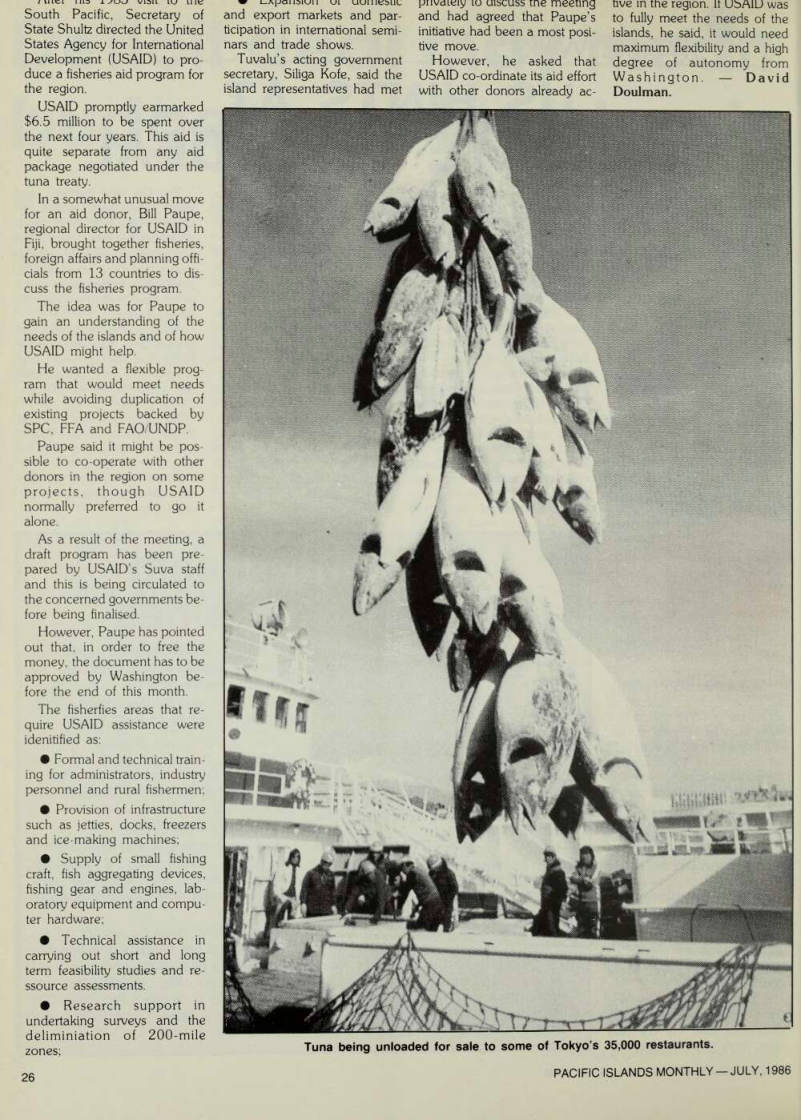
Tuna being unloaded for sale to some of Tokyo’s 35,000 restaurants.