bulk buying plan
p. 19 · Read in the full issue
Oil summit rejects bulk buying plan
South Pacific Forum energy ministers met in Suva to consid er a World Bank report on the supply and pricing of oil and petroleum products in the is lands.
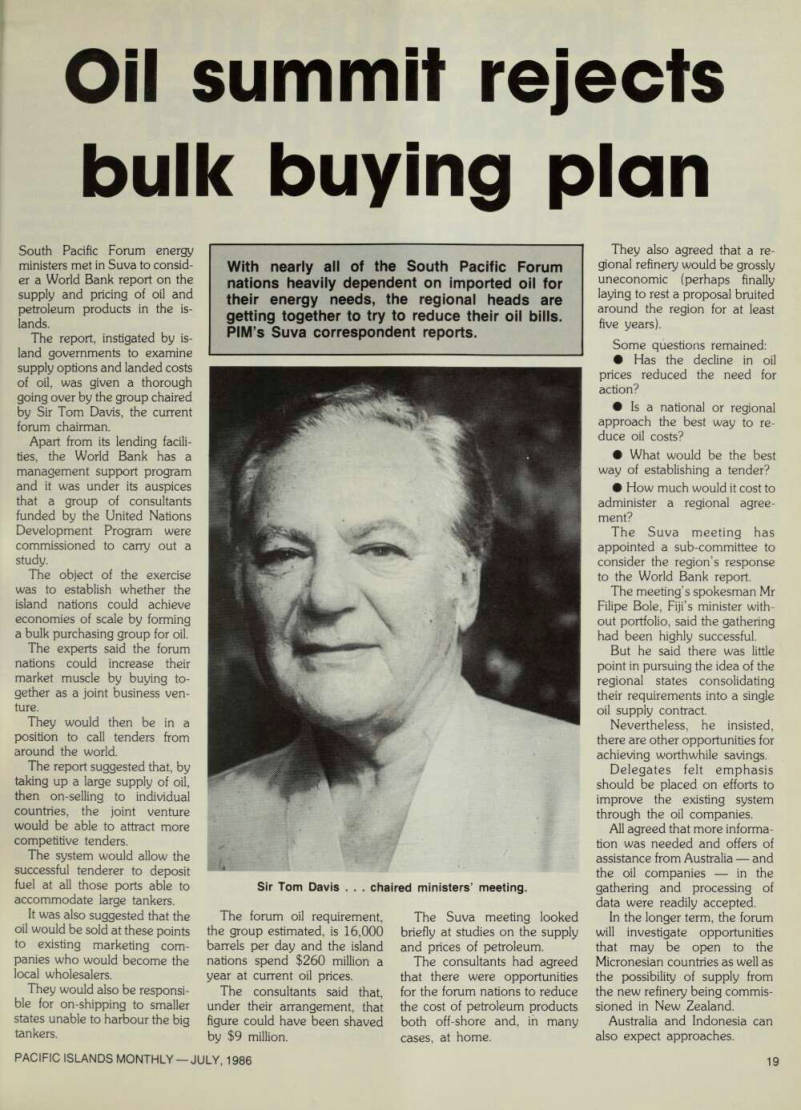
The report, instigated by is land governments to examine supply options and landed costs of oil, was given a thorough going over by the group chaired by Sir Tom Davis, the current forum chairman.
Apart from its lending facili ties, the World Bank has a management support program and it was under its auspices that a group of consultants funded by the United Nations Development Program were commissioned to carry out a study.
The object of the exercise was to establish whether the island nations could achieve economies of scale by forming a bulk purchasing group for oil.
The experts said the forum nations could increase their market muscle by buying to gether as a joint business ven ture.
They would then be in a position to call tenders from around the world.
The report suggested that, by taking up a large supply of oil, then on-selling to individual countries, the joint venture would be able to attract more competitive tenders.
The system would allow the successful tenderer to deposit fuel at all those ports able to accommodate large tankers.
It was also suggested that the oil would be sold at these points to existing marketing com panies who would become the local wholesalers.
They would also be responsi ble for on-shipping to smaller states unable to harbour the big tankers.
With nearly ail of the South Pacific Forum nations heavily dependent on imported oil for their energy needs, the regional heads are getting together to try to reduce their oil bills.
PlM’s Suva correspondent reports.
The forum oil requirement, the group estimated, is 16,000 barrels per day and the island nations spend $260 million a year at current oil prices.
The consultants said that, under their arrangement, that figure could have been shaved by $9 million.
The Suva meeting looked briefly at studies on the supply and prices of petroleum.
The consultants had agreed that there were opportunities for the forum nations to reduce the cost of petroleum products both off-shore and, in many cases, at home.
They also agreed that a re gional refinery would be grossly uneconomic (perhaps finally laying to rest a proposal bruited around the region for at least five years).
Some questions remained: • Has the decline in oil prices reduced the need for action? • Is a national or regional approach the best way to re duce oil costs? • What would be the best way of establishing a tender? • How much would it cost to administer a regional agree ment?
The Suva meeting has appointed a sub-committee to consider the region’s response to the World Bank report.
The meeting’s spokesman Mr Filipe Bole, Fiji’s minister with out portfolio, said the gathering had been highly successful.
But he said there was little point in pursuing the idea of the regional states consolidating their requirements into a single oil supply contract.
Nevertheless, he insisted, there are other opportunities for achieving worthwhile savings.
Delegates felt emphasis should be placed on efforts to improve the existing system through the oil companies.
All agreed that more informa tion was needed and offers of assistance from Australia and the oil companies in the gathering and processing of data were readily accepted.
In the longer term, the forum will investigate opportunities that may be open to the Micronesian countries as well as the possibility of supply from the new refinery being commis sioned in New Zealand.
Australia and Indonesia can also expect approaches.
Sir Tom Davis ... chaired ministers’ meeting.