Battle To Bust
pp. 16-17 · Read in the full issue
If the Pel-Air inquiry which covered alleged drug traf ficking proved anything, it proved that, at the very least, serious attempts have been made to stage illegal drugs through Papua New Guinea en route to Australia.
Most people, particularly ex patriates, are aware of the PNG “drugs scene” which extends to locally available herbal mari juana.
Fewer, however, are aware of the large scale attempts to smuggle heroin, usually from the Golden Triangle, into Aus tralia through the South Pacific islands.
At least, that is, until the Pel-Air affair brought it to in ternational prominence.
The Pel-Air inquiry, estab lished by the PNG government under former prime minister Michael Somare and extended by current prime minister Paias Wingti, is due to report to the Parliament next month.
It centred on the aborted search by PNG customs officers of an Australian aircraft at Port Moresby.
Dogs trained to sniff out drugs had reacted positively to the aircraft, but after a call from
The island states of the South Pacific have been used as staging posts in the international narcotics trade because of their remote and often under-patrolled nature. Now, however, the region’s customs services are making a joint effort to stem the flow.
one of the passengers, then prime minister Somare arrived at the airport, the search was called off and the aircraft allowed to leave.
Other evidence unearthed in Australia has shown that there were attempts to bring heroin into Australia through PNG.
Australian and PNG customs officials are unable to give fi gures to illustrate just how much drug running is going on.
But they do know that there have been other cases.
While the Pel-Air inquiry was taking place in Port Moresby, a regional drugs “summit” meet ing was taking place in Can berra.
This brought together cus toms and police officers from the South Pacific region as well as officers from Interpol.
The regional co-operation continues.
The problem, however, for customs officers is to keep watch on one of the world’s largest expanse of water, with thousands of islands and mas sive and often very remote coastlines.
The islands route is attractive to smugglers because small ships and light aircraft can often travel long distances unnoticed.
That, at least, is about to change.
Australian customs official Col Vassarotti told PIM that PNG, as Australia’s nearest neighbour, was seen as a “likely staging post” for drug smug gling.
“There is a degree of history associated with that (drug run ning from Asia through PNG to Australia), but there is no recent history that I’m in a position to talk about,” he said.
“But certainly we have every reason to believe that narcotics have been staged through PNG in the same way that Australia can be regarded as- a staging point for other parts of this
region, for example New Zealand.”
Mr Vassarotti, Assistant Comptroller-General, Barrier Enforcement A, said Australia was New Zealand’s main source of narcotics.
He believed that the majority of drugs staged through PNG and other Pacific islands were moved in small craft “and we have some evidence of that.”
Australia maintains a string of customs posts around its nothem seaboard, where speciallytrained officers are posted.
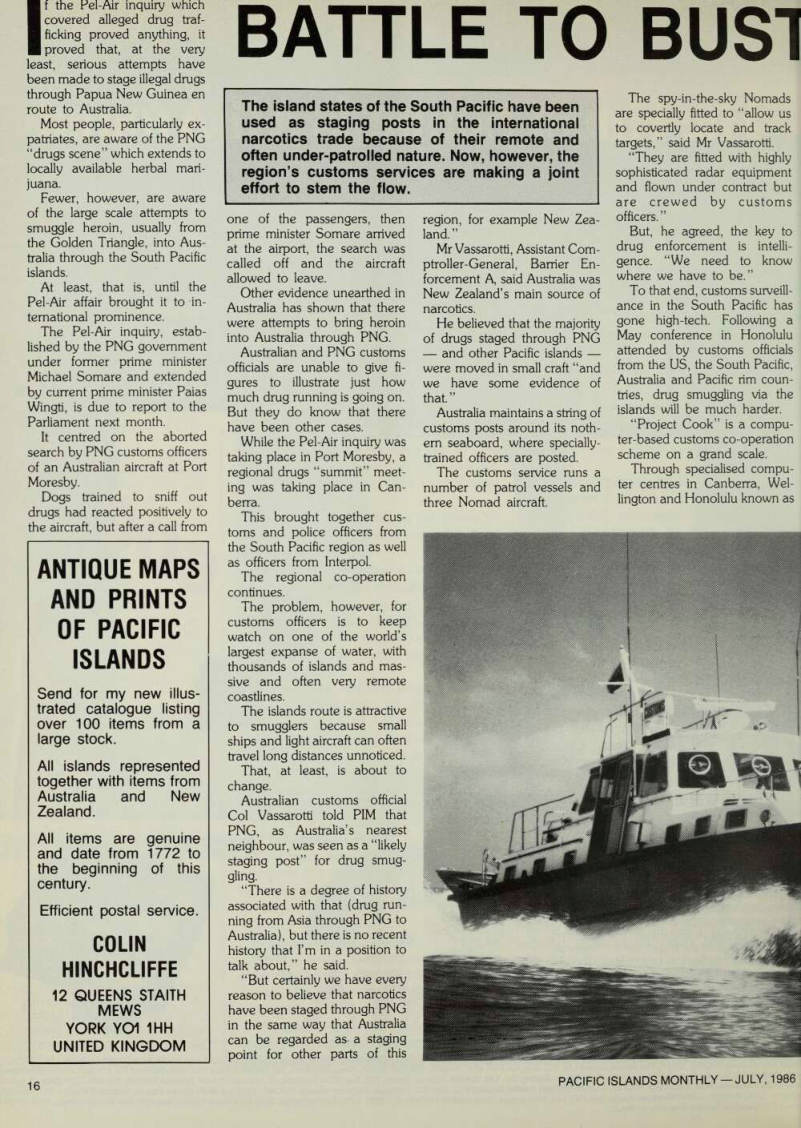
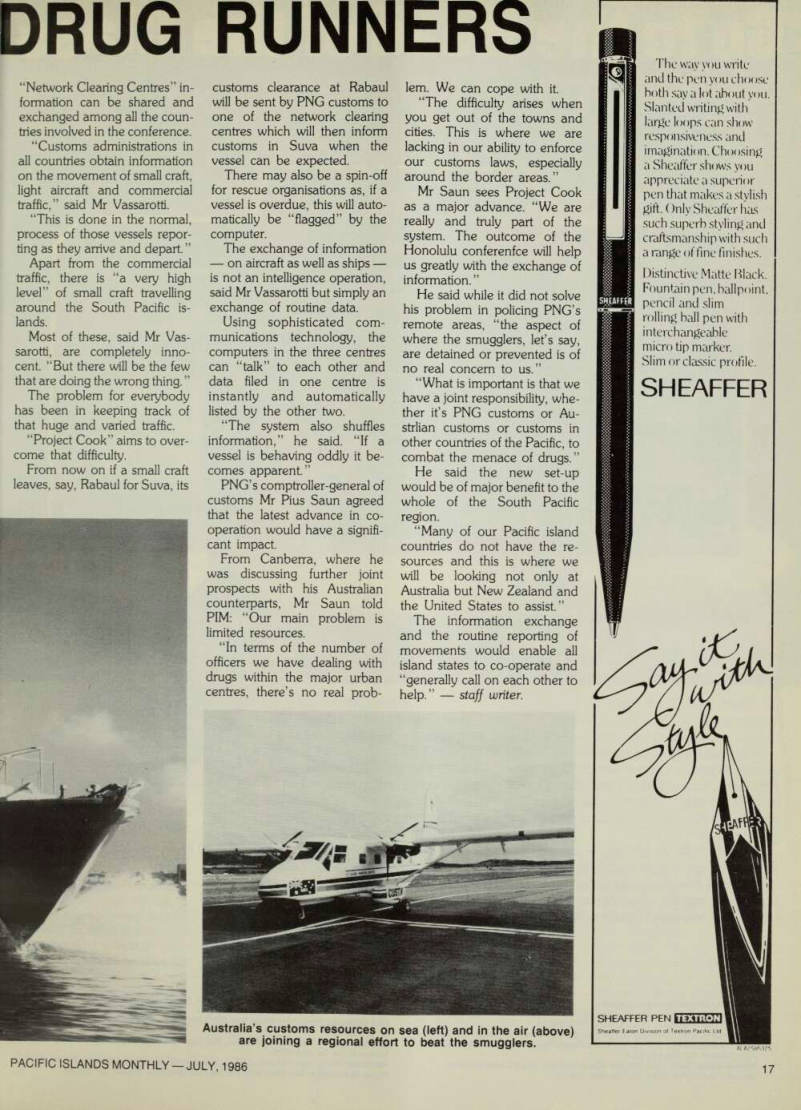
The customs service runs a number of patrol vessels and three Nomad aircraft.
The spy-in-the-sky Nomads are specially fitted to “allow us to covertly locate and track targets,” said Mr Vassarotti.
“They are fitted with highly sophisticated radar equipment and flown under contract but are crewed by customs officers. ”
But, he agreed, the key to drug enforcement is intelli gence. “We need to know where we have to be.”
To that end, customs surveill ance in the South Pacific has gone high-tech. Following a May conference in Honolulu attended by customs officials from the US, the South Pacific, Australia and Pacific rim coun tries, drug smuggling via the islands will be much harder.
“Project Cook” is a compu ter-based customs co-operation scheme on a grand scale.
Through specialised compu ter centres in Canberra, Wel lington and Honolulu known as
“Network Clearing Centres” in formation can be shared and exchanged among all the coun tries involved in the conference.
“Customs administrations in all countries obtain information on the movement of small craft, light aircraft and commercial traffic,” said Mr Vassarotti.
“This is done in the normal, process of those vessels repor ting as they arrive and depart. ”
Apart from the commercial traffic, there is “a very high level” of small craft travelling around the South Pacific is lands.
Most of these, said Mr Vas sarotti, are completely inno cent. “But there will be the few that are doing the wrong thing. ”
The problem for everybody has been in keeping track of that huge and varied traffic.
“Project Cook” aims to over come that difficulty.
From now on if a small craft leaves, say, Rabaul for Suva, its
customs clearance at Rabaul will be sent by PNG customs to one of the network clearing centres which will then inform customs in Suva when the vessel can be expected.
There may also be a spin-off for rescue organisations as, if a vessel is overdue, this will auto matically be “flagged” by the computer.
The exchange of information on aircraft as well as ships is not an intelligence operation, said Mr Vassarotti but simply an exchange of routine data.
Using sophisticated com munications technology, the computers in the three centres can “talk” to each other and data filed in one centre is instantly and automatically listed by the other two.
“The system also shuffles information,” he said. “If a vessel is behaving oddly it be comes apparent.”
PNG’s comptroller-general of customs Mr Pius Saun agreed that the latest advance in co operation would have a signifi cant impact.
From Canberra, where he was discussing further joint prospects with his Australian counterparts, Mr Saun told PIM: “Our main problem is limited resources.
“In terms of the number of officers we have dealing with drugs within the major urban centres, there’s no real prob
lem. We can cope with it.
“The difficulty arises when you get out of the towns and cities. This is where we are lacking in our ability to enforce our customs laws, especially around the border areas.”
Mr Saun sees Project Cook as a major advance. “We are really and truly part of the system. The outcome of the Honolulu conferenfce will help us greatly with the exchange of information. ”
He said while it did not solve his problem in policing PNG’s remote areas, “the aspect of where the smugglers, let’s say, are detained or prevented is of no real concern to us.”
“What is important is that we have a joint responsibility, whe ther it’s PNG customs or Au strian customs or customs in other countries of the Pacific, to combat the menace of drugs.”
He said the new set-up would be of major benefit to the whole of the South Pacific region.
“Many of our Pacific island countries do not have the re sources and this is where we will be looking not only at Australia but New Zealand and the United States to assist.”
The information exchange and the routine reporting of movements would enable all island states to co-operate and “generally call on each other to
help.”
staff writer.
Australia’s customs resources on sea (left) and in the air (above) are joining a regional effort to beat the smugglers.