Reasons for leaving
pp. 11-14 · Read in the full issue
Too many people, not enough land; too few resources, not enough money; great expecta tions, poor results is this how Pacific islanders view their home lives?
In many instances the answer appears to be ‘yes’.
And many of these people find the only workable solution to be migration to one of the Pacific rim’s developed coun tries. And once they have gone, they rarely return for other than short holidays.
Inevitably, too, it’s the most skilled workers who leave, de priving their homelands of any return on their investments in education.
That’s how the population migration problem is often de bated.
However, evidence is emer ging of a different, more com plex scenario.
In his paper “Population and economic development in the island nations of the South Pacific’’Dennis Ah rlberg argues that there is no aggregate regio nal picture.
“There is no evidence of significant impact of population on economic development ... for Fiji, Solomon Islands, Ton ga, Vanuatu, Western Samoa or a larger sample of SPC members for the late 19705.”
However, he does see sup port for a negative impact of population on Fiji’s deve lopment between 1956 and 1983.
“Most nations plan to create jobs in the rural sector. How ever, serious barriers to this policy exist. Among these are insufficient investment, land te nure arrangements, capital in tensive crops and technologies, migration and rising expecta tions tied to urban employ ment,” notes Ahlberg.
“If a child’s future income is determined by his or her pa rents’ income, and poor parents have more children than richer parents, the population growth
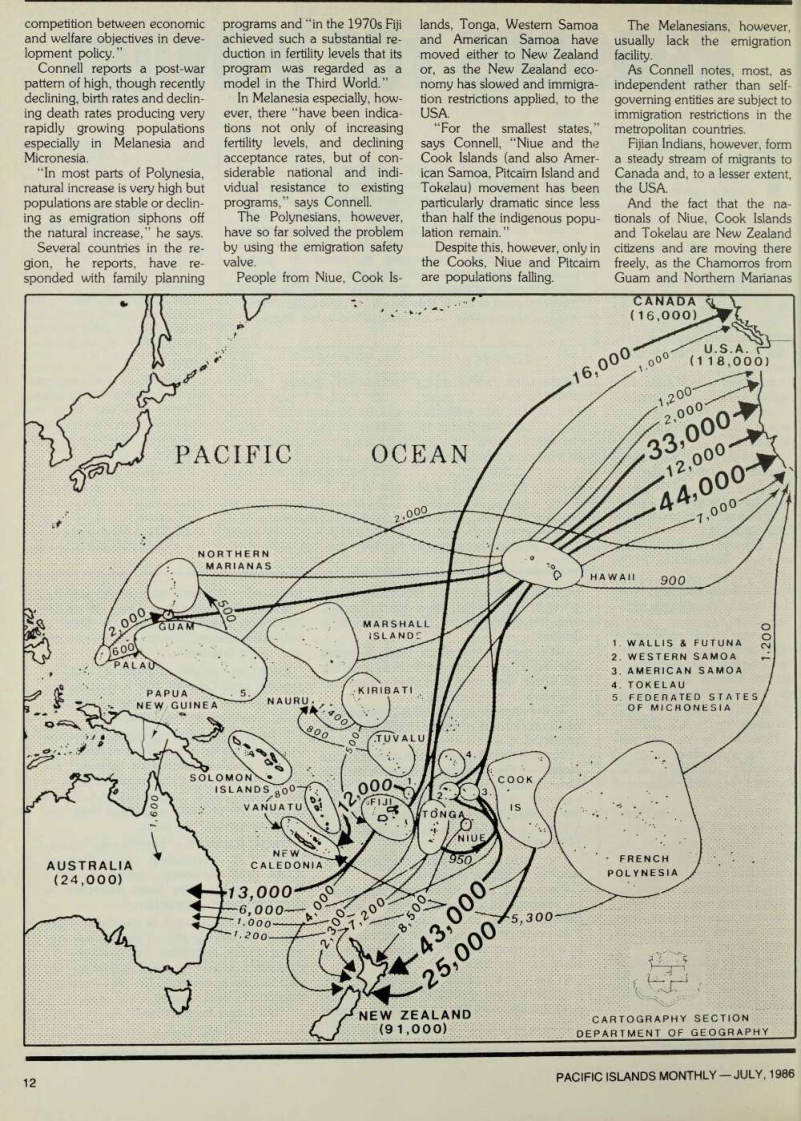
One of the Pacific islands’ staple exports is people.
Some of the greatest concentrations of islanders now live in cities such as Auckland, Honolulu and Los Angeles rather than in the Pacific itself. In some of the smaller island states there are more people overseas than at home. And if conventional images of the region are often conceived in terms of island paradises where a tranquil existence in conditions of “subsistence affluence” is readily available for a small amount of work, this is not the perception in the islands themselves as emigration rates show.
... worsens the distribution of income,” he writes in his paper, published in the collection “Selected Issues in Pacific Is lands Development” by the ANU’s National Centre for De velopment Studies.
The only data Ahlberg could find on income distribution came from Fiji where, depen ding on whether you’re rich or poor, the picture is either very
rosy or very gloomy.
“In 1968 4.9 per cent of private income went to the bottom 20 per cent of the population,” he records.
This rose to 5.1 per cent in 1972 but collapsed to 3.7 per cent in 1977.
The corresponding figures for the top 20 per cent were; 48.2, 47.7, and 53.3. In other words, by 1977 the top fifth of the
population accounted for more than half of the nation’s income while the bottom fifth could call on less than one twenty-fifth.
In “Paradise Left” a chap ter of a book studying migration around the Pacific rim to be published in the USA this year John Connell of the Sydney University geography depart ment agrees with Ahlberg that population growth rates in most South Pacific island countries are still high by world stan dards.
Connell has an aggregate regional growth rate of around 2.5 per cent and notes that some observers have suggested a looming crisis as population outstrips resources.
“A critical issue in future development is that of maintaining, let alone impro ving, existing standards of living in the face of both rapid popu lation increases and intensified
Population pressure on resources is not great in the Pacific, says John Connell, and the potential for mechanisation is limited.
This means that rural land is being worked by a smaller residual population (as urban drift continues) but without an increase in productivity.
At the same time, growing populations need more food either home grown or imported.
Connell reports that of the seven larger states Fiji, French Polynesia, Papua New Guinea, Solomon Islands, Tonga, Vanuatu and Western Samoa only PNG increased food production at a greater rate than its population from 1965-1978.
The others dropped considerably, leading to higher imports.
Previously productive land may even be abandoned in favour of remittances from the cities or from overseas.
In parts of Fiji migration had resulted in a declining area of cultivated land as early as the 19505.
In the Cook Islands, he states, regular payments from overseas appear to en courage middle-aged and elderly people
to abandon full-time agricultural activity.
Especially in the atoll states, lands are becoming neglected and the idea of achieving self-sufficiency becomes more and more implausible.
Even on larger islands it can be argued, says Connell, that migration is a far more lucrative investment than any thing available in the village.
“The processes of agricultural decline that have earlier gone on elsewshere, as in the smaller Caribbean islands, are being repeated on the small islands of the Pacific and especially on those where international migration has be come common,” he says.
These trends are continuing, some times at an increasing pace, through urban drift “whereas increased urban demand might have been expected to stimulate rural production.”
“The establishment of capitalism and with it the emergence of cash cropping, wage labour, migration and greater indi vidualism within nuclear families, has also tended to separate families from the community and women from men.
“This trend is universal.”
competition between economic and welfare objectives in deve lopment policy.”
Connell reports a post-war pattern of high, though recently declining, birth rates and declin ing death rates producing very rapidly growing populations especially in Melanesia and Micronesia.
“In most parts of Polynesia, natural increase is very high but populations are stable or declin ing as emigration siphons off the natural increase,” he says.
Several countries in the re gion, he reports, have re sponded with family planning
programs and “in the 1970 s Fiji achieved such a substantial re duction in fertility levels that its program was regarded as a model in the Third World.”
In Melanesia especially, how ever, there “have been indica tions not only of increasing fertility levels, and declining acceptance rates, but of con siderable national and indi vidual resistance to existing programs,” says Connell.
The Polynesians, however, have so far solved the problem by using the emigration safety valve.
People from Niue, Cook Is
lands, Tonga, Western Samoa and American Samoa have moved either to New Zealand or, as the New Zealand eco nomy has slowed and immigra tion restrictions applied, to the
Usa.
“For the smallest states,” says Connell, “Niue and the Cook Islands (and also Amer ican Samoa, Pitcairn Island and Tokelau) movement has been particularly dramatic since less than half the indigenous popu lation remain.”
Despite this, however, only in the Cooks, Niue and Pitcairn are populations falling.
The Melanesians, however, usually lack the emigration facility.
As Connell notes, most, as independent rather than self governing entities are subject to immigration restrictions in the metropolitan countries.
Fijian Indians, however, form a steady stream of migrants to Canada and, to a lesser extent, the USA.
And the fact that the na tionals of Niue, Cook Islands and Tokelau are New Zealand citizens and are moving there freely, as the Chamorros from Guam and Northern Marianas
move to the USA, seems to suggest an underlying desire to emigrate that is stifled else where by immigration restric tions.
However, notes Connell, the signing of the Compact of Free Association between the former entities of the Trust Territory of the Pacific Islands (Palau, Mar shall Islands, Northern Marianas and FSM) and the USA allows free movement be tween those states and the US.
And “although Micronesians are not well-placed for Amer ican employment (by virtue of distance, language ability and skills) it is likely that out migration will increase substan tially within the next decade.”
Also, there is the possibility that Australia may be soon be more willing to accept Pacific islanders, especially from Kiri bati and Tuvalu.
“If this proves to be the case,” says Connell “Australian employment opportunities will be welcomed throughout the Pacific. ”
Few would argue with this conclusion.
Already, says Connell, “ex cluding Papua New Guinea, more than one out of every ten Pacific islanders are in the met ropolitan countries fringing the region, and, excluding French Polynesia (and New Zealand Maoris and Hawaiians) one third of all Polynesians are overseas. ”
Though data is scarce, says Connell, it appears, that most emigration is permanent.
Thus, the number of Pacific islanders in Australia more than doubled between 1971 and 1981, although growth may have slowed recently as a result of New Zealand migration re strictions.
In the USA the number at least doubled in about the same period.
Connell also notes the chan ging attitute in the islands to work in the agricultural sector which “has been losing pre stige. ”
Throughout the region there are fewer and fewer young men willing to work in the gardens seeing cash employment in the urban service industries as more attractive.
In some countries education is geared to that outlook. “In Kiribati, attempts to introduce vocational education in com munity high schools have been strongly opposed by parents concerned that their children will be unable to obtain bureaucratic employment,” says Connell, while many educational systems “inevitably result in a disdain for rural life. ”
Connell quotes Tongan anthropologist ‘Epeli Hau’ of a: “Once you are educated, once your mind is expanded, subsistence on a remote little island is simply unacceptable ...
Psychologically we are no longer islanders. Travel has changed our material values and expectations, drained us of talent, changed outlooks within families and transformed eating
habits ... We have no future other than feeding ourselves, for nothing else is here.”
“Invariably,” says Connell, “migration results in the loss of the most energetic, skilled and innovative individuals and this loss is not compensated either by remittances or by urban and national development.”
What’s more, the brain drain is likely to continue.
The process of migrants (urban and international) retur ning remittances to their kin at home fuels a desire for goods which, once acquired, encour age the tendency to want more, which in turn leads to a need for more wage employment and so it goes.
“Earlier wants,” says Con nell, “have become needs.”
Indeed, Ahlberg cites other
writers (including Connell) when he states that “remitt ances are primarily spent on imported consumption goods and the church.”
And external migration is but an extension of internal migra tion urban drift.
Ahlberg reports that, in Fiji, the Central region has had an exceptionally high inflow which reflected high outflows of popu lation in the agricultural areas.
The picture is the same in the Solomon Islands with predomi nantly young men seeking wage employment.
And while Ahlberg’s study did not include Papua New Guinea, it would be hard to argue that Port Moresby’s con siderable problems are not caused by migration. staff writers.
Island families who migrate to the golden opportunities of the USA do not always find what they are looking for.
Many find themselves confined in little better than ghetto conditions in the large US cities.
Alcohol, drugs and crime are one inevitable result of this environment.
Frustration at being unable to enjoy the standard of living of those around them who seem to acquire effortless wealth leads many immig rants to despair It may have led one young Tongan man to his grave, as Ralph Craib reports from San Francisco.
The young Tongan father shot and killed his estranged wife while hol ding police off in a 48-hour siege.
He himself was shot dead by police when they dynamited their way into the convenience food store in Fort Worth, Texas.
This gun-slinging Texas shoot-out went on for so long that ice cream vendors set up stands nearby for the throngs of people who drove to witness the scene.
Malone (Maro) Mataele, 27, went to a Kwik Pantry food store where his estranged wife, Casandra, known as Sane, was employed and took her hostage.
The store is in the suburban com munity of Euless, where some 800
Tongans have settled in the past few years.
It’s a small piece of Nukualofa deep in the heart of Texas, it seems.
Police tried repeatedly to negotiate a peaceful outcome to the hostage drama. They begged Mataele to let his wife go free and to throw down his .38 calibre pistol.
One of Mataele’s brothers spoke to him on the telephone while another went into the store against police orders to try and talk the young father out of his anger.
It was when the brother was told on the telephone by Mataele that he had already killed his wife, that the waiting police decided to act.
Officers said that they feared Mataele, reported as “increasingly hostile” in telephone conversations, would kill the brother who had gone inside.
They said Matele had twice earlier agreed to surrender but had then reneged.
His major concern, police said, was to see his 8-year-old daughter.
The negotiating officers said they would make sure he saw her all he wanted if he would only throw his gun into the street.
Instead of disarming himself, he aimed his gun at one of the police entering the dynamited back door.
He died moments later in a hail of police fire.