pacific report
pp. 7-10 · Read in the full issue


Cyclone Devastates
Solomon Islands
Cyclone Namu caused at least 102 deaths with many reported missing. The island of Guadcalcanal was hardest hit, and an international relief operation was immediately launched with help from throughout the region and from Britain and the US. Prime Minister Sir Peter Kenilorea said the country urgently needed emergency shelter for the 90,000 people who lost their homes.
Health officials were worried about the possibility of a major disease outbreak and reported that, in Honiara, dozens of people had been treated for dysentry and eye diseases. Officials warned that, ten days after Namu struck, many parts were still without safe drinking water, Australian Associated Press reported that relief officials were concerned at possible malpractices in the distribution of food aid. The AAP report said some food was being given to distributors’ relatives and some had been diverted for sale. Police were investigating the claims. Sir Peter declared June 2 a day of national mourning as the Australian Navy ship Stalwart arrived in Honiara with tonnes of food, construction materials, tarpaulins, telecommunica tions equipment, water purification plants and steel pylons. However, five tonnes of food donated by village people on Efate, Vanuatu could not be accepted because of quarantine regulations. Un ited Nations funding sources have com mitted US$l.5 million for relief and rehabilitation work. Mr Andrew Nori, who was directing the relief work, said it could be three years before Solomon Islands recovers from the disaster.
Meanwhile, a New Zealand company donated an unusual gift. The manager of the Kiwi Ice Cream Company, Mr Bill Bracks, said he had given 1,000 litres of ice cream to help raise the morale of the islanders who, he said, were good customers, buying some 30,000 to 40,000 litres annually.
Bulekon To Fight
Dismissal Order
Leader of Vanuatu's opposition, Mr Vin cent Bulekon, has promised a Supreme Court challenge to an order by the Speaker, Mr Fred Timakata, that his seat be declared vacant after he had failed to attend three consecutive sittings of Parliament without obtaining the Speaker’s permission. Meanwhile the sitting of Parliament proceeded despite an Opposition boycott. Opposition MPs walked out in protest at Mr Timakata’s decision to vote with the government on a resolution seeking to suspend stan ding orders.
Court Bid To
Halt Compact
THE Republic of Palau’s controversial Compact of Free Association ratification process once again erupted with dissent on the threshold of final US Congressio nal and United Nations approval. On May 20, paramount chief Ibedel Yutaka Gibbons filed a law suit at the ROP Supreme Court against compact pas sage. The high chief and several other plaintiffs name Palau President Lazarus Salii as defendant in the suit, alleging that the compact conflicts with the ROP constitution. In particular, the complaint charges that the compact violates Palau’s constitutional ban on nuclear weapons and gives the US military too many sweeping concessions in what has been the world’s only strategic trust. The suit states that the ROP constitution stipulates that any agreement which “authorises use, testing, storage or disposal of nuclear, toxic, chemical, gas or bioligical weapons intended for use in warfare shall require approval of not less than three-quarters of the votes cast in a referendum. “The 75 per cent issue has been a constant thorn in the side of compact passage, preventing its appro val in a series of political status plebis cites. An accord ballyhooed as a “new, improved compact”, was reached, signed and voted on February 21 resulting, this time, in a 72 per cent approval rating from the voters. Besides attacking the compact on the 75 per cent and nuclear issues, the complaint goes on to charge that the administration “intentionally or negligently misinformed” voters in a US financed $400,000 plebis cite political education program that was not “fair or impartial.” The Palau Senate, too, has expressed last-minute fears regarding the compact. On May 30, it passed a joint resolution stating that any amendments to the accord are subject to final approval by the Palau National Congress (OEK) which is anxious that
the US Congress may adversely amend Palau’s compact as it did the Federated States of Micronesia and Republic of the Marshall Islands’ compacts. The resolu tion has been transmitted to the house of delegates for their approval. And on May 28, the Soviet Union voted “nyet” on T. termination, although Great Bri tain, France, and the United States outvoted it. However, according to the U. charter, article 83, “alteration or amendment” of a strategic trust “shall be exercised by the security council” where the Soviets hold veto power. E.
Rampell.
Libya Link Affects
Tax Haven Status
Vanuatu’s reputation as a safe tax haven for foreign investors may have been harmed by the country’s decision to establish diplomatic links with Libya.
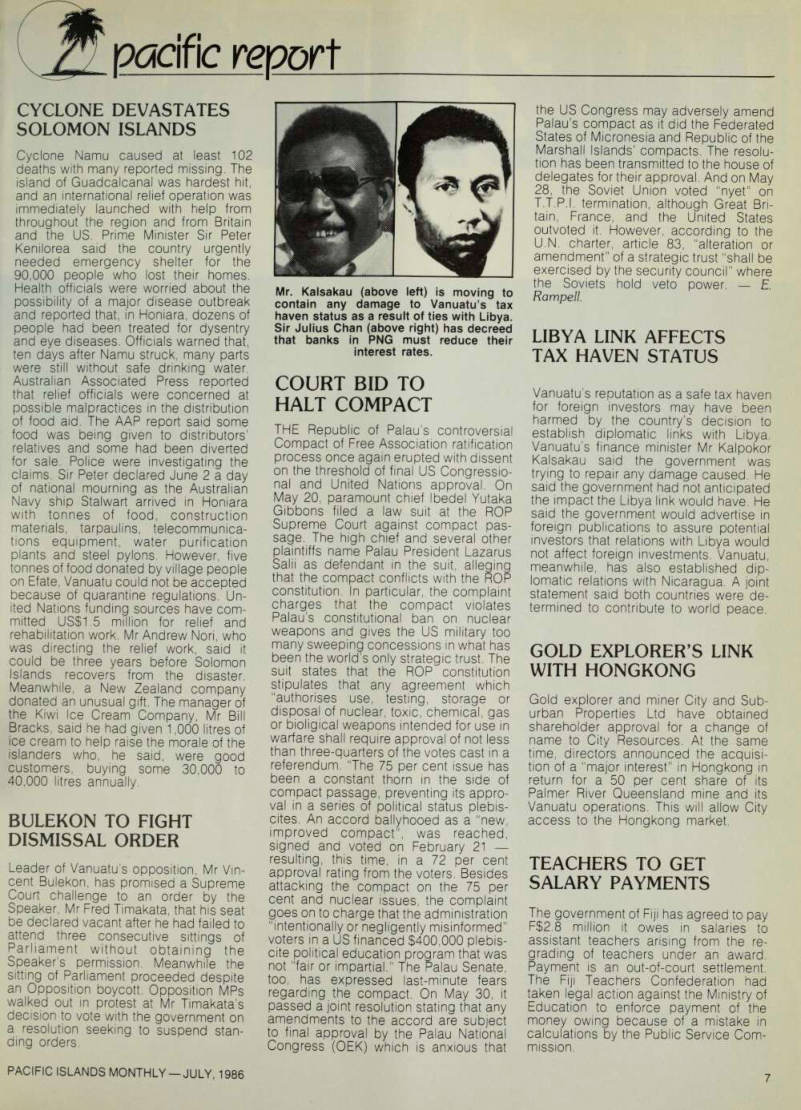
Vanuatu’s finance minister Mr Kalpokor Kalsakau said the government was trying to repair any damage caused. He said the government had not anticipated the impact the Libya link would have. He said the government would advertise in foreign publications to assure potential investors that relations with Libya would not affect foreign investments. Vanuatu, meanwhile, has also established dip lomatic relations with Nicaragua. A joint statement said both countries were de termined to contribute to world peace.
Gold Explorer’S Link
With Hongkong
Gold explorer and miner City and Sub urban Properties Ltd have obtained shareholder approval for a change of name to City Resources. At the same time, directors announced the acquisi tion of a “major interest” in Hongkong in return for a 50 per cent share of its Palmer River Queensland mine and its Vanuatu operations. This will allow City access to the Hongkong market.
Teachers To Get
Salary Payments
The government of Fiji has agreed to pay Fs2.B million it owes in salaries to assistant teachers arising from the re grading of teachers under an award.
Payment is an out-of-court settlement.
The Fiji Teachers Confederation had taken legal action against the Ministry of Education to enforce payment of the money owing because of a mistake in calculations by the Public Service Com mission.
Mr. Kalsakau (above left) is moving to contain any damage to Vanuatu’s tax haven status as a result of ties with Libya.
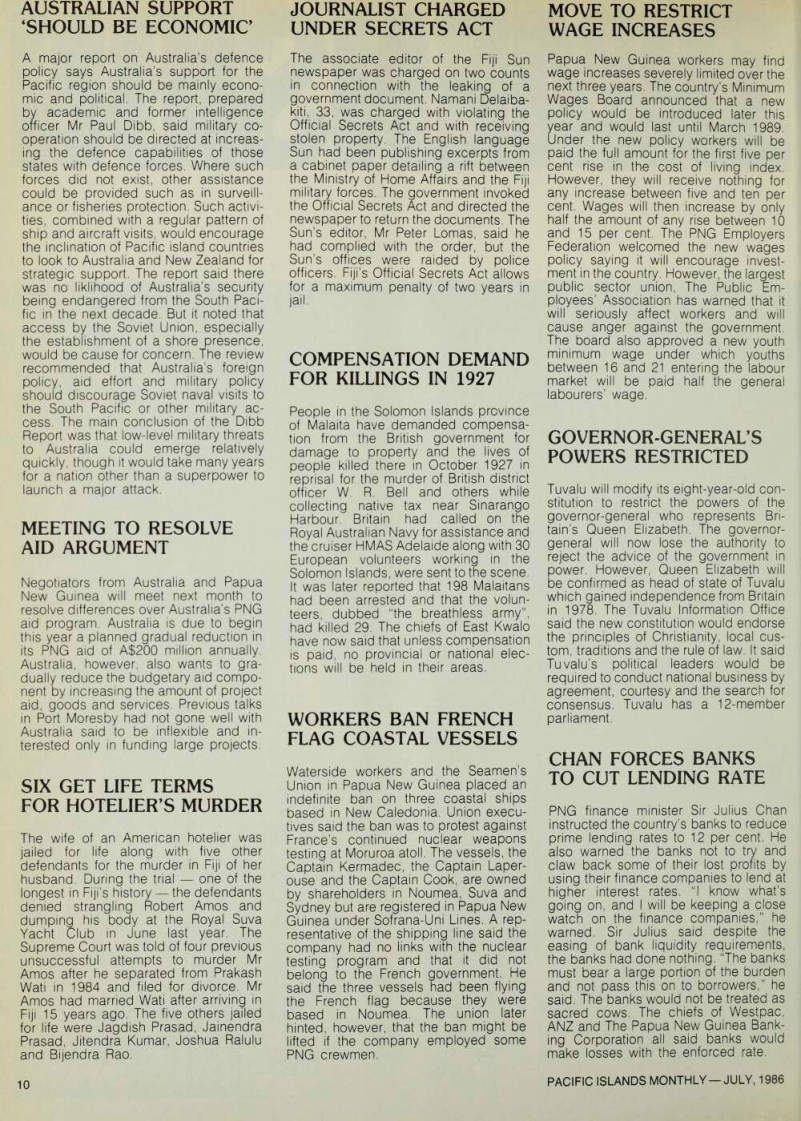
Sir Julius Chan (above right) has decreed that banks in PNG must reduce their interest rates.
Australian Support
‘Should Be Economic
A major report on Australia’s defence policy says Australia’s support for the Pacific region should be mainly econo mic and political. The report, prepared by academic and former intelligence officer Mr Paul Dibb, said military co operation should be directed at increas ing the defence capabilities of those states with defence forces. Where such forces did not exist, other assistance could be provided such as in surveill ance or fisheries protection. Such activi ties, combined with a regular pattern of ship and aircraft visits, would encourage the inclination of Pacific island countries to look to Australia and New Zealand for strategic support. The report said there was no liklihood of Australia’s security being endangered from the South Paci fic in the next decade. But it noted that access by the Soviet Union, especially the establishment of a shore presence, would be cause for concern. The review recommended that Australia’s foreign policy, aid effort and military policy should discourage Soviet naval visits to the South Pacific or other military ac cess. The main conclusion of the Dibb Report was that low-level military threats to Australia could emerge relatively quickly, though it would take many years for a nation other than a superpower to launch a major attack.
Meeting To Resolve
Aid Argument
Negotiators from Australia and Papua New Guinea will meet next month to resolve differences over Australia’s PNG aid program. Australia is due to begin this year a planned gradual reduction in its PNG aid of As2oo million annually.
Australia, however, also wants to gra dually reduce the budgetary aid compo nent by increasing the amount of project aid, goods and services. Previous talks in Port Moresby had not gone well with Australia said to be inflexible and in terested only in funding large projects.
Six Get Life Terms
For Hotelier’S Murder
The wife of an American hotelier was jailed for life along with five other defendants for the murder in Fiji of her husband. During the trial one of the longest in Fiji’s history the defendants denied strangling Robert Amos and dumping his body at the Royal Suva Yacht Club in June last year. The Supreme Court was told of four previous unsuccessful attempts to murder Mr Amos after he separated from Prakash Wati in 1984 and filed for divorce. Mr Amos had married Wati after arriving in Fiji 15 years ago. The five others jailed for life were Jagdish Prasad, Jainendra Prasad, Jitendra Kumar, Joshua Ralulu and Bijendra Rao.
Journalist Charged
Under Secrets Act
The associate editor of the Fiji Sun newspaper was charged on two counts in connection with the leaking of a government document. Namani Delaiba kiti, 33, was charged with violating the Official Secrets Act and with receiving stolen property. The English language Sun had been publishing excerpts from a cabinet paper detailing a rift between the Ministry of Home Affairs and the Fiji military forces. The government invoked the Official Secrets Act and directed the newspaper to return the documents. The Sun’s editor, Mr Peter Lomas, said he had complied with the order, but the Sun’s offices were raided by police officers. Fiji’s Official Secrets Act allows for a maximum penalty of two years in jail.
Compensation Demand
For Killings In 1927
People in the Solomon Islands province of Malaita have demanded compensa tion from the British government for damage to property and the lives of people killed there in October 1927 in reprisal for the murder of British district officer W. R. Bell and others while collecting native tax near Sinarango Harbour. Britain had called on the Royal Australian Navy for assistance and the cruiser HMAS Adelaide along with 30 European volunteers working in the Solomon Islands, were sent to the scene.
It was later reported that 198 Malaitans had been arrested and that the volun teers, dubbed “the breathless army”, had killed 29. The chiefs of East Kwalo have now said that unless compensation is paid, no provincial or national elec tions will be held in their areas.
Workers Ban French
Flag Coastal Vessels
Waterside workers and the Seamen’s Union in Papua New Guinea placed an indefinite ban on three coastal ships based in New Caledonia. Union execu tives said the ban was to protest against France's continued nuclear weapons testing at Moruroa atoll. The vessels, the Captain Kermadec, the Captain Laper ouse and the Captain Cook, are owned by shareholders in Noumea, Suva and Sydney but are registered in Papua New Guinea under Sofrana-Uni Lines. A rep resentative of the shipping line said the company had no links with the nuclear testing program and that it did not belong to the French government. He said the three vessels had been flying the French flag because they were based in Noumea. The union later hinted, however, that the ban might be lifted if the company employed some PNG crewmen.
Move To Restrict
Wage Increases
Papua New Guinea workers may find wage increases severely limited over the next three years. The country’s Minimum Wages Board announced that a new policy would be introduced later this year and would last until March 1989.
Under the new policy workers will be paid the full amount for the first five per cent rise in the cost of living index.
However, they will receive nothing for any increase between five and ten per cent. Wages will then increase by only half the amount of any rise between 10 and 15 per cent. The PNG Employers Federation welcomed the new wages policy saying it will encourage invest ment in the country. However, the largest public sector union, The Public Em ployees’ Association has warned that it will seriously affect workers and will cause anger against the government.
The board also approved a new youth minimum wage under which youths between 16 and 21 entering the labour market will be paid half the general labourers’ wage.
Governor-General’S
Powers Restricted
Tuvalu will modify its eight-year-old con stitution to restrict the powers of the governor-general who represents Bri tain’s Queen Elizabeth. The governor general will now lose the authority to reject the advice of the government in power. However, Queen Elizabeth will be confirmed as head of state of Tuvalu which gained independence from Britain in 1978. The Tuvalu Information Office said the new constitution would endorse the principles of Christianity, local cus tom, traditions and the rule of law. It said Tuvalu’s political leaders would be required to conduct national business by agreement, courtesy and the search for consensus. Tuvalu has a 12-member parliament.
Chan Forces Banks
To Cut Lending Rate
PNG finance minister Sir Julius Chan instructed the country’s banks to reduce prime lending rates to 12 per cent. He also warned the banks not to try and claw back some of their lost profits by using their finance companies to lend at higher interest rates. “I know what’s going on, and I will be keeping a close watch on the finance companies,” he warned. Sir Julius said despite the easing of bank liquidity requirements, the banks had done nothing. “The banks must bear a large portion of the burden and not pass this on to borrowers," he said. The banks would not be treated as sacred cows. The chiefs of Westpac, ANZ and The Papua New Guinea Bank ing Corporation all said banks would make losses with the enforced rate.