the seats of power
pp. 20-21 · Read in the full issue
Flosse settles into the seats of power
Concurrent with the March territorial elections in French Polynesia, resul ting in a victory for in cumbent Premier Gaston Flos se and his Tahoeraa Party (PIM May 86, p. 25), and totally overshadowed by them, was a separate election to fill the territory’s two seats in the French National Assembly.
The seats for the first time allocated on a proportional basis in a single constituency comprising the whole of French Polynesia went to Gaston Flosse and his right hand man Alexandre Leontieff, due to the inability of the opposition lead ers to agree on a common list.
The latter found the self administered bitter pill particu larly hard to swallow, as the total number of ballots cast in favor of their six competing lists was an impressive 43,771 whereas the winning Tahoeraa team obtained only 30,571 votes.
The high turnout was solely due to the fact that, quite exceptionally, these “national” elections were this time held jointly with the territorial polls, which alone are able to arouse the passions of the local voters.
Normally, no such “package deal” is offered, and as a result voter turnout in these “na tional” elections is feeble, due to their futility.
For what can the two forlorn representatives of the Polyne sian people achieve in the French parliament in Paris, made up of a vastly superior number of deputies (increased by the socialist government from 491 to 577), who know nothing and care even less about the very special problems of 170,000 natives in a remote South Sea colony?
How little weight the wishes and protests of the overseas deputies carry was most clearly demonstrated during the 1984 crisis in New Caldedonia, when
the Melanesian deputy Rock Pidjot spoke either to an empty or a hostile house.
Considering that Premier Gaston Flosse’s overriding ambition was to win the terri torial elections with an in creased majority and thus re main safely in power, it seemed strange that he cared to run at the same time for the purely ceremonial post of French deputy.
But he is an avid collector of
honors and offices to the point of having had himself elected in June 1984 on a Gaullist ticket to the post of deputy in the European parlia ment far away in Strasbourg, where his seat has remained mostly unoccupied.
He missed his only chance of intervening in European affairs by remaining aloof, when his fellow deputy Dorothee Pier mont representing the German Greens was expelled from Tahi
ti by the French high commis sioner in spite of her par liamentary status for having taken part in an anti-nuclear rally (PIM April 86, p. 7).
Flosse had, however, an other and more valid reason for standing also as a national candidate. That was his not so secret hope of becoming Minis ter for Overseas Territories and Departments, when and if his good friend Jacques Chirac be came Prime Minister.
Almost true to his word, Chirac appointed Flosse not as a full cabinet minister, but a junior minister for Pacific Affairs. A West Indian female politician was simultaneously appointed junior minister of “francophone affairs,” and will thus presumably encroach somewhat on Flosse’s domain.
Both will, however, do the biddings of the senior minister for the French Overseas Terri tories and Departments, the former secretary-general of the RPR party, Bernard Pons.
In consequence of his cabinet appointment, Flosse had to give up his newly won seat in the French National Asembly in favor of his proxy and son-in law, Edouard Fritsch, who by profession is an engineer.
On the other hand, there was no constitutional impediment to stop Flosse combining his new ministerial position with that of elected Premier of French Polynesia simply because the authors of the French con stitution had never imagined such a strange amalgam of powers.
As the Tahoeraa party had won a clear majority in the Territorial Assembly, Flosse was formally elected Premier on 15 April by 25 of the 41 assembly men. Whereupon he reap pointed most of the young technocrats in dark flannel suits and ties, who had served him so well during the previous
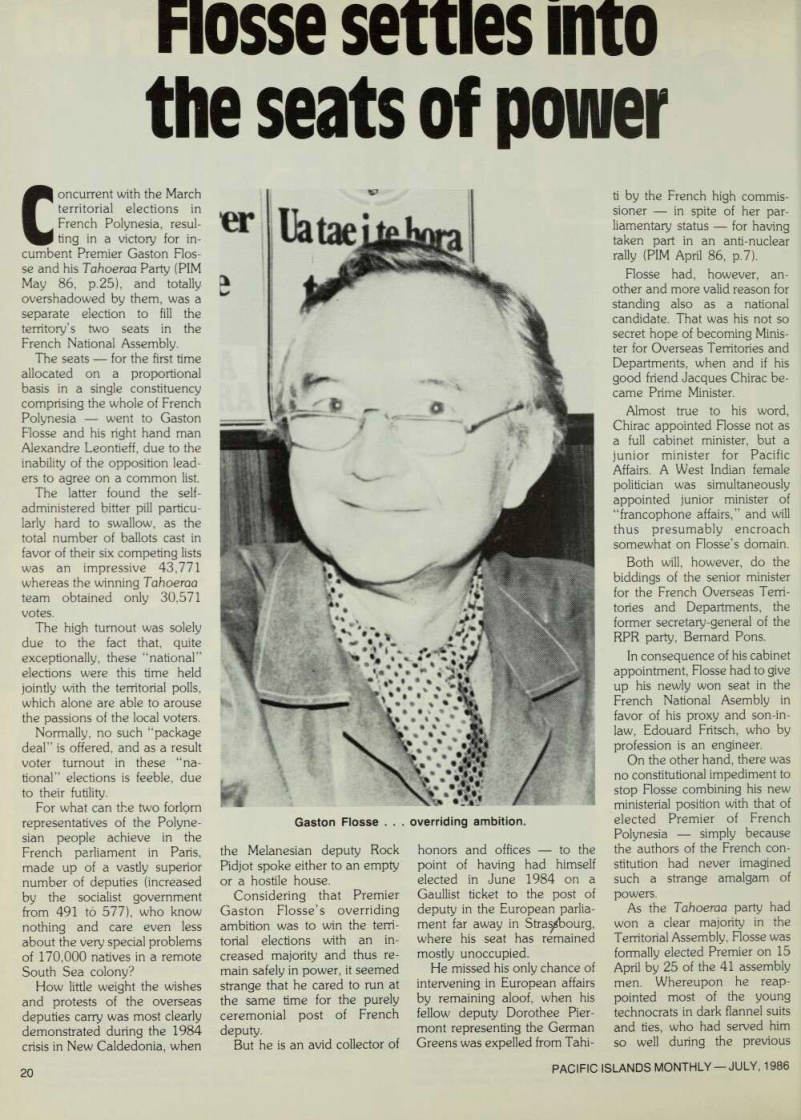
Gaston Flosse ... overriding ambition.
term, to the same ministenal posts in his ten-man local gov ernment.
Incidentally, a first attempt to convene the Assembly on 11 April came to nothing, due to the lack of a quorum, resulting from the decision of the princi pal opposition parties to boycott all sessions until the courts had heeded their request to condemn the Tahoeraa party for electoral fraud.
Then at the second convoca tion, when only a simple major ity was required to achieve a quorum, newly elected assemblyman Oscar Temaru, popped up like a jack in the box and virtually stole the show with an impassioned, two-hour speech in favor of immediate and complete independence.
As we have previously re ported, high commissioner Ber nard Gerard had sworn to get Temaru, even if he had to use the flimsiest pretext (PIM March 86, pp 20-22).
But so many Polynesians approved of Temaru’s stand that he was catapaulted into the Territorial Assembly, together with the second candidate on his list, James Salmon. So instead of ending up in jail, like another independence fighter, Charlie Ching, here was Temarse in the Assembly, in front of the TV cameras, speak ing to the Polynesian people in their own tongue.
Still another newly elected assemblyman, J. M. Raapoto, took advantage of this opportunity to make his more moderate, pro-Polynesian views heard.
It was therefore something of an anti-climax, when Gaston Flosse eventually strode to the rostrum and began reading a long catalogue of social and economic measures he prom ised his new government would deliver.
In fact, his speech was most noteworthy for the total absence of any references to the two most burning issues: a local referendum for or against continued nuclear testing at Moruroa, and a thorough health survey of the whole Polynesian population to be carried out by impartial medical doctors.
Yet, before March 16, Flosse had constantly favored these proposals both in public and in
discussions with t-rench cabinet ministers (PIM March 85, pp. 29-30).
What Flosse did say in his inaugural speech was essential ly that he still has an absolute faith in a free enterprise system of the American type, based on tourism and with a very soft welcome mat for all foreign investors.
The main stumbling block in Flosse’s view is the virtual monopoly held by the French UTA airline, which is totally opposed to low fare charter flights and prefers to restrict the number of regular flights, so as to be sure of full aircraft.
To emphasise the point, Flos se flew the following day to Paris (to be initiated into the mysteries of his ministerial duties), not on UTA but on a Qantas plane.
The day after that, UTA announced expanded Pacific services on such a magnificent scale that there will be 10,000 additional seats during the rest
ot the year.
The local UTA director in sisted the timing of this announcement was pure coincidence.
At the local level, meanwhile, a most curious situation now arises. Flosse the Premier should take orders from Flosse the cabinet minister. Up to now, the role and duty of the gov ernor, recently restyled high commissioner, has been to keep a watchful eye on the Premier and the whole local government and tell them what the constitution allows them to do.
But the high commissioner was in his turn simply the executor of the policies decided by his superior the Parisian minister for overseas territories and departments. With the triangular rule just instituted, what will happen to the new high commissioner, old Pacific hand, Pierre Angeli, governor of French Polynesia from 1969 to 1973.
in the wider Pacific context, as Flosse has already on several occasions explained his role will be that of a French ambassador whose main task will be to implement the policy recently formulated by Mitterand’s for mer adviser Regis Debray.
This aims to offer large-scale cultural exchange programs and generous grants to other Pacific governments, personali ties and students in the hope that the whole nuclear issue will eventually be washed away by the general flood of good-will thus generated. (PIM March 86, pp 20-22).
So far, however, all previous attempts by French cabinet ministers, diplomats, high com missioners and special emissar ies, including Regis Debray, have failed to soften opposition to the Mururoa tests.
As a local derm, Flosse may be more acceptable to other Pacific leaders. Only time can tell if it will work Marie- Therese and Bengt Danielsson