Aussat options
pp. 26-27 · Read in the full issue
up in the air
Despite considerable reserva tions on the part of many island governments, the Pacific is like ly to have broadcast television operating domestically within about a year, using satellites operated by either Aussat or Intelsat, or perhaps both.
At least three Australian tele vision broadcasting companies, plus one or two American or ganisations, are interested in providing services to countries such as Papua New Guinea, Fiji and Tonga. Additionally, talks have been held with govern ments in Niue and the Cook Islands.
By comparison with the big and aggressively-attacked Aus tralian commercial television market the Pacific islands might be seen as quite modest oppor tunities, but they offer the chance of valuable expansion for companies held in very tight rein by Australian broadcasting laws which limit ownership of the medium.
Companies like NBN-3, the Newcastle, NSW, arm of the Parry communications or ganisation, Mr Kerry Packer’s Channel Nine, and Mr Rupert Murdoch’s Channel Ten, have all shown interest in the islands.
So, too, have some US-based groups, primarily church backed.
Initially, NBN-3 won appro val from the previous, Somare, government of Papua New Guinea to set up a domestic service. A roughly similar deal was struck in Fiji by Channel Nine.
More recently, however, PNG’s new prime minister, Paias Wingti, has demanded a review of his country’s arrange ments while rumors (firmly dis missed by the Packer com pany’s men) have been coming out of Fiji that a change of mind may be developing there.
But there is another level of activity which involves both the Australian and New Zealand governments. Australia, parti cularly, faces something of a dilemma for it must decide
The arrival of Aussat, the Australian satellite corpora tion, in the burgeoning field of South Pacific telecommunications has produced an intriguing politi cal minefield for Australia as the island nations are wooed by a series of television entrepreneurs. PlM’s staff writer on communications here surveys the battlefield.
within about a month whether to support the use of Aussat for telecommunications and televi sion within, to, and among, the island nations of the South Pacific Forum.
On the face of it, Canberra should have no doubts, but in fact the scene is more compli cated than it appears.
While the Australian com mercial operators are well ahead in their negotiations in the Pacific, the Australian Broadcasting Commission is now also showing interest in providing what some have seen as a television version of the much-admired multi-lingual Radio Australia shortwave radio service. They would presum ably favor use of Aussat for both technical and financial reasons.
On February 25 the ABC told the Australian government that it could start a satellite beamed television service to the South Pacific for less than $6 million per annum. They said they could draw upon their domestic Australian network for programming, but would also set up a special unit to provide news and other material of specific Pacific interest.
This expression of interest will form part of the Duffy submission due to go to the Australian Cabinet in March.
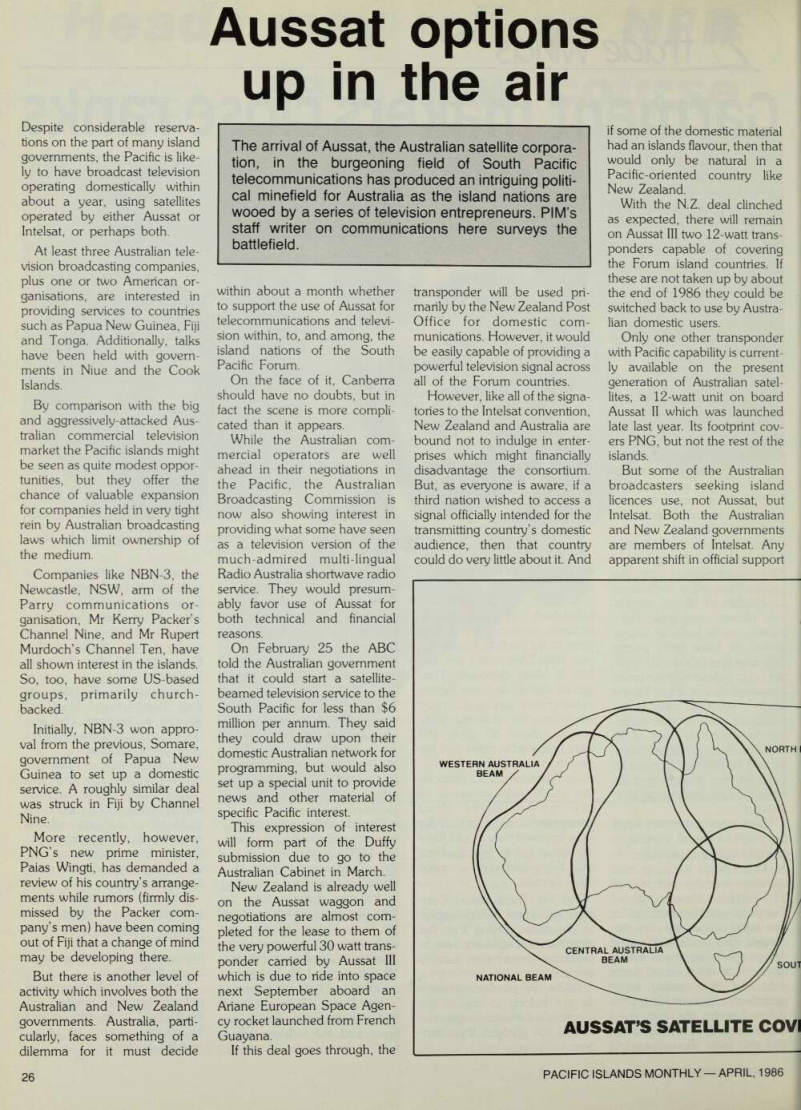
New Zealand is already well on the Aussat waggon and negotiations are almost com pleted for the lease to them of the very powerful 30 watt trans ponder carried by Aussat 111 which is due to ride into space next September aboard an Ariane European Space Agen cy rocket launched from French Guayana.
If this deal goes through, the
transponder will be used pri marily by the New Zealand Post Office for domestic com munications. However, it would be easily capable of providing a powerful television signal across all of the Forum countries.
However, like all of the signa tories to the Intelsat convention, New Zealand and Australia are bound not to indulge in enter prises which might financially disadvantage the consortium.
But, as everyone is aware, if a third nation wished to access a signal officially intended for the transmitting country’s domestic audience, then that country could do very little about it. And
if some of the domestic material had an islands flavour, then that would only be natural in a Pacific-oriented country like New Zealand.
With the N.Z. deal clinched as expected, there will remain on Aussat 111 two 12-watt trans ponders capable of covering the Forum island countries. If these are not taken up by about the end of 1986 they could be switched back to use by Austra lian domestic users.
Only one other transponder with Pacific capability is current ly available on the present generation of Australian satel lites, a 12-watt unit on board Aussat II which was launched late last year. Its footprint cov ers PNG, but not the rest of the islands.
But some of the Australian broadcasters seeking island licences use, not Aussat, but Intelsat. Both the Australian and New Zealand governments are members of Intelsat. Any apparent shift in official support
for that organisation would have international political re percussions. Recently the Aus tralian minister for communica tions, Mr Duffy, turned over for full Cabinet discussion a recom mendation from his departmen tal officials that he support Aussat’s case in the Pacific television drama.
Aussat does not provide a television service, but acts as the carrier of signals for service providers. The same applies for Intelsat. Yet both Aussat and Intelsat are vitally interested in who provides television to the islands, and how they do it.
Thus, in the last months the Pacific has been crowded not only with eager television en trepreneurs, but also with mis sions from Aussat and Intelsat.
Fairly promptly after the change of government in PNG, senior management of Aussat went to Port Moresby for dis cussions about PNG making use of the Aussat II spot beam.
Neither side has yet made any decision from those talks.
Much seems to depend upon the review Prime Minister Wingti has ordered of the televi sion licensing arrangement reached between the Somare government and the Parry group’s NBN-3. A number of
other players are in the arena now, including both Channel Nine and Channel Ten a situation which is now almost completely duplicated in Fiji, except that there it is Channel Nine which has the understan ding with the government and the others which are present on the understanding, or the hope, that Prime Minister Ratu Sir Kamisese Mara is also rethink ing his country’s position.
While PNG only can be served by the spot-beam re maining available on Aussat 11, the South-West Pacific, plus New Zealand, will be offered the much more elaborate facili ties of Aussat 111. These are the big 30-watt transponder, now virtually signed up under lease to New Zealand at a fee of Auss2.s6 million per annum for the seven year life of the satellite, and two 12-watt trans ponders still available for lease at $1.6 million per annum.
Aussat has been interested for several years in providing a service to the south-west Pacific and has held a series of discus sions with SPEC, and its tele communications arm, the SPTC, led by Mr Jim Wilkin son. It was because of those discussions that the third satel lite was modified so that its “footprints” could cover the region.
While this was a natural enough development it appears to have been seen in some quarters as an “invasion” of what had been an Intelsat monopoly. Aussat’s signals will be much stronger than those of Intelsat which means that the receiving installations can be smaller and cheaper. To receive adequate television signals from the 30-watt south-west Pacific transponder a ground station would need a 4.5 metre dish.
To get similar quality from Intelsat a much more expensive 10-metre dish would be re quired.
Channel Nine already uses a transponder on board Intelsat to carry its programming into Australia. They plan to use the same equipment to off-load material to the islands.
Aussat has had fairly detailed discussions with all the hopeful program providers in the Pacific television game but so far no deals have been signed with any of them.
“We are a carrier,” an Aussat
executive told me. “We would be happy to carry a signal for whoever wins the contest to provide television programs.”
There might appear now to be competition between Aussat and Intelsat, he said, but that was an over-statement of a situation which was involved with the whole question of de-regulation of international broadcasting, he said. The main focus of this was in the North Atlantic region, but the effects of that had probably "made Intelsat much more competitive and protective of its interests.
The original modifications to Aussat were to allow domestic communications in the Pacific.
Intelsat was chartered to pro vide international links.
But, the changes to Aussat had opened the way for diffe rent applications which some of the communicators, like televi sion companies, had seen might be more cost effective on Aussat than on Intelsat, he said.
But, while Aussat could pro vide these links, it was not prepared to proceed with them until the Australian govern ment, a shareholder in Intelsat, had approved the use of the system for regional internatio nal communications.
“Given that the facilities on Aussat 111 are limited there are only three transponders aboard able to provide this regional service we looked at it in terms of development of pilot schemes,” he said. “This would give us a chance to see what we might do on the second generation of Aussat craft which will begin coming into service in the next decade.
By then the nations of the south-west Pacific should have a clearer idea of what they plan
to do with satellite communica tion.
“Australia is a foundation member of the Intelsat consor tium and has one of the largest
shareholdings in it. Obviously
there are questions of govern ment policy which have to be resolved. There are foreign affairs matters, in terms of Aus tralian aid to the Pacific’s deve lopment, and many other con siderations, ” he said.
Hence, it seems, Mr Duffy’s caution in taking the problem to the full Cabinet in Canberra.
“Our commitment has been to provide capacity for internal communications and, basically that is where we stand today.
On the other hand, if one owns a Ferrari one is not necessarily going to use it only to tootle around in the backyard. But it will depend upon the govern ment’s decision.”
Equally, New Zealand is a signatory to the Intelsat agree ment and is thought unlikely to do anything to upset the con sortium in a major way.
But the competition, real or imagined, has had an effect upon Intelsat, and already it has reduced its prices and set about improving its service wherever it can.
The appearance of Aussat has, in fact, brought about some of the first really serious thinking in the region about communications. Aussat is a commercial organisation and must run efficiently.
“But we also very much wish to be a good neighbor in the area and to serve it well,” said the Aussat executive.
A region which remains one of the most remote on the planet can only be grateful for
that.
Garry Barker.
ABC waiting in the wings?