Garment makers close ranks
p. 25 · Read in the full issue
trade wields
Fiji’s garment industry, still in its infancy but growing at a rapid pace, faced a setback late last month when the Fiji gov ernment hit it with a minimum wage order.
This resulted in the laying off of some 1500 workers and the closing down of factories around the country. But the industry was back to normal after only two days when the order was suspended pending an investigation by a three-man tribunal.
For some years the govern ment had been contemplating a minimum wage for workers in the garment factories and in 1984 had even gone as far as publishing an order, but follow ing strong objections from the factory owners claiming that they would go broke, the gov ernement relented and the order was shelved.
However recently, and since the formation and launching of Fiji’s newest political party, the Labour Party of Fiji, the issue of exploitation of labour, particu larly women, was again high lighted. Some factories are re ported to have been paying their unskilled workers 21 cents per hour. Following widespread condemnation of these “sweat shops” the Fiji government published a wage order outlin ing the minimum wage of 90 cents per hour for skilled work ers and for trainees 70 cents an hour for the first six months while they are undergoing their training.
The wages order also fixed the wage of casual workers in manufacturing industries at $1.42 an hour, a 25 per cent increase over the old rate of $1.13 an hour. It was explained that there were two reasons for the hefty wage rise for the casuals. This, it was said, would discourage bosses from taking on workers on a casual basis only and not making them permanent, thus avoiding pro viding benefits like their con tributions to the provident fund and also meal allowances, job
security, regular hours and holi days.
As soon as the order was published, garment manu facturers announced that they were in no position to pay the new rates. They could not sus tain it, they declared. They agreed that while some factory owners were paying 21 cents an hour, the majority were paying around 50 cents and were prepared to make that the minimum rate. After the Gar ment Manufacturers’ Associa tion made representations to the government they announced that if the order were imposed they would have no option but to lay off about half the workforce some 1500 people.
The Fiji Trade Union Con gress also came out in support of the order, saying that the government should not bow to pressure from the factory owners.
While the garment workers do not belong to any of the congress’s member bodies, the unions still pledged their sup port.
The Fiji Trades Union Con gress and the Fiji Employers Consultative Association, both members of the Wages Council said they did not favour any variation to the order.
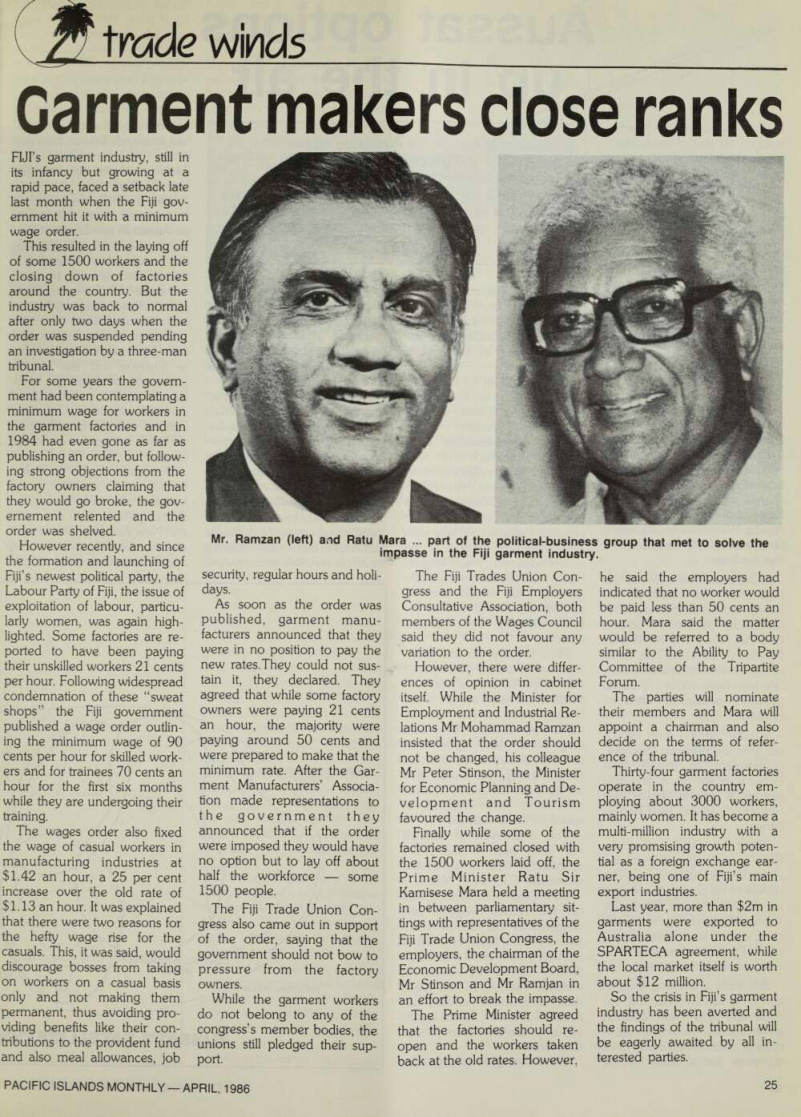
However, there were differ ences of opinion in cabinet itself. While the Minister for Employment and Industrial Re lations Mr Mohammad Ramzan insisted that the order should not be changed, his colleague Mr Peter Stinson, the Minister for Economic Planning and De velopment and Tourism favoured the change.
Finally while some of the factories remained closed with the 1500 workers laid off, the Prime Minister Ratu Sir Kamisese Mara held a meeting in between parliamentary sit tings with representatives of the Fiji Trade Union Congress, the employers, the chairman of the Economic Development Board, Mr Stinson and Mr Ramjan in an effort to break the impasse.
The Prime Minister agreed that the factories should re open and the workers taken back at the old rates. However,
he said the employers had indicated that no worker would be paid less than 50 cents an hour. Mara said the matter would be referred to a body similar to the Ability to Pay Committee of the Tripartite Forum.
The parties will nominate their members and Mara will appoint a chairman and also decide on the terms of refer ence of the tribunal.
Thirty-four garment factories operate in the country em ploying about 3000 workers, mainly women. It has become a multi-million industry with a very promsising growth poten tial as a foreign exchange ear ner, being one of Fiji’s main export industries.
Last year, more than s2m in garments were exported to Australia alone under the SFARTECA agreement, while the local market itself is worth about $l2 million.
So the crisis in Fiji’s garment industry has been averted and the findings of the tribunal will be eagerly awaited by all in terested parties.
Mr. Ramzan (left) and Ratu Mara ... part of the political-business group that met to solve the impasse in the Fiji garment industry.