Chan puts brake on spending
p. 29 · Read in the full issue
IT WAS a stagnating economy and a “batten down the hatch es” budget that played a large part in the downfall of Papua New Guinea’s long-standing Prime Minister Michael Somare last November.
A dangerous trend towards excessive spending and borrowing had been started in the Somare budget brought down in 1984. By 1985, with overseas debts topping K 1.5 billion, the message that the country was living beyond its means began to sink in.
So the budget introduced in 1985 for this year set out to reverse the downward drift. But it never got the chance it was thrown out by the new govern ment of Paias Wingti. And everyone has been waiting to see what miracle the new Fin ance Minister Sir Julius Chan could produce to see if he could do better than the pre vious finance minister and yet still keep the voters of a 1987 general election happy.
Sir Julius has certainly gone further than the previous ad ministration but it will take longer than the 16 months before the next election to test the real success of his strategies.
He has cut borrowing, cut spending and seems not to have hit the man in the street too hard. His tinned fish and rice, cigarettes and alcohol, pet rol and most important of all his income tax have not been touched. In fact with the stated aim of giving people more say over how they spend their earnings Sir Julius promised an income tax review with the intention of lowering it.
How did he juggle the figures to do the impossible? For a start he has made drastic cuts in the amount the country will spend on repaying its debts. Instead of borrowing K 209.8 million as previous Finance Minister Philip Bouraga had planned to do, Sir Julius is going to raise only K 140.6 million a saving of K 69 million which will not have to be repaid, with interest, in future years. Of the K 140.6 million, only K 44 million (as against Mr Bouraga’s planned
K 64 million) is in commercial overseas loans. The rest comes from domestic borrowing, con cessional loans and grant aid.
However, the repayments on the country’s present debts, estimated at K 1.75 billion, had to remain at K 176 million a year. That accounts for a hefty 18.9 per cent of all spending.
Sir Julius has long com plained of an appalling lack of planning over borrowing. He quoted the example of a Swiss loan arranged last year for K 23 million but it was not needed and was deferred until this year.
He has drawn up strict guide lines for future borrowing.
PNG was now regarded as more of a credit risk because it had spent much of its loans on day-to-day living rather than on tangible projects.
From the gloom of the Bouraga budget, how has this turnaround in borrowing been possible? First, Sir Julius hopes to win more money by various methods but it is question able whether revenue will in crease in real terms.
He will cash in from an
import levy which has almost doubled to 7.5 per cent (but not including basic foodstuffs as Mr Bouraga had planned), which will put up shop prices. He also expects to pick up millions of kina following a major cam paign to improve revenue col lection.
Sir Julius hopes to boost consumer spending thus in creasing indirect tax revenue by encouraging people to buy their luxury goods in PNG rather than Hong Kong or Singapore. To do this he re duced import duties (from sometimes as high as 85 per cent) to 50 per cent on such items as televisions and videos, cassette players and cameras.
Consumers will also have more to spend when income tax is cut some time before 1987, Sir Julius promised. All this is planned to boost the economy, the main aim of the government. To create wealth, it is doing all it can to get people to make money anyway they can.
That is why more money is being pumped into trade and
into primary industry, tourism, minerals and energy and for estry.
However, many of these measures will not come to fruition in the immediate future.
The key to Sir Julius’s book balancing really lies in the spen ding cutback. That is why such sectors as education, housing, conservation, foreign affairs, transport, capital works, provin cial governments and adminis tration in general have suffered budget cuts.
Expenditure on domestic programs has been cut by seven per cent in real terms the largest cut ever. Whether the spending reductions can be achieved depends on the re straint which Mr Wingti and Sir Julius can exercise on the spen ding ministries. PNG is re nowned for having plenty of plans but not implementing them.
This reservation aside, Sir Julius’s budget is widely re garded as a good one. A consistent budget for 1987 is needed to consolidate the
achievement.
Tim Sinclair.
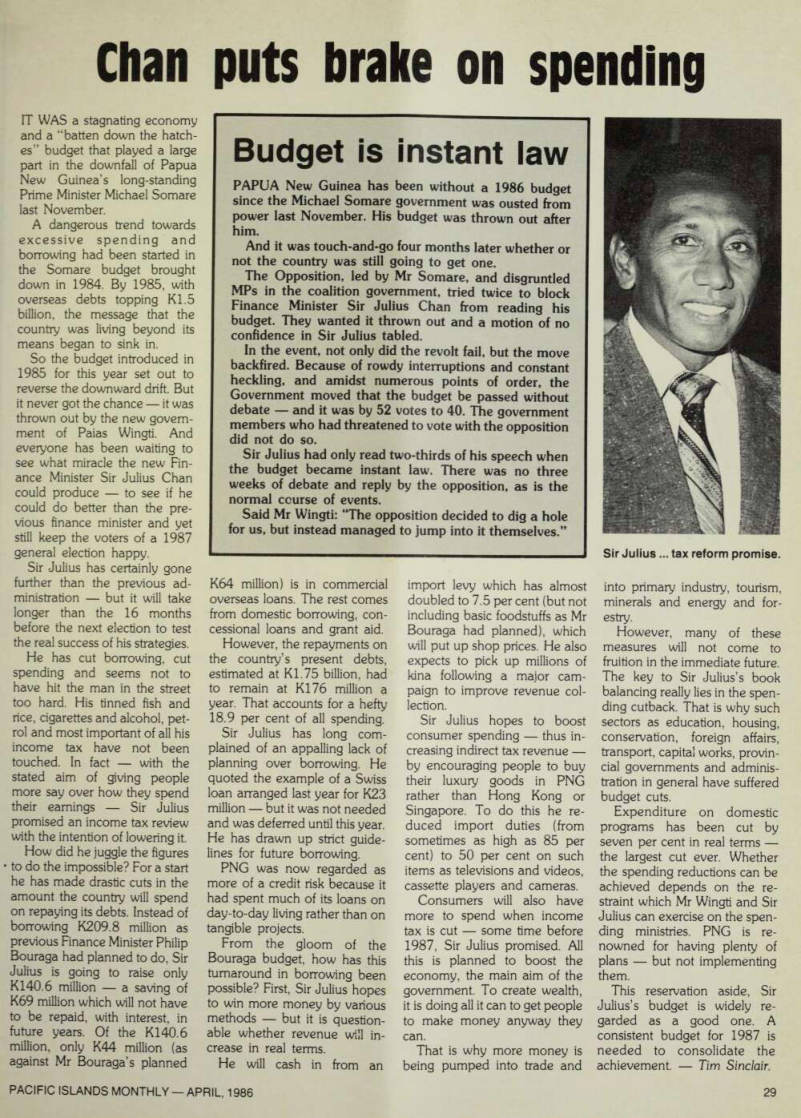
Sir Julius ... tax reform promise.